GS 2: International RelationsGS 3: Environment & Ecology
We need to underline value of collaboration on climate change, Pg10
Article emphasizes collaborative climate action amid multilateralism challenges, highlighting finance gaps and trade action threats for vulnerable populations.
Practice MCQs
898 Students attempted
Key Highlights:
- The US exit from international climate treaties has strained multilateralism, shaking the ethical architecture of international climate policy.
- A policy shift in the US may dampen public and private sector investments in clean energy transition, accentuating the gap in achieving the global climate goal of limiting temperature increase to 1.5 degree Celsius.
- Current global climate finance flows are estimated at $1.9 trillion annually, falling short of the required $6-9 trillion to stay on the 1.5-degree trajectory.
- India needs $10-20 trillion, or $250-450 billion annually by 2070, to meet its net-zero goal, while current flows are only about $135 billion.
- Global powers are increasingly using trade as an instrument to enforce domestic environmental goals, such as forcing global standards for carbon consumption.
- India will have the chance to revisit these issues in partnership with global leaders and stakeholders during the 25th Edition of the World Sustainable Development Summit hosted by TERI in Delhi this month.
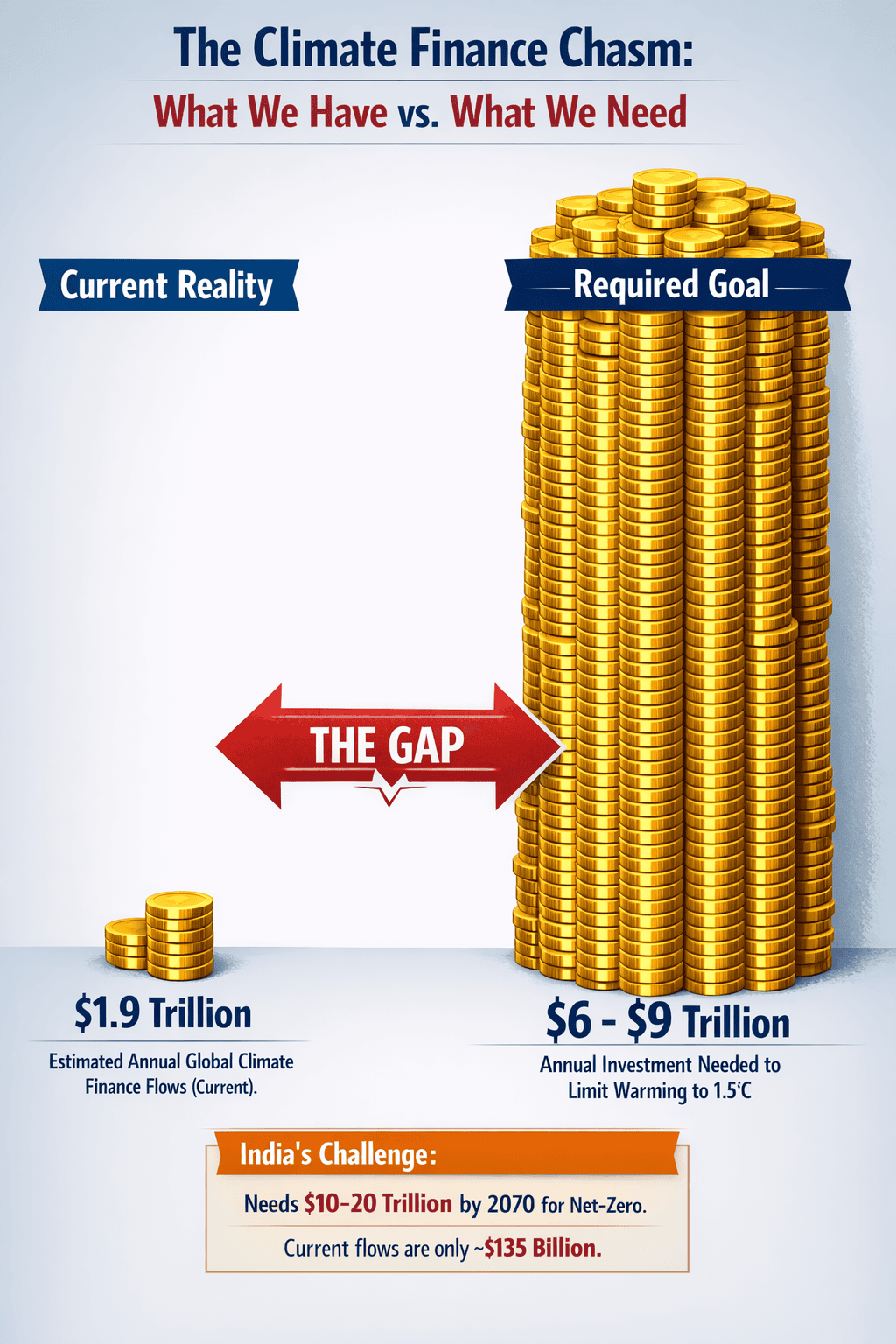
Global Climate Finance Gap
Detailed Insights:
- The increased preference for bilateral and plurilateral deals indicates a loss of confidence in the consensus-based legal order, replaced by arrangements driven by reciprocal gains rather than internationally agreed goals.
- The Global Implementation Accelerator reflects an awareness that the threat to multilateralism can be partially tackled through the reengineering of global processes.
- It is important to avoid getting entangled in procedural legitimacy and focus more on actions that all major stakeholders can take, such as non-CO2 mitigation and ecosystem restoration.
- There is a need for greater engagement amongst willing partners to keep the momentum of global financial flows for a clean and just energy transition.
- Multilateral cooperation needs to be insulated from the threat of unilateral trade actions in the name of protecting the climate.
- Development must ensure that the voices of the marginalised are included in its planning and execution, building trust in an equitable and inclusive decision-making process.
- India has been the leading voice of the developing world, pursuing equity-based cooperation at the global level while pushing aggressive domestic goals for climate.
- The World Sustainable Development Summit serves as a platform to foster dialogue and collaborative climate action amongst partners of the developed and developing world.
Key Concepts Involved:
- Multilateralism: Cooperation among several countries on a particular issue.
- Climate Finance: Financial resources aimed at mitigating and adapting to climate change.
- Net-Zero: Achieving a balance between the amount of greenhouse gas produced and the amount removed from the atmosphere.

SuperKalam is your personal mentor for UPSC preparation, guiding you at every step of the exam journey.
Download the App


STUDY RESOURCES
CONTACT US
ⓒ Snapstack Technologies Private Limited