GS 2: Social JusticeGS 2: GovernanceGS 3: Environment & EcologyGS 1: Indian SocietyPrelims
Kerala’s battle with water-borne diseases, Pg9
Kerala's public health beacon dims as recurrent Hepatitis A and shigellosis outbreaks expose critical failures in sanitation infrastructure and groundwater contamination, threatening its model status.
Practice MCQs
739 Students attempted
Key Highlights:
- Kerala, despite its strong public health record, is facing recurrent outbreaks of water-borne diseases like shigellosis and Hepatitis A.
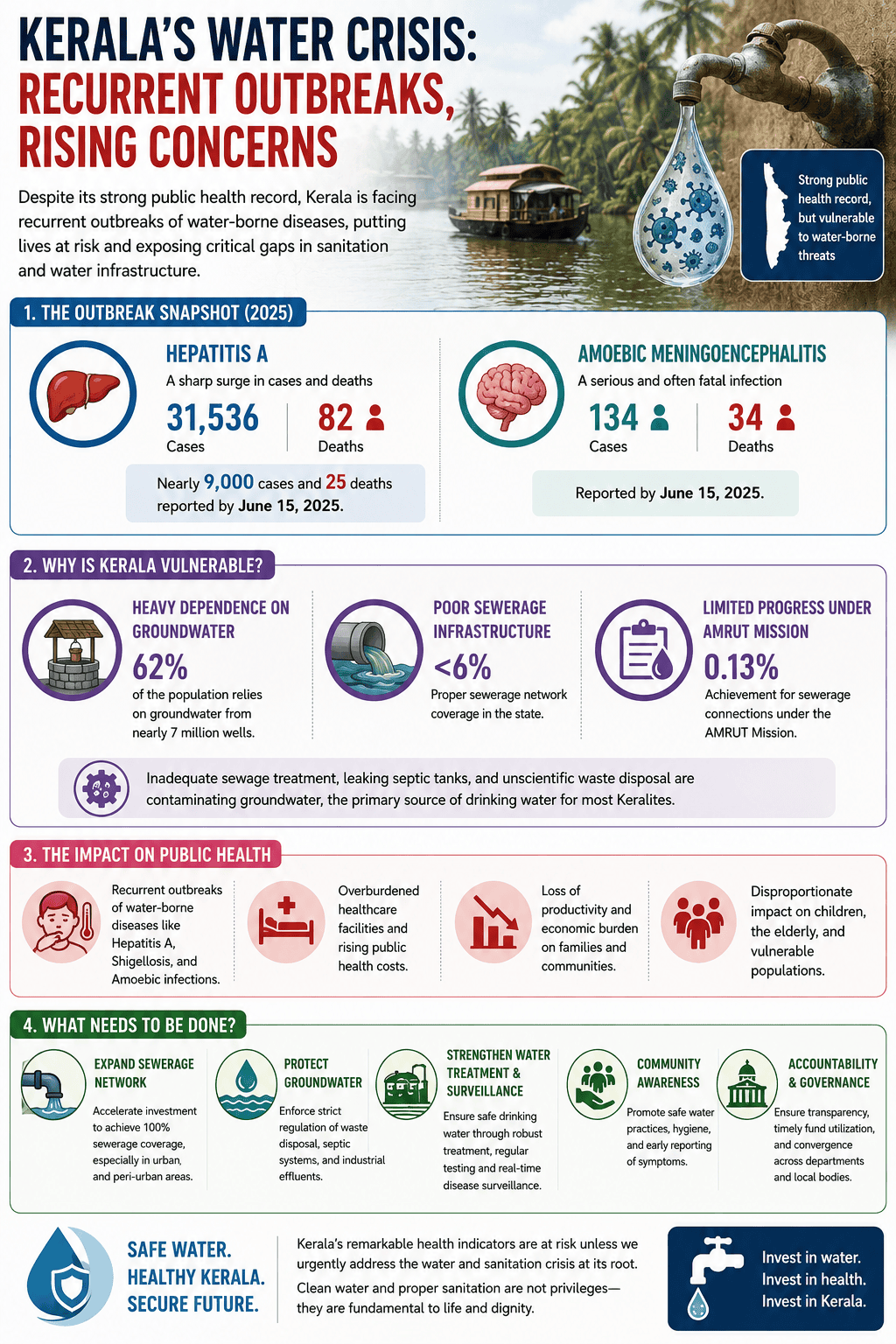
- The state reported 31,536 cases and 82 deaths from Hepatitis A in 2025, with nearly 9,000 cases and 25 deaths by June 15 this year.
- Amoebic meningoencephalitis has emerged as a significant concern, with 134 cases and 34 deaths reported by June 15 this year.
- Groundwater contamination is a major factor, with 62% of the population relying on groundwater from nearly 7 million wells.
- Kerala has less than 6% proper sewerage network coverage, and its achievement under the AMRUT Mission for sewerage connections was only 0.13%.
Kerala Water crisis.png
Detailed Insights:
- The rise in water-borne diseases is attributed to rapid urbanization, inadequate environmental health measures, and poor sewage infrastructure.
- The state's success in managing complex diseases like Nipah contrasts sharply with its current struggle against preventable water-borne illnesses.
- Poorly designed septic tanks, often located close to domestic wells, contribute significantly to groundwater contamination.
- Studies have revealed high levels of faecal contamination in over 70% of open wells, particularly in densely populated areas.
- Outbreaks of Hepatitis A and shigellosis are frequently linked to local drinking water sources in rural areas.
- Regional water supply systems often lack adequate chlorination or filtration, and supply lines running near sewage drains pose a contamination risk.
- The issue highlights a broader failure in inter-sectoral coordination and under-investment in essential urban infrastructure like sewerage networks.
- Long-term solutions require substantial investments in urban planning, safe water distribution, wastewater treatment, and environmental surveillance.
Key Concepts Involved:
- Shigellosis: An infectious disease caused by bacteria, leading to severe diarrhea, fever, and abdominal cramps.
- Hepatitis A: A highly contagious liver infection caused by the Hepatitis A virus, typically spread through contaminated food or water.
- Amoebic meningoencephalitis: A rare and severe brain infection caused by free-living amoebae, often linked to contaminated water.
- AMRUT Mission: A central government initiative aimed at ensuring universal access to safe water supply and reliable sewerage connections in urban areas.

SuperKalam is your personal mentor for UPSC preparation, guiding you at every step of the exam journey.
Download the App


STUDY RESOURCES
CONTACT US
ⓒ Snapstack Technologies Private Limited