GS 2: PolityGS 2: Social JusticeGS 2: GovernanceEthicsPrelims
Just truths, Pg8
Supreme Court mandates DNA paternity tests as last resort, balancing fundamental right to privacy with child's legitimacy and truth, post-Puttaswamy.
Practice MCQs
739 Students attempted
Key Highlights:
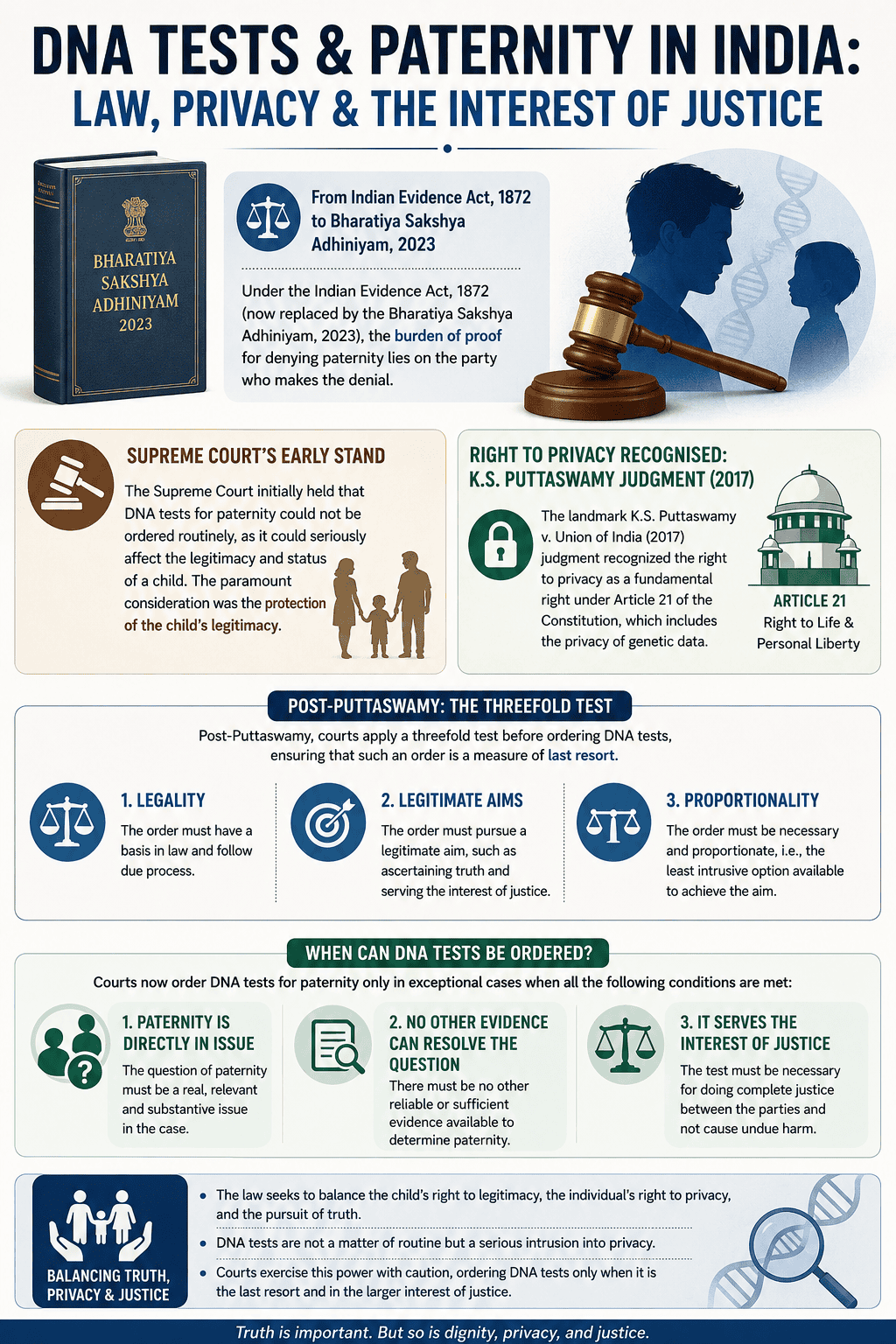
- The Indian Evidence Act 1872, now replaced by the Bharatiya Sakshya Adhiniyam 2023, places the burden of proof for denying paternity on the party making the denial.
- The Supreme Court initially held that DNA tests for paternity could not be ordered routinely, prioritizing the protection of a child's legitimacy.
- The landmark K.S. Puttaswamy judgment (2017) established the right to privacy, including genetic data, as a fundamental right under Article 21 of the Constitution.
- Post-Puttaswamy, courts apply a threefold test (legality, legitimate aims, and proportionality) to order DNA tests only as a last resort.
- DNA tests are now ordered only when paternity is directly in issue, no other evidence can resolve the question, and it serves the interest of justice.
Paternity Test.png
Detailed Insights:
- Early judgments like Goutam Kundu (1993) and Shri Banarsi Dass (2005) emphasized that DNA tests should not be routine, safeguarding the legitimacy of children.
- The Court later evolved its stance in cases like Nandlal Wasudeo Badwaik (2014), stating that reliable scientific proof could prevail over legal fiction.
- Dipanwita Roy (2014) further acknowledged that refusing a DNA test could lead to an adverse inference against the refusing party.
- The K.S. Puttaswamy judgment (2017) introduced a critical constraint by recognizing the fundamental right to privacy for genetic data.
- The Aparna Ajinkya Firodia (2023) case applied the threefold test, mandating that DNA tests must be necessary and proportionate.
- Recent judgments like Ivan Rathinam (2025) and CP vs AP (2026) have balanced privacy, stigma, and the necessity of scientific determination.
- The current judicial approach ensures that while scientific evidence is utilized, it respects individual rights and bodily autonomy.
Key Concepts Involved:
- Indian Evidence Act 1872: The erstwhile law governing the admissibility of evidence in Indian courts.
- Bharatiya Sakshya Adhiniyam 2023: The new law that has replaced the Indian Evidence Act 1872, governing evidence in India.
- Right to Privacy: A fundamental right under Article 21 of the Indian Constitution, protecting an individual's personal space and data, including genetic information.
- Threefold test: A judicial standard comprising legality, legitimate aims, and proportionality, used to assess restrictions on fundamental rights.

SuperKalam is your personal mentor for UPSC preparation, guiding you at every step of the exam journey.
Download the App


STUDY RESOURCES
CONTACT US
ⓒ Snapstack Technologies Private Limited