GS 3: Environment & EcologyGS 3: EconomyGS 3: Science & TechnologyPrelims
Biochar offers a way to turn India’s farm smoke into ‘black gold’, Pg2
Biochar: India's 'black gold' solution to stubble burning, enhancing soil health, crop productivity, and farmer income via carbon credit markets.
Practice MCQs
739 Students attempted
Key Highlights:
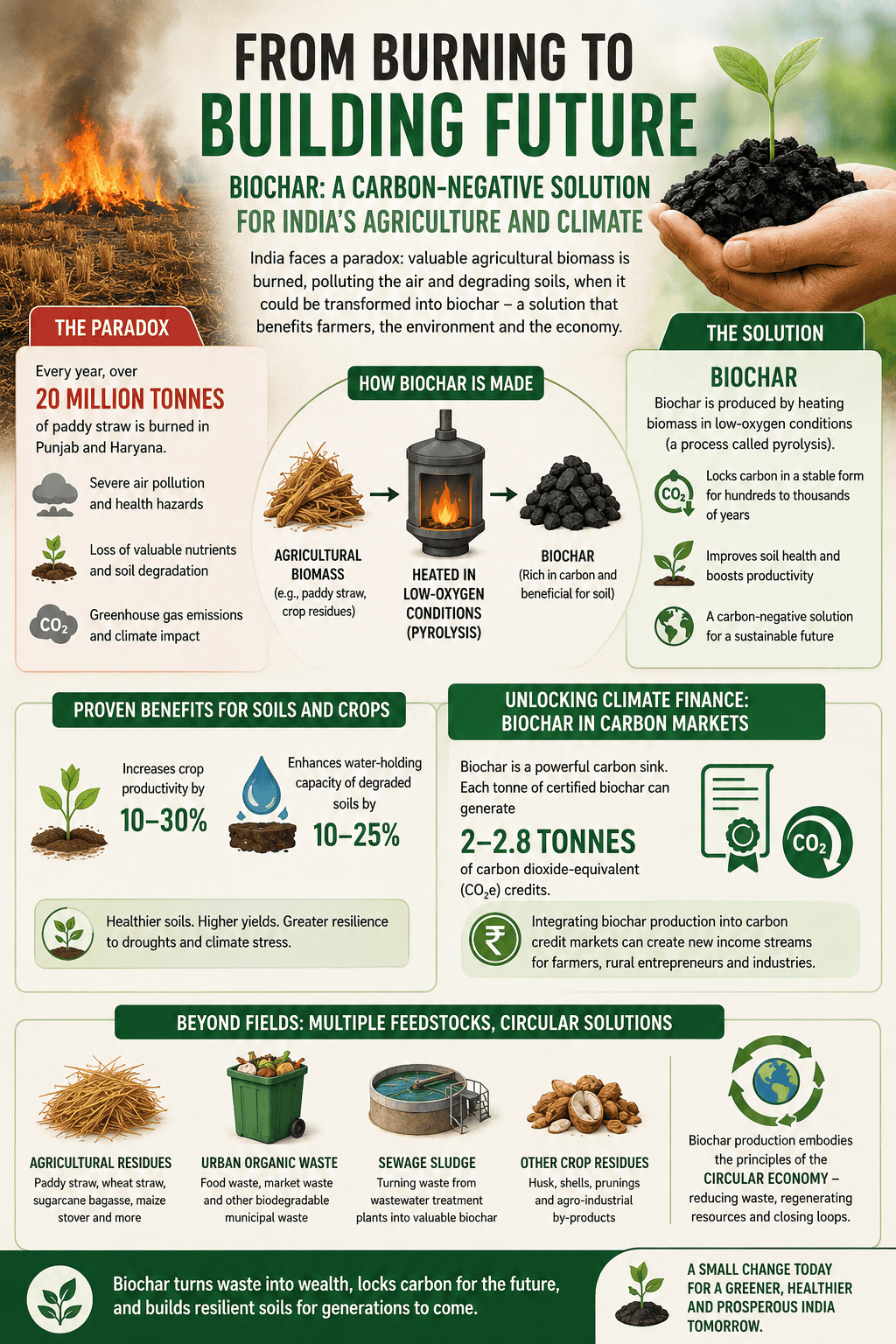
- India faces a paradox where agricultural biomass, like paddy straw, is burned (over 20 million tonnes annually in Punjab and Haryana), causing pollution and soil degradation.
- Biochar, produced by heating agricultural waste in low-oxygen conditions, offers a carbon-negative solution to this problem.
- Studies indicate biochar can improve crop productivity by 10-30% and water-holding capacity by 10-25% in degraded soils.
- The government could integrate biochar production into carbon credit markets, with each tonne of certified biochar generating 2-2.8 tonnes of carbon dioxide-equivalent credits.
- Biochar can also be made from urban organic waste, sewage sludge, and other crop residues, aligning with circular economy principles.
Biochar.png
Detailed Insights:
- The burning of agricultural residues releases significant greenhouse gases and fine particulate matter, contributing to air pollution and loss of soil organic matter.
- Many Indian agricultural lands, including black soils of Maharashtra and red soils of Kerala, suffer from low soil organic carbon and poor water retention.
- Biochar is highly porous, aggregates soil particles, enhances water retention, and fosters beneficial microbial growth, improving soil health long-term.
- Research in Akola, Maharashtra, and Kerala has demonstrated biochar's effectiveness in improving soil organic carbon and fertility using local feedstocks.
- Integrating biochar into existing initiatives like natural farming and soil health management can enhance climate resilience and reduce dependency on external agricultural inputs.
- The KISAN kiln from IIT-Kharagpur is an example of technology enabling smallholders to monetize farm waste through biochar production.
- International examples from Kenya, Thailand, and Brazil showcase successful large-scale biochar adoption and its benefits for soil and carbon sequestration.
- The VM0042 agricultural land management methodology quantifies both avoided emissions from residue burning and long-term carbon sequestration by biochar.
Scientific/Technical Concepts Involved:
- Biochar: A carbon-rich material produced by heating biomass in a low-oxygen environment (pyrolysis), used to improve soil health and sequester carbon.
- Pyrolysis: A thermochemical decomposition of organic material at elevated temperatures in the absence of oxygen.
- Carbon Sequestration: The process of capturing and storing atmospheric carbon dioxide, often in soils or oceans, to mitigate climate change.
- Circular Economy: An economic system aimed at eliminating waste and the continual use of resources, contrasting with the traditional linear economy.

SuperKalam is your personal mentor for UPSC preparation, guiding you at every step of the exam journey.
Download the App


STUDY RESOURCES
CONTACT US
ⓒ Snapstack Technologies Private Limited