GS 2: PolityGS 2: GovernanceGS 2: Social JusticePrelims
Are footpaths more than safe spaces?, Pg10
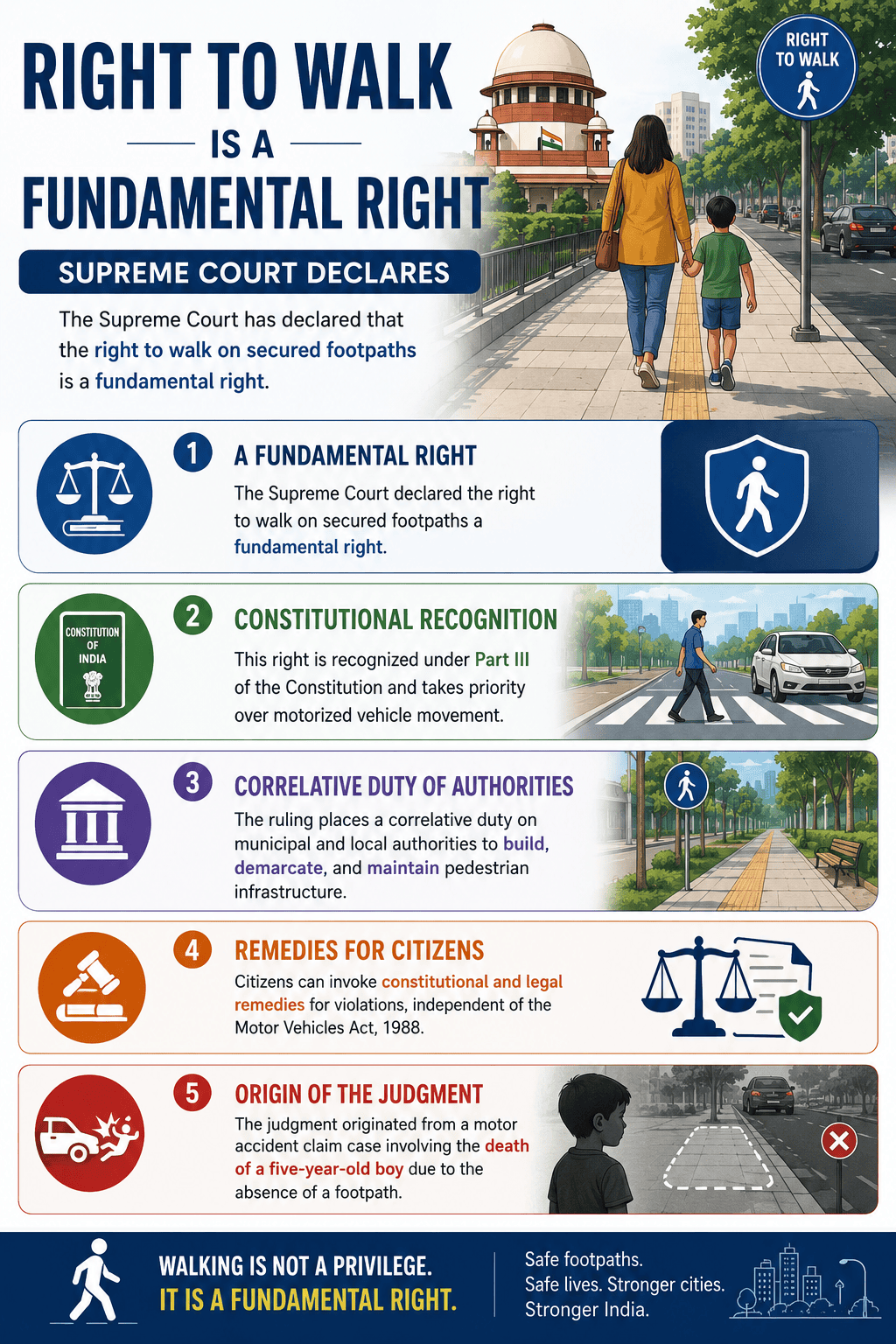
Supreme Court declares 'right to walk' on safe footpaths a fundamental right, urging statutory law and regulator for equitable urban access.
Practice MCQs
739 Students attempted
Key Highlights:
- The Supreme Court of India, in the case of Maniyar Iliyaz@Shaik Riyaz versus P. Ayyappan, declared the right to walk on safe and demarcated footpaths as a Fundamental Right.
- The judgment, delivered by Justices P.S. Narasimha and Atul S. Chandurkar on June 19, 2026, asserts that this right takes priority over the movement of motor vehicles.
- The Court emphasized that footpaths are crucial for civilisational advancement and the freedom to walk, not solely for accident prevention.
- It recommended that the government enact a statutory law and establish a regulator to implement and protect this fundamental right.
- The ruling highlighted the neglect of pedestrian infrastructure in urban planning, which often prioritizes motorized transport.
Right to Walk.png
Detailed Insights:
- The Supreme Court's decision stemmed from a case involving a fatal accident where a five-year-old child was killed due to the absence of a footpath.
- The right to walk is rooted in Article 19(1)(d), guaranteeing freedom of movement, and Article 21, ensuring the right to life and personal liberty.
- The judgment also linked the right to walk to other fundamental freedoms under Article 19, including speech, expression, peaceful assembly, and forming associations.
- The Court observed that the current legal framework, such as the Motor Vehicles Act of 1988, has historically prioritized wheeled transport, often at the expense of pedestrian rights.
- Urban development authorities, municipal corporations, municipalities, and panchayats were identified as duty-bearers responsible for providing and maintaining footpaths.
- The Court likened the deterioration of footpaths due to encroachment and neglect to the concept of the tragedy of the commons.
- It directed its Registry to forward the judgment to relevant Central Ministries and the Law Commission of India to consider drafting a comprehensive legal framework.
Key Concepts Involved:
- Fundamental Right: A basic human right guaranteed by the Constitution, enforceable by courts.
- Statutory Law: Legislation formally enacted by a legislative body, distinct from constitutional provisions.
- Regulator: An independent body tasked with overseeing and enforcing rules and standards in a specific sector.
- Tragedy of the Commons: An economic theory where individuals deplete a shared resource acting in their self-interest.
- Duty-bearers: Entities, typically government bodies, responsible for upholding and protecting rights.
- Article 19(1)(d): Constitutional provision guaranteeing freedom of movement throughout India.
- Article 21: Constitutional provision guaranteeing protection of life and personal liberty.
- Article 39(b): A Directive Principle of State Policy mandating equitable distribution of community material resources for common good.
- Motor Vehicles Act, 1988: An Act of Parliament regulating all aspects of road transport vehicles in India.
- Right to Education Act: Enacted in 2009, based on Article 21A, ensuring free and compulsory education for children aged 6-14.

SuperKalam is your personal mentor for UPSC preparation, guiding you at every step of the exam journey.
Download the App


STUDY RESOURCES
CONTACT US
ⓒ Snapstack Technologies Private Limited