GS 2: International RelationsGS 3: Economy
India must draw a red line on U.S. unilateral sanctions, Pg6
India grapples with U.S. sanctions' impact amidst geopolitical tensions, urged to assert strategic autonomy and defy unilateral restrictions.
Practice MCQs
724 Students attempted
Key Highlights:
- The Indian economy is suffering due to the U.S.-Israel war against Iran, leading to rising energy bills, supply chain disruptions, and a slump in exports.
- India's ranking among the world's largest economies has slipped from fourth to sixth, according to the International Monetary Fund (IMF), due to the falling rupee.
- The U.S. has imposed numerous sanctions, with India partially or fully complying, including halting Iranian and Venezuelan oil imports since May 2019.
- India complied with U.S. demands to reduce Russian oil imports from November 2025 to February 2026, halving its intake.
- The U.S. waiver extension on India’s use of Chabahar port is set to expire on April 26.
Detailed Insights:
- The "whack-a-mole" nature of U.S. sanctions creates uncertainty and hinders India's efforts to diversify its energy, food, and fertilizer sourcing.
- Yielding to U.S. sanctions has not curbed their appetite, leading to additional demands for compliance, while ignoring sanctions, such as CAATSA, has proven beneficial.
- Compliance with U.S. sanctions has weakened the rules-based international order and the UN's multilateral mandate.
- India can counter U.S. sanctions by building payment mechanisms like the rupee-rial trade system, developing national payment systems, and expanding renewable energy sources.
- The U.S.'s "short-tether" policy in 1966, limiting grain shipments to India, serves as a historical example of using food as leverage.
Key Concepts Involved:
- Unilateral Sanctions: Economic penalties imposed by one country on another.
- Strategic Autonomy: A country's ability to make independent foreign policy decisions.
- International North South Transport Corridor (INSTC): A multi-modal transportation route linking India, Iran, Afghanistan, Russia, and Europe.
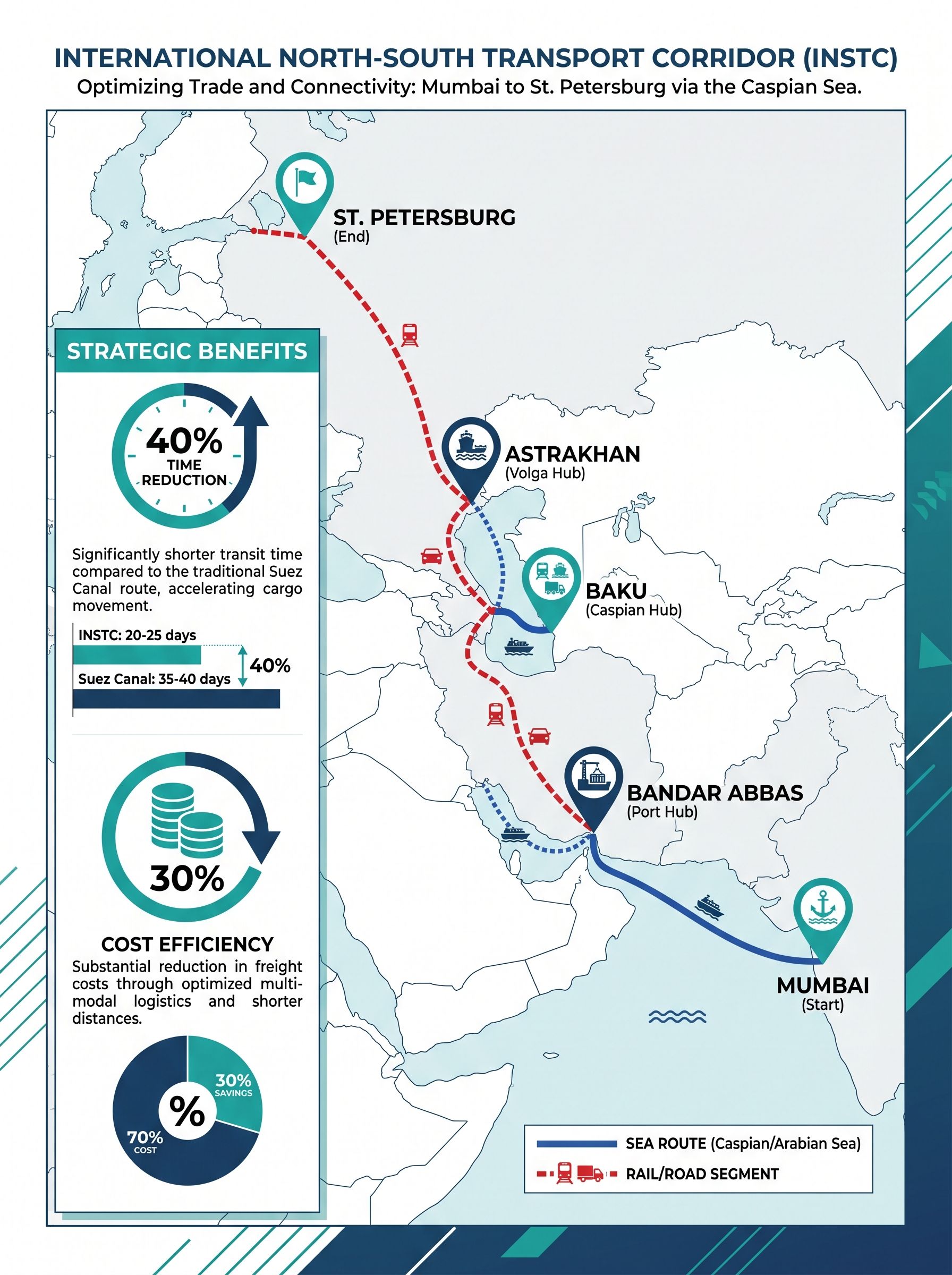
INSTC

SuperKalam is your personal mentor for UPSC preparation, guiding you at every step of the exam journey.
Download the App


STUDY RESOURCES
CONTACT US
ⓒ Snapstack Technologies Private Limited