GS 3: Science & TechnologyPrelims
Quantum test shows cause, effect need not follow a set order, Pg11
Quantum experiment demonstrates indefinite causal order, challenging traditional cause-and-effect relationships, potentially revolutionizing quantum technologies.
Practice MCQs
898 Students attempted
Key Highlights:
- Physicists from the University of Vienna and the Christian Doppler Laboratory have made strides in proving that cause and effect do not necessarily follow a set order in quantum mechanics.
- The experiment, published in PRX Quantum on March 17, demonstrated indefinite causal order (ICO) using pairs of light particles (photons) sent through a quantum switch.
- The experiment achieved a VBC score of 1.83, exceeding the standard causality limit of 1.75, suggesting the presence of ICO.
- The experiment's results suggest that the photons were in a superposition of both orderings at once.
Detailed Insights:
- Quantum systems can exist in multiple states simultaneously until measured, a concept known as superposition, which challenges classical notions of causality.
- Indefinite causal order (ICO), where events A and B can occur before each other simultaneously, has potential applications in enhancing quantum key distribution for secure communication.
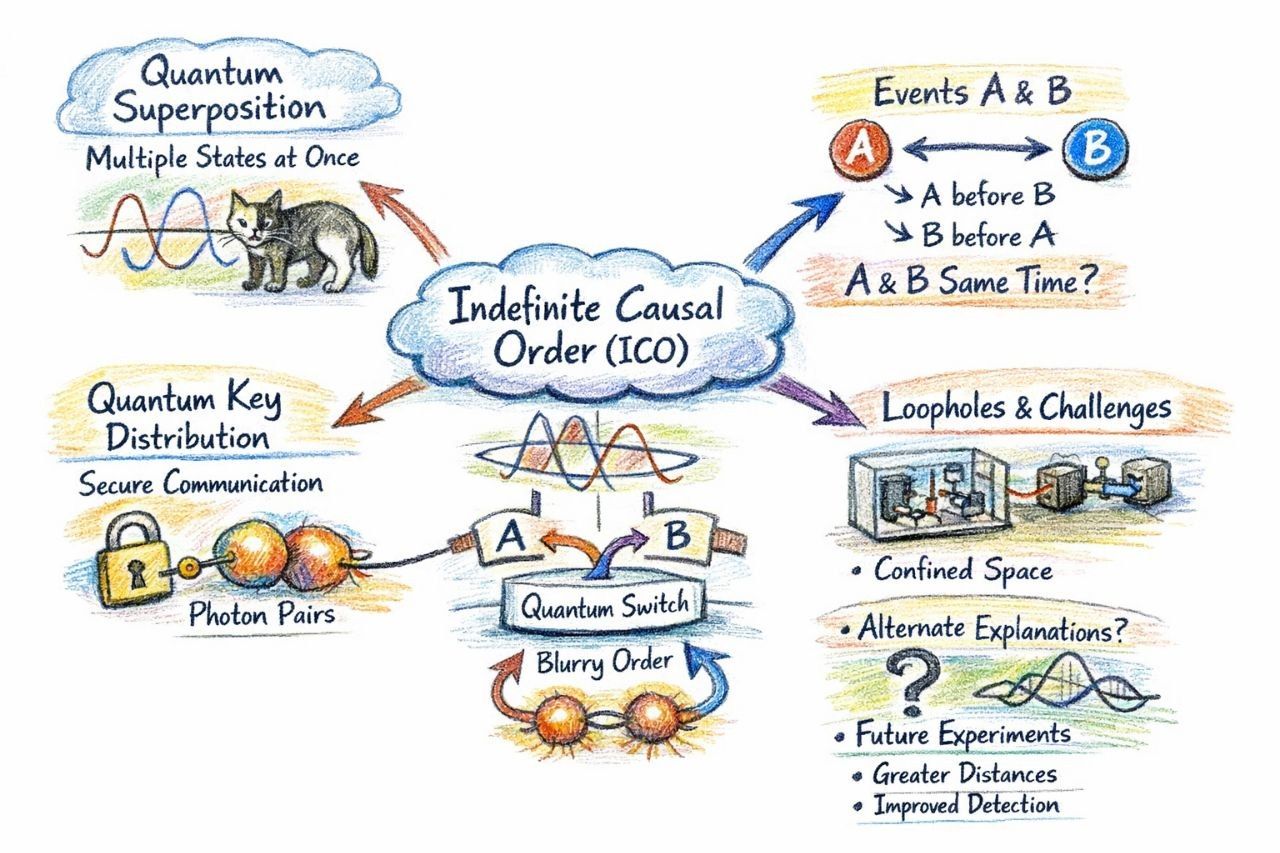
Quantum Systems.jpg
- The experiment involved creating pairs of photons and subjecting them to two operations in a blurred order using a quantum switch, resulting in correlations that defy explanation by fixed sequences.
- The researchers acknowledge existing loopholes, such as the experiment's confined space, which could allow for alternative explanations mimicking ICO, necessitating future experiments with greater distances and improved detection.
Scientific/Technical Concepts Involved:
- Quantum mechanics: The branch of physics dealing with the behavior of matter and energy at the atomic and subatomic level.
- Superposition: The ability of a quantum system to exist in multiple states simultaneously until measured.
- Photon: A particle representing a quantum of light or other electromagnetic radiation.
- Quantum key distribution: A method of secure communication that uses the principles of quantum mechanics to encrypt and transmit data.

SuperKalam is your personal mentor for UPSC preparation, guiding you at every step of the exam journey.
Download the App


STUDY RESOURCES
CONTACT US
ⓒ Snapstack Technologies Private Limited