GS 2: PolityGS 2: Governance
Judiciary cannot tie President, Governor to timelines, says SC, Pg1
Supreme Court clarifies judiciary's role, stating it cannot impose fixed timelines on President/Governors for assenting to bills, upholding separation of powers.
Practice MCQs
760 Students attempted
Key Highlights:
- The Supreme Court stated that the judiciary cannot impose fixed timelines on Governors and the President for disposing of State Bills.
- The court was answering the 16th Presidential Reference and emphasized that setting rigid timetables would undermine the separation of powers.
- Prolonged inaction on State Bills by the President and Governors was cautioned against by the court.
- The Supreme Court clarified that Governors have options under Article 200, including granting assent, reserving for presidential consideration, or returning the bill with comments.
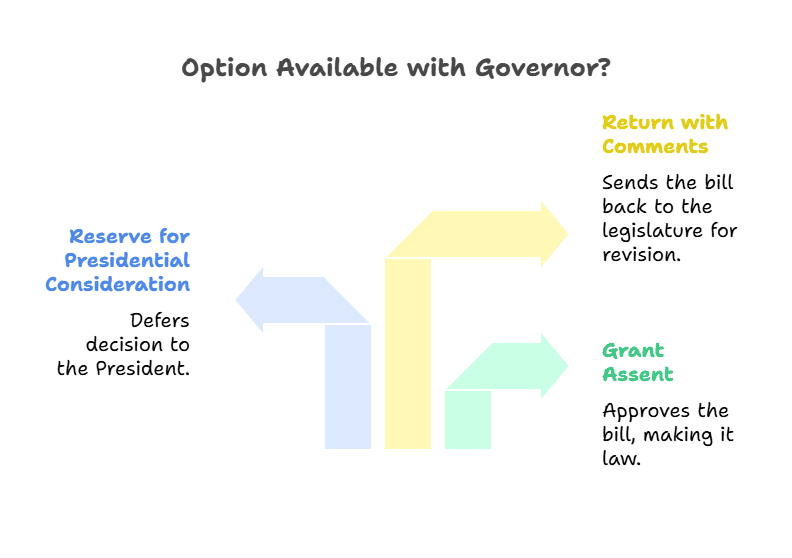
Option Available with Governor.png
Detailed Insights:
- The Presidential Reference was triggered after a prior Supreme Court judgment on April 8 fixed a three-month deadline for disposing of pending State Bills.
- The court clarified that it can address general legal questions referred by the President, even if related to a prior judgment.
- The Supreme Court termed the President's set of 14 questions as a "functional reference" concerning the roles of state legislatures, Governors, and the President.
- The Governor must return a bill to the State Assembly with reasons for withholding assent, upholding the principles of federalism.
- While the court cannot review the merits of a Governor's decision under Article 200, it can issue a mandamus for timely action in cases of prolonged inaction.
- Governors have personal immunity from court proceedings under Article 361 of the Constitution.
- The President is not obligated to consult the Supreme Court on every State Bill referred by Governors.
- Courts cannot adjudicate the contents of a bill before it becomes law, respecting the legislative process.
Key Concepts Involved:
- Presidential Reference: Advice sought by the President from the Supreme Court on a question of law or fact under Article 143.
- Article 200: Constitutional provision outlining the Governor's powers regarding assent to bills passed by the State Legislature.
- Separation of Powers: Doctrine distributing distinct powers to the Legislature, Executive, and Judiciary to prevent abuse of authority.

SuperKalam is your personal mentor for UPSC preparation, guiding you at every step of the exam journey.
Download the App


STUDY RESOURCES
CONTACT US
ⓒ Snapstack Technologies Private Limited