GS 3: EconomyGS 2: International RelationsPrelims
What US Fed's rate hike signal could mean for struggling Indian markets, Pg11
US Fed's hawkish rate hike signal threatens Indian markets with foreign capital outflows, impacting rupee and equities amidst high crude.
Practice MCQs
731 Students attempted
Key Highlights:
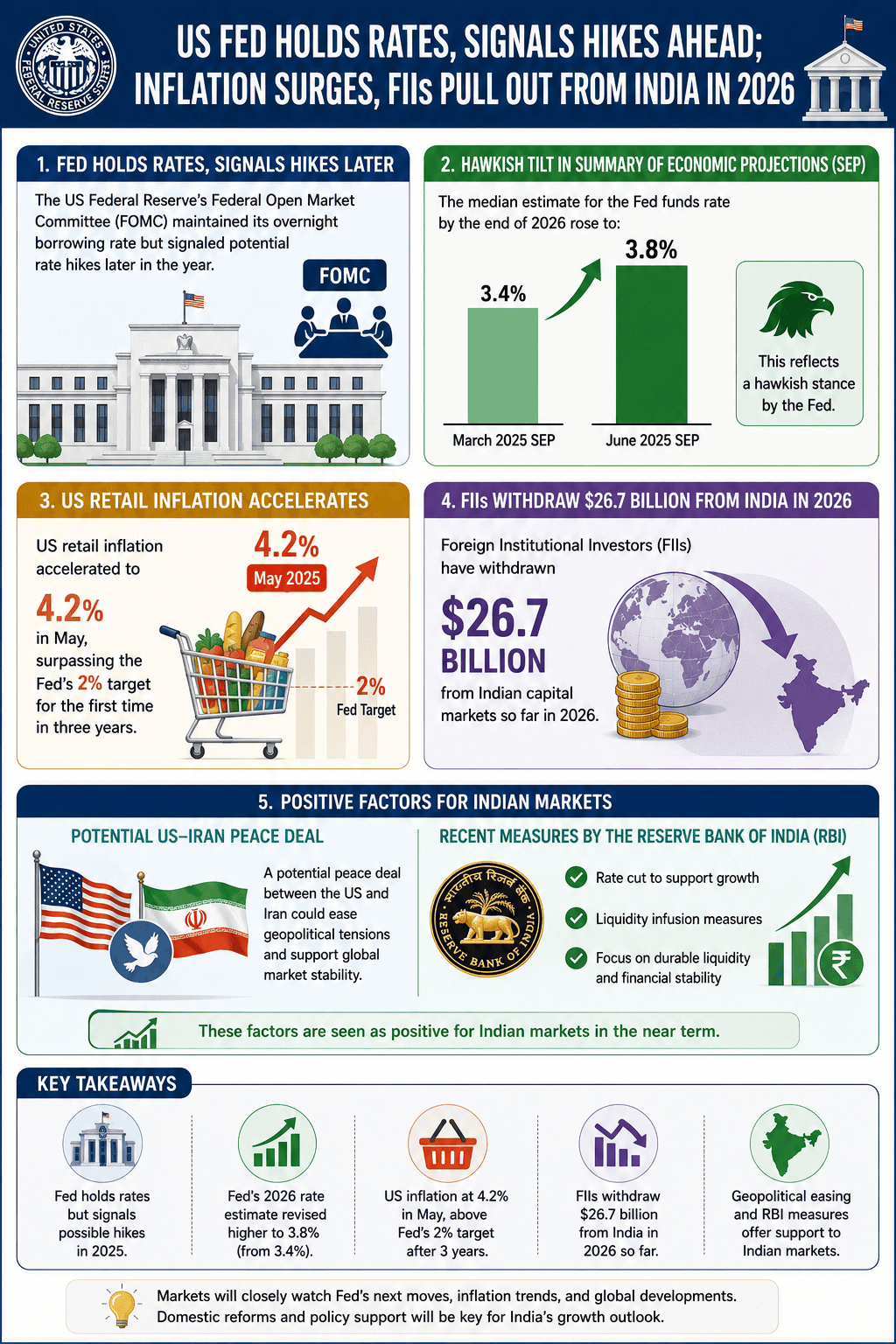
- The US Federal Reserve's Federal Open Market Committee (FOMC) maintained its overnight borrowing rate but signaled potential rate hikes later in the year.
- This hawkish stance was reflected in the Summary of Economic Projections (SEP), with the median estimate for the Fed funds rate by the end of 2026 rising to 3.8% from 3.4%.
- US retail inflation accelerated to 4.2% in May, surpassing the Fed's 2% target for the first time in three years.
- Foreign Institutional Investors (FIIs) have withdrawn $26.7 billion from Indian capital markets so far in 2026.
- A potential US-Iran peace deal and recent measures by the Reserve Bank of India (RBI) are seen as positive factors for Indian markets.
US Fed rate.png
Detailed Insights:
- The FOMC kept the overnight borrowing rate steady in the range of 3.50%-3.75% during Fed Chairman Kevin Warsh's inaugural press conference.
- Nine FOMC officials projected at least one rate hike this year, with six anticipating multiple increases.
- The hawkish outlook is supported by strong US growth and labor data, despite persistent inflationary pressures.
- US inflation has been exacerbated by reciprocal tariffs and disruptions to fuel prices and supply chains due to the West Asia conflict.
- Short-term US treasuries saw yields rise to a 16-month high, with market odds placing a 72% chance on an October rate hike.
- Higher US interest rates typically lead to capital outflows from emerging markets like India, as US assets become more attractive.
- Indian markets have been grappling with challenges such as elevated crude oil prices, geopolitical uncertainties, and a weakening rupee.
- Despite initial dips, the Indian rupee recovered against the dollar, and benchmark indices like Nifty 50 and Sensex ended positively.
- RBI's recent initiatives to attract foreign capital, including easing FPI norms, are contributing to a constructive sentiment for the Indian Rupee and bond market.
Key Concepts Involved:
- Federal Open Market Committee (FOMC): The monetary policymaking body of the US Federal Reserve System.
- Fed funds rate: The target interest rate set by the FOMC at which commercial banks lend reserves to each other overnight.
- Summary of Economic Projections (SEP): A quarterly report by the Federal Reserve outlining economic forecasts of FOMC members for key indicators and the Fed funds rate.
- Hawkish monetary policy: A central bank stance focused on controlling inflation, typically by raising interest rates and tightening the money supply.
- Foreign Institutional Investors (FIIs): Entities registered outside India that invest in Indian financial markets, including stocks, bonds, and other securities.
- Capital Outflows: The movement of financial capital out of a country's economy to be invested in other countries.
- Rupee Depreciation: A decline in the value of the Indian Rupee relative to foreign currencies, typically the US Dollar.
- Reserve Bank of India (RBI): India's central bank responsible for monetary policy, financial regulation, and foreign exchange management.
- Yields (bond yields): The return an investor earns from a bond, expressed as a percentage of its current market price, inversely related to bond prices.

SuperKalam is your personal mentor for UPSC preparation, guiding you at every step of the exam journey.
Download the App


STUDY RESOURCES
CONTACT US
ⓒ Snapstack Technologies Private Limited