GS 2: PolityGS 2: Social JusticeGS 3: Internal Security
The bail rule, Pg8
Supreme Court reaffirms bail as the rule, even under UAPA, disapproving stringent interpretations hindering personal liberty and speedy trial.
Practice MCQs
724 Students attempted
Key Highlights:
- The Supreme Court granted bail to Syed Iftikhar Andrabi, who was in pre-trial custody for over five years under the UAPA.
- The court reiterated that the right to personal liberty and a speedy trial are paramount and cannot be overridden by Section 43-D(5) of UAPA.
- The judgment disapproved of previous rulings in Gurwinder Singh (2024) and Gulfisha Fatima, which had diluted the principle established in K.A. Najeeb (2021).
Detailed Insights:
- The K.A. Najeeb (2021) ruling stated that the restrictions of Section 43-D(5) would diminish if the trial was unlikely to conclude within a reasonable time and the accused had already been incarcerated for a substantial period.
- The court found that the two-judge benches in Gurwinder Singh and Gulfisha Fatima could not deviate from the binding three-judge ruling in K.A. Najeeb.
- In the Gulfisha Fatima case, bail was denied to Umar Khalid and Sharjeel Imam, despite their lengthy pre-trial detention, based on a narrow interpretation of the Najeeb ruling.
- The Supreme Court's decision in Syed Iftikhar Andrabi vs National Investigation Agency, Jammu reinforces constitutional principles, prioritizing personal liberty and speedy trial over stringent UAPA provisions.
- The Additional Solicitor General's statement that the presumption of innocence takes a backseat under UAPA's statutory bail bar is in direct opposition to the principles upheld in the Andrabi case.
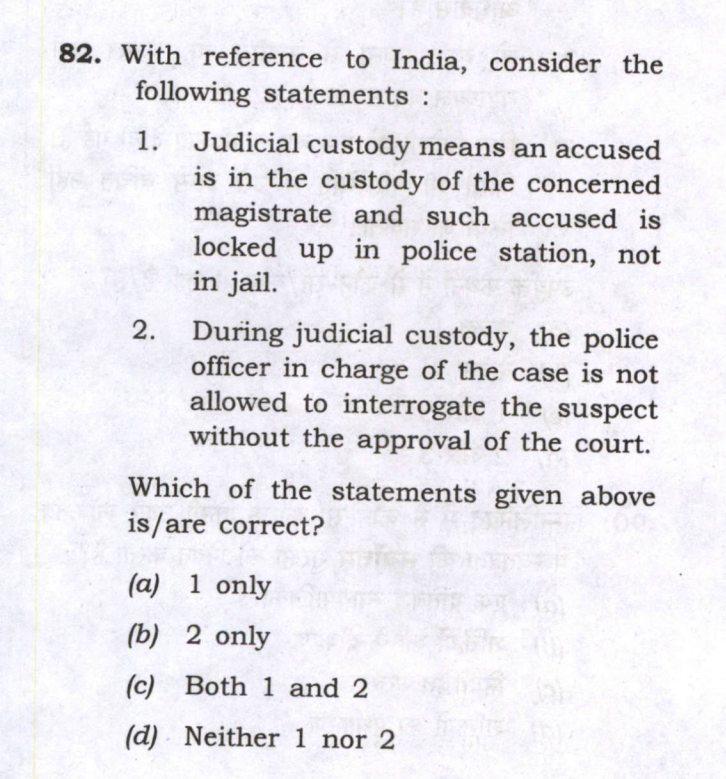
PYQ-2021.jpg
Key Concepts Involved:
- UAPA (Unlawful Activities (Prevention) Act): Legislation aimed at preventing unlawful activities and dealing with terrorism.
- Section 43-D(5): A stringent provision within UAPA that makes granting bail difficult once the court finds a prima facie case against the accused.
- Prima facie: Based on the first impression; accepted as correct until proved otherwise.

SuperKalam is your personal mentor for UPSC preparation, guiding you at every step of the exam journey.
Download the App


STUDY RESOURCES
CONTACT US
ⓒ Snapstack Technologies Private Limited