GS 3: Environment & EcologyGS 1: Indian GeographyPrelims
India’s forests could nearly double carbon storage by 2100, study finds, Pg16
Indian forests could nearly double carbon storage by 2100 with rising precipitation and elevated CO₂ levels, study reveals.
Practice MCQs
898 Students attempted
Key Highlights:
- A new study projects India's forests could nearly double their carbon storage capacity by 2100 if current greenhouse gas emission trends continue.
- The study forecasts vegetation carbon biomass will increase by 35% under a low-emissions future, 62% under a medium-emissions pathway, and 97% under a high-emissions scenario.
- Rising precipitation and elevated atmospheric CO₂ levels are the primary drivers of the projected increases in carbon storage.
- The largest relative increases in vegetation carbon are expected in India's driest regions, including Rajasthan, Gujarat, and western Madhya Pradesh.
Detailed Insights:
- The study's projections diverge from official estimates compiled by the Forest Survey of India (FSI), highlighting the need for granular forecasts of forest carbon stocks.
- Until 2030, all emission scenarios project similar vegetation quantities, after which they diverge sharply, with the steepest acceleration occurring post-2050.
- Higher rainfall is projected across much of India, providing more moisture for tree growth, while increased CO₂ enhances photosynthesis and water-use efficiency.
- The Western Ghats and the Himalayas are projected to see smaller relative increases due to ecological saturation and specific climatic pressures.
- The study warns that disruptive forces like deforestation, land conversion, fire, and pest outbreaks, intensified by warming, are not captured in the models.
Key Concepts Involved:
- Carbon Sequestration: The process of capturing and storing atmospheric carbon dioxide in plants, soil, or other reservoirs.
- Greenhouse Gas Emissions: The release of gases like carbon dioxide and methane into the atmosphere, trapping heat and contributing to climate change.
- Vegetation Biomass: The total mass of living plant matter in a given area, often used as a measure of carbon storage potential.
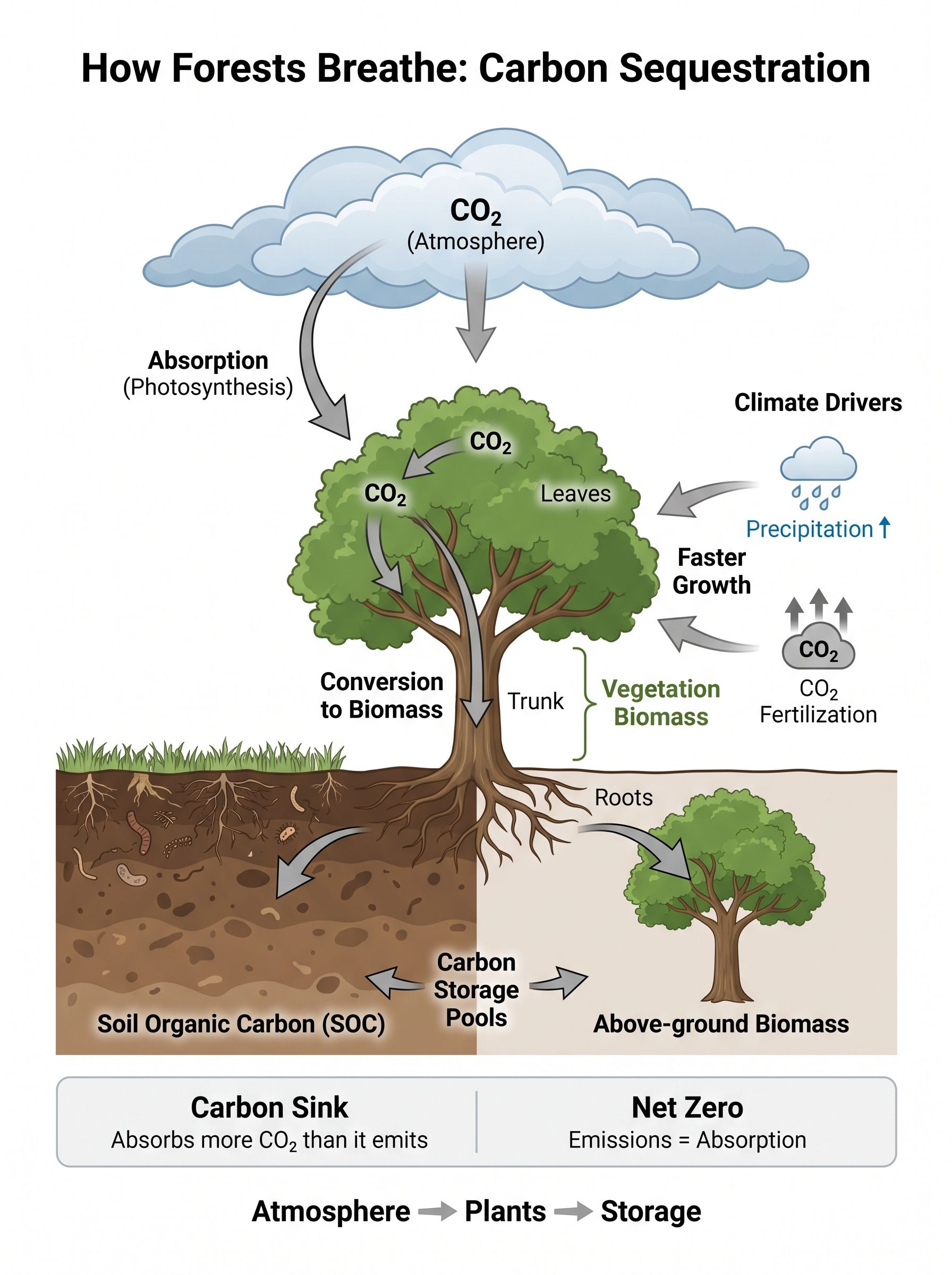
Carbon Sequestration

SuperKalam is your personal mentor for UPSC preparation, guiding you at every step of the exam journey.
Download the App


STUDY RESOURCES
CONTACT US
ⓒ Snapstack Technologies Private Limited