GS 3: EconomyGS 2: International RelationsPrelims
India must not wait for the next Hormuz crisis, Pg14
Iran's Hormuz closure triggered India's economic crisis, with surging inflation, rupee depreciation, and forex depletion, forcing RBI into a policy trilemma.
Practice MCQs
724 Students attempted
Key Highlights:
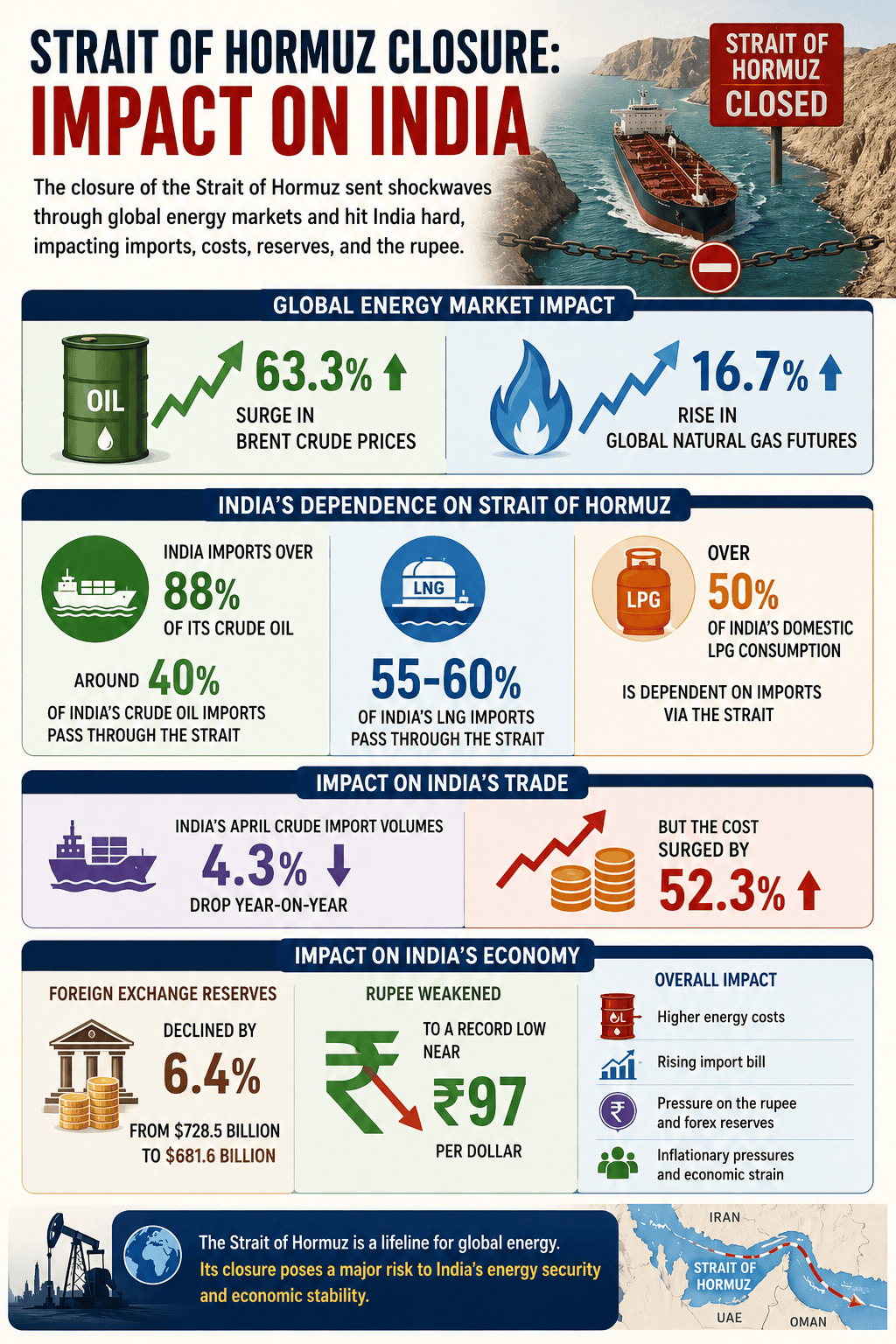
- The closure of the Strait of Hormuz led to a 63.3% surge in Brent crude prices and a 16.7% rise in global natural gas futures.
- India, importing over 88% of its crude oil, saw approximately 40% of its crude and 55-60% of its LNG imports pass through the strait.
- Over 50% of India's domestic LPG consumption was dependent on imports via the Strait of Hormuz.
- The crisis caused India's April crude import volumes to drop by 4.3% year-on-year, while the cost surged by 52.3%.
- India's foreign exchange reserves declined by 6.4%, from $728.5 billion to $681.6 billion, and the rupee weakened to a record low near Rs 97 per dollar.
Strait of Hormuz.png
Detailed Insights:
- The Strait of Hormuz is a critical chokepoint, handling roughly one-fifth of global oil supplies, making its disruption globally significant.
- India's high dependence on energy imports through this single route exposed its economy to severe price and supply shocks.
- The blockade led to stagflationary pressures, characterized by rising prices and declining import volumes.
- April wholesale inflation reached 8.3%, with fuel-and-power inflation at 24.7% and crude-petroleum inflation at 88.1%.
- The merchandise trade deficit widened significantly from $20.7 billion in March to $28.38 billion in April due to higher import costs.
- The Reserve Bank of India (RBI) faced a policy trilemma, balancing inflation control, rupee defense, and economic growth.
- Solutions include diversifying crude oil sourcing from regions like Russia, the Americas, and Africa to reduce route dependence.
- Promoting renewable electricity, energy storage, electric mobility, and biofuels can decrease India's overall petroleum intensity.
Key Concepts Involved:
- Strait of Hormuz: A narrow sea passage between the Persian Gulf and the Gulf of Oman, crucial for global oil transport.
- Stagflation: An economic condition marked by slow economic growth, high unemployment, and rising prices (inflation).
- Policy Trilemma: A situation where a central bank cannot simultaneously achieve three desirable policy goals, such as independent monetary policy, fixed exchange rates, and free capital movement.
- Foreign Exchange Reserves: Assets held by a central bank in foreign currencies, used to back liabilities and influence monetary policy.

SuperKalam is your personal mentor for UPSC preparation, guiding you at every step of the exam journey.
Download the App


STUDY RESOURCES
CONTACT US
ⓒ Snapstack Technologies Private Limited