GS 3: Environment & EcologyGS 3: Disaster ManagementGS 1: Physical GeographyPrelims
Four glacial lakes in Arunachal have expanded in a decade: study, Pg10
New satellite study reveals four high-risk glacial lakes in Arunachal Pradesh expanded significantly, escalating GLOF threat in Eastern Himalaya.
Practice MCQs
724 Students attempted
Key Highlights:
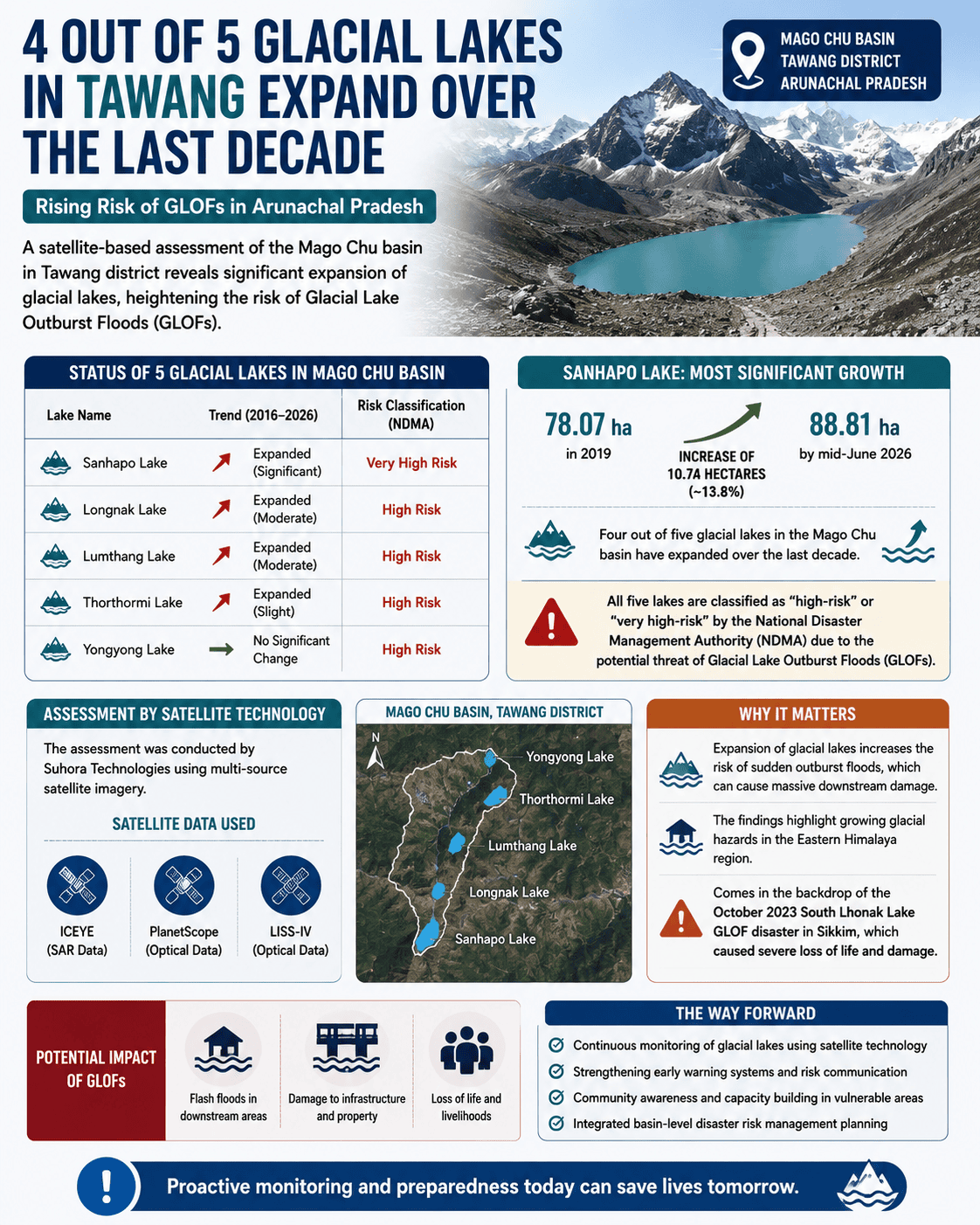
- A satellite-based assessment in Arunachal Pradesh's Tawang district revealed that four out of five glacial lakes in the Mago Chu basin have expanded over the last decade.
- Sanhapo Lake showed the most significant growth, increasing from 78.07 hectares in 2019 to 88.81 hectares by mid-June 2026.
- These five lakes are classified as "high-risk" or "very high-risk" by the National Disaster Management Authority (NDMA) due to potential Glacial Lake Outburst Floods (GLOFs).
- The assessment, conducted by Suhora Technologies, utilized imagery from ICEYE, PlanetScope, and LISS-IV satellites.
- The findings underscore concerns over glacial hazards in the Eastern Himalaya, following the October 2023 South Lhonak Lake disaster in Sikkim.
Glacial Lake.png
Detailed Insights:
- The expansion of glacial lakes is attributed to the general trend of glacial retreat and increased meltwater storage, primarily driven by rising temperatures.
- While lake expansion does not directly indicate an imminent flood event, it highlights the critical need for continuous monitoring and further assessment of these unstable lakes.
- The NDMA has identified 189 high-risk glacial lakes for monitoring and mitigation under the National Glacial Lake Outburst Floods Risk Mitigation Programme.
- The 2023 South Lhonak Lake GLOF in Sikkim, which destroyed the Chungthang hydropower dam and caused casualties, intensified focus on Himalayan glacial hazards.
- Experts emphasize that the stability of moraine dams and other factors like landslides, avalanches, or rockfalls into the lake are crucial in determining the actual risk of a GLOF.
- Satellite observations are increasingly vital for monitoring remote mountain regions where field access is challenging, aiding in tracking changes in glacial lake extent.
- Translating scientific assessments into practical risk reduction measures, including early-warning systems and hazard modeling, remains a significant challenge.
Key Concepts Involved:
- Glacial Lake Outburst Flood (GLOF): A sudden release of a large volume of water from a glacial lake, typically caused by the failure of its natural dam (often a moraine dam).
- National Disaster Management Authority (NDMA): India's apex statutory body for disaster management, responsible for policies, plans, and guidelines under the Disaster Management Act, 2005.
- Moraine Dam: A natural dam formed by unconsolidated rock and sediment debris deposited by a glacier, which can impound meltwater to form a glacial lake.
- Glacial Retreat: The process where a glacier shrinks or recedes due to a net loss of ice, primarily caused by rising global temperatures and changes in precipitation patterns.

SuperKalam is your personal mentor for UPSC preparation, guiding you at every step of the exam journey.
Download the App


STUDY RESOURCES
CONTACT US
ⓒ Snapstack Technologies Private Limited