GS 3: Science & TechnologyGS 1: Physical GeographyPrelims
Zwan-Wolf effect: stream diverter, Pg2
NASA's MAVEN spacecraft detects Zwan-Wolf effect on Mars during coronal mass ejection, revealing complex magnetic phenomena on 'unmagnetized' planets.
Practice MCQs
898 Students attempted
Key Highlights:
- Researchers using NASA's MAVEN spacecraft found evidence of the Zwan-Wolf effect at Mars in December 2023.
- The effect was observed during a powerful coronal mass ejection that struck Mars.
- The event caused a 50% reduction in the local density of charged particles in Mars's ionosphere.
- The discovery suggests that even planets without strong magnetic fields can experience complex magnetic phenomena.
Detailed Insights:
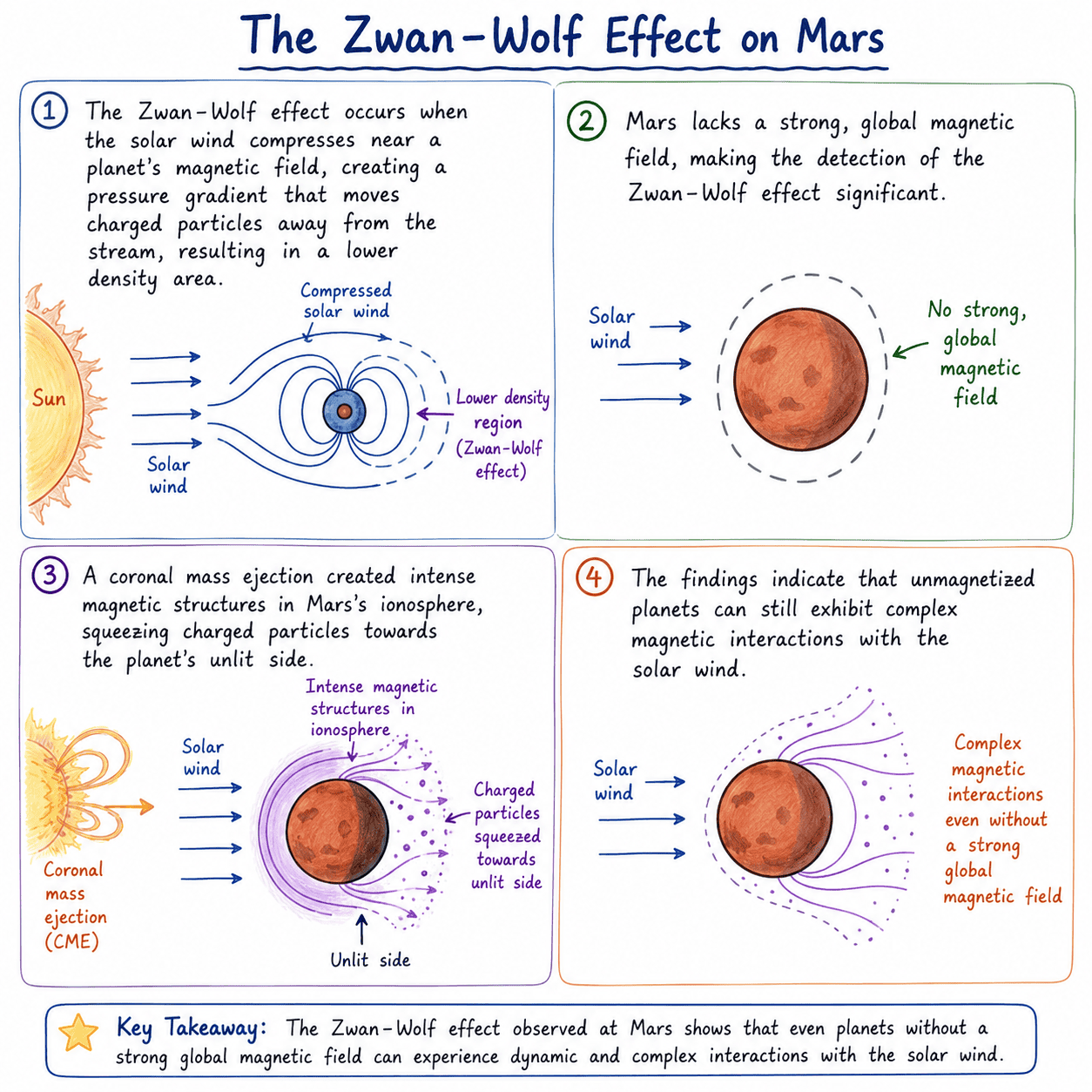
- The Zwan-Wolf effect occurs when the solar wind compresses near a planet's magnetic field, creating a pressure gradient that moves charged particles away from the stream, resulting in a lower density area.
- Mars lacks a strong, global magnetic field, making the detection of the Zwan-Wolf effect significant.
- The coronal mass ejection created intense magnetic structures in Mars's ionosphere, squeezing charged particles towards the planet's unlit side.
- The findings indicate that unmagnetized planets can still exhibit complex magnetic interactions with the solar wind.
Zwan-Wolf.png
Scientific/Technical Concepts Involved:
- Solar Wind: A stream of charged particles flowing outwards from the Sun.
- Coronal Mass Ejection: A significant release of plasma and magnetic field from the solar corona.
- Ionosphere: A layer of a planet's atmosphere containing a high concentration of ions and free electrons.

SuperKalam is your personal mentor for UPSC preparation, guiding you at every step of the exam journey.
Download the App


STUDY RESOURCES
CONTACT US
ⓒ Snapstack Technologies Private Limited