GS 3: Science & TechnologyGS 3: EconomyPrelims
Fast breeder reactors to play key role in long-term energy security, Pg15
NPCIL emphasizes fast breeder reactors' pivotal role in India's energy security, aiming 54 GWe capacity by 2047 with private sector collaboration.
Practice MCQs
891 Students attempted
Key Highlights:
- India's first indigenous Fast Breeder Reactor (FBR) at Kalpakkam has achieved criticality, marking a significant step for long-term energy security.
- Nuclear Power Corporation of India Ltd (NPCIL) aims to increase nuclear power capacity to 22 GWe by 2031-32 and 54 GWe by 2047.
- Pressurized Heavy Water Reactors (PHWRs) will remain crucial until FBR technology matures.
- NPCIL will support private sector entry into nuclear power through technology transfer, project development, and design assistance.
Detailed Insights:
- India's nuclear program follows a three-stage approach: PHWRs using natural uranium, FBRs using plutonium from PHWRs, and advanced reactors using Thorium-232.
- FBRs use plutonium and depleted uranium to breed more fuel, converting Thorium-232 into Uranium-233 for advanced reactors, ensuring fuel independence.
- While the world uses Pressurized Water Reactors (PWRs) or Light Water Reactors (LWRs) with enriched uranium, India focused on PHWRs due to limited uranium and abundant thorium reserves.
- NPCIL has mastered 700 MWe PHWR technology with three units operating successfully and also operates PWRs of 1,000 MWe capacity at Kudankulam with Russian technology.
- NPCIL envisions playing a "motherly role" by offering expertise in site selection, design, engineering, construction, operation, waste management and quality assurance to private players.
- The 1-2-3 agreement improved fuel supply and capacity factors, and with land acquired and technology frozen for 700 MWe units, the sector is poised for growth.
Key Concepts Involved:
- Fast Breeder Reactor (FBR): A reactor that breeds more fissile material than it consumes while generating power.
- Pressurized Heavy Water Reactor (PHWR): A nuclear reactor that uses heavy water as its coolant and moderator and natural uranium as fuel.
- Thorium-232: A fertile material that can be converted into fissile Uranium-233 in a nuclear reactor.
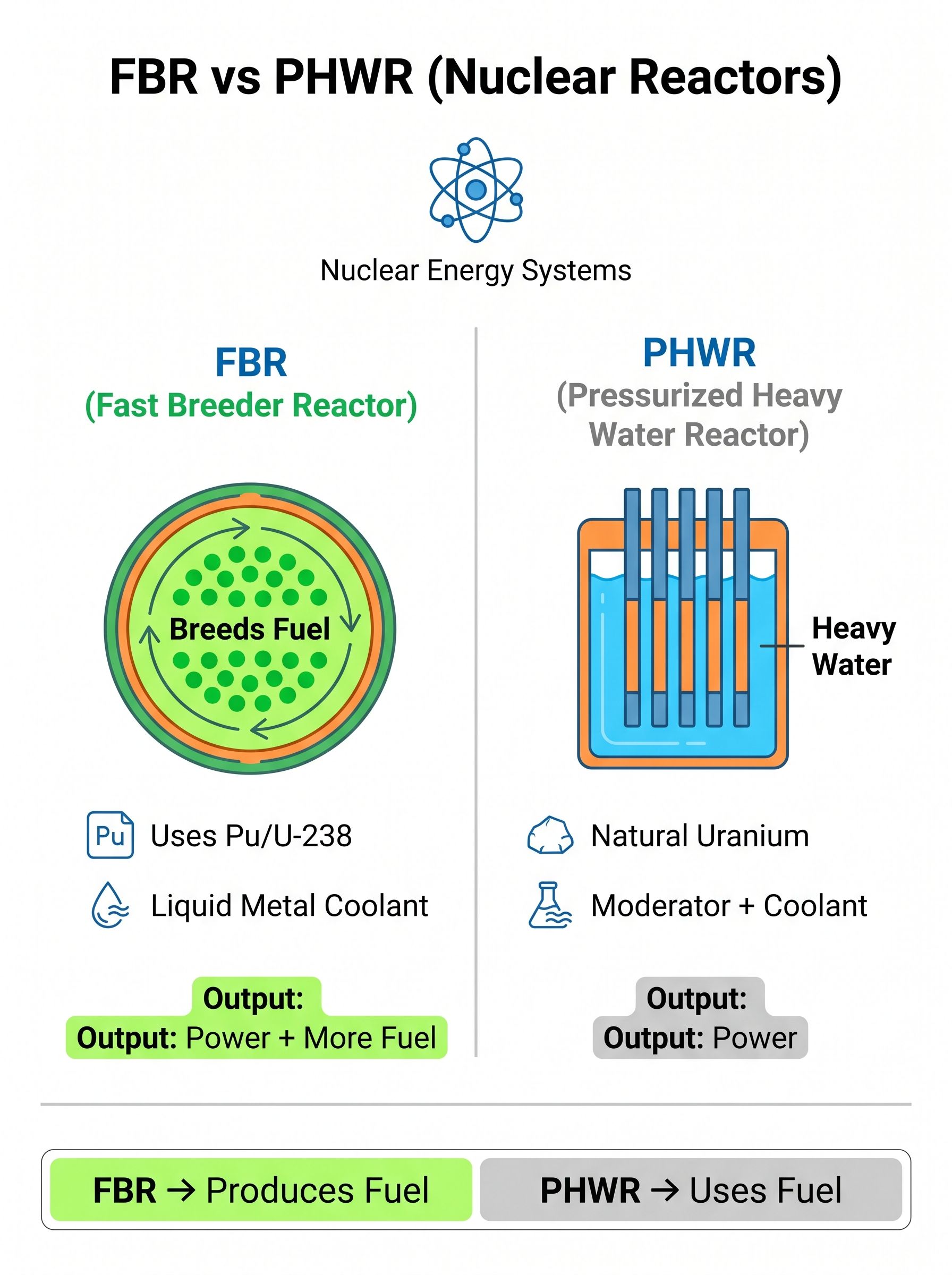
FBR vs PHWR

SuperKalam is your personal mentor for UPSC preparation, guiding you at every step of the exam journey.
Download the App


STUDY RESOURCES
CONTACT US
ⓒ Snapstack Technologies Private Limited