GS 3: EconomyPrelims
New GDP series, charting the path ahead, Pg12
New GDP series (Base Year 2022-23) released, revealing refined methodologies, challenges in data allocation, and sector-specific growth rates.
Practice MCQs
883 Students attempted
Key Highlights:
- The Ministry of Statistics and Programme Implementation released a new GDP series with the base year 2022-23 on February 27, 2026.
- The new series estimates the Indian economy's size at ₹261.18 lakh crore (FY 2022-23), ₹289.84 lakh crore (FY 2023-24), and ₹318.07 lakh crore (FY 2024-25) at current prices.
- The manufacturing sector showed high real GVA growth of 12.7% in 2023-24 and 9.3% in 2024-25.
- Private final consumption expenditure constitutes approximately 56% of the GDP.
Detailed Insights:
- The updated GDP series addresses the need for a more accurate depiction of the Indian economy by replacing the outdated 2011-12 base year.
- The relative shares of primary, secondary, and tertiary sectors in total Gross Value Added (GVA) at current prices during 2024-25 were 21.4%, 25.8%, and 52.9%, respectively.
- Refinements in the new series include segregation of multi-activity enterprises, use of industry-specific blown-up factors, comprehensive coverage of Limited Liability Partnerships (LLPs), and high-frequency data on GVA per worker.
- The new series expands the application of ‘double deflation’ and ‘volume extrapolation’ methods for estimating real GVA, aligning with international standards.
- Challenges remain in allocating national-level GVA of companies across states to derive Gross State Value Added (GSVA) due to limitations in the Annual Survey of Industries (ASI) frame.
- Addressing volatility in GVA per worker estimates from the Annual Survey of Unincorporated Sector Enterprises (ASUSE) requires methodological improvements, such as a rotating panel design.
- Updating the ASI frame using MCA and GST databases and refining the ASUSE survey methodology can further improve GDP and GSDP estimates.
Key Concepts Involved:
- GDP (Gross Domestic Product): The total monetary or market value of all the finished goods and services produced within a country’s borders in a specific time period.
- GVA (Gross Value Added): A measure of the total value of goods and services produced in an economy, less the value of intermediate consumption used in production.
- Double Deflation: A method used to calculate real GVA by separately deflating the value of output and intermediate consumption.
- Volume Extrapolation: A method used to estimate real GVA by projecting the volume of production using relevant indicators.
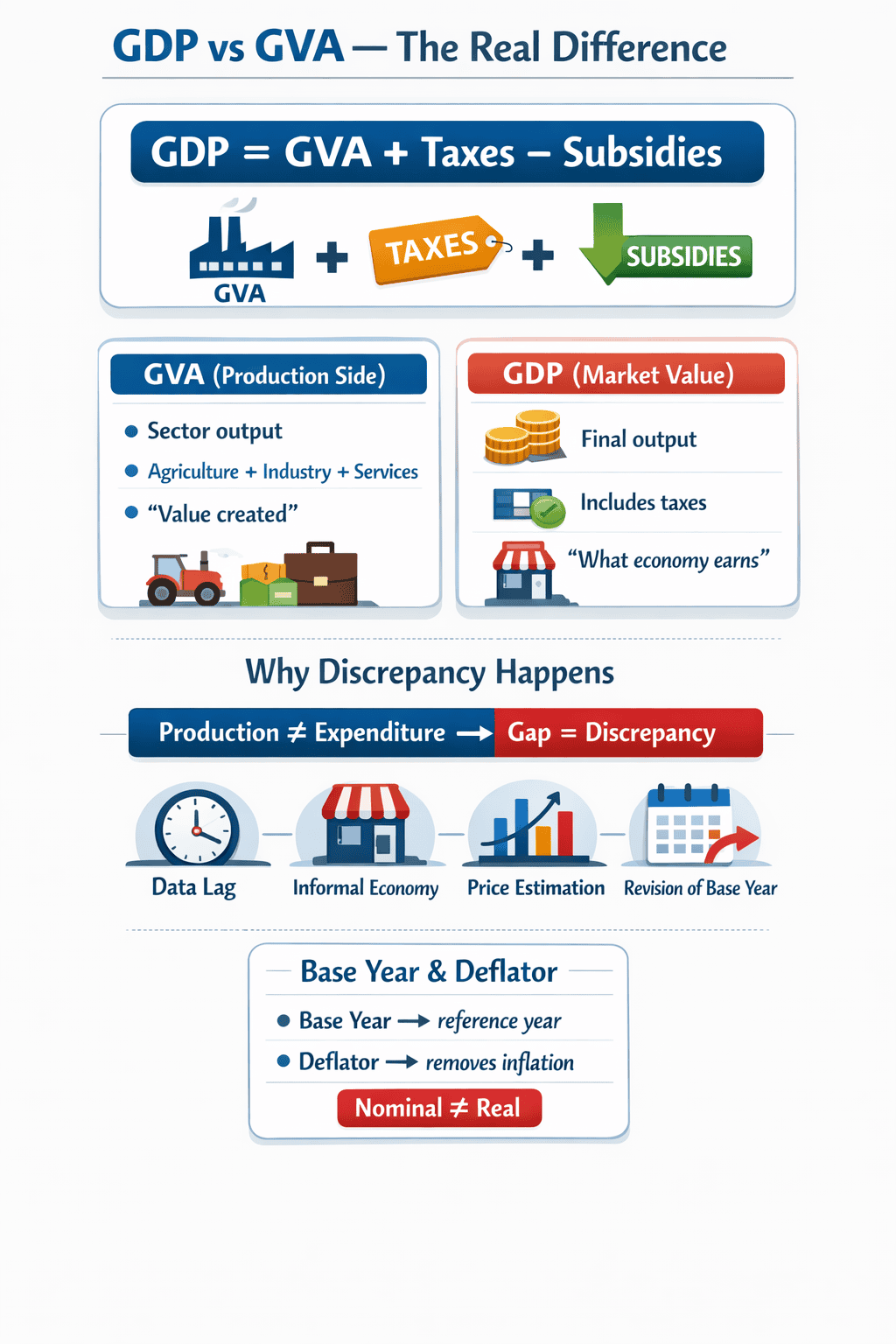
GDP vs GVA

SuperKalam is your personal mentor for UPSC preparation, guiding you at every step of the exam journey.
Download the App


STUDY RESOURCES
CONTACT US
ⓒ Snapstack Technologies Private Limited