GS 3: Science & TechnologyGS 3: EconomyPrelims
How do graphics processing units work?, Pg12
Decoding GPUs: From gaming origins to AI dominance, understand their architecture, applications, energy consumption and Nvidia's market power in AI computing.
Practice MCQs
876 Students attempted
Key Highlights:
- In 1999, Nvidia introduced the GeForce 256, considered the first GPU, to enhance video game performance.
- A GPU is a processor designed for performing numerous simple calculations simultaneously, unlike a CPU, which handles fewer, more complex tasks.
- GPUs use a rendering pipeline involving vertex processing, rasterization, fragment shading, and writing to frame buffer to display scenes.
- Neural networks utilize GPUs due to their ability to perform parallel tasks and efficiently manage large data volumes.
- Nvidia holds a significant market share in the GPU market, particularly in personal computers and data centers.
Detailed Insights:
- GPUs are optimized for repetitive tasks like determining pixel colors for a display, handling tasks such as lighting, textures and shadows.
- The rendering pipeline in GPUs involves breaking down 3D models into triangles and processing them to determine pixel colors using shaders.
- VRAM (video RAM) is dedicated memory in GPUs designed for high bandwidth to quickly move large amounts of data, complemented by caches for faster access.
- Neural networks benefit from GPUs due to their parallel processing capabilities and high memory bandwidth, essential for matrix and tensor operations.
- Nvidia's CUDA software platform enhances its market position by enabling general-purpose computation on Nvidia GPUs, creating a software ecosystem.
- European regulators are examining whether Nvidia leverages its market dominance to potentially lock customers in through pricing strategies.
Key Concepts Involved:
- GPU (Graphics Processing Unit): A processor designed to perform many simple calculations at the same time.
- CPU (Central Processing Unit): A processor designed to perform a smaller number of complicated tasks quickly.
- VRAM (Video RAM): Dedicated memory in GPUs with high bandwidth for fast data transfer.
- CUDA: Nvidia's software platform for general-purpose computation on Nvidia GPUs.
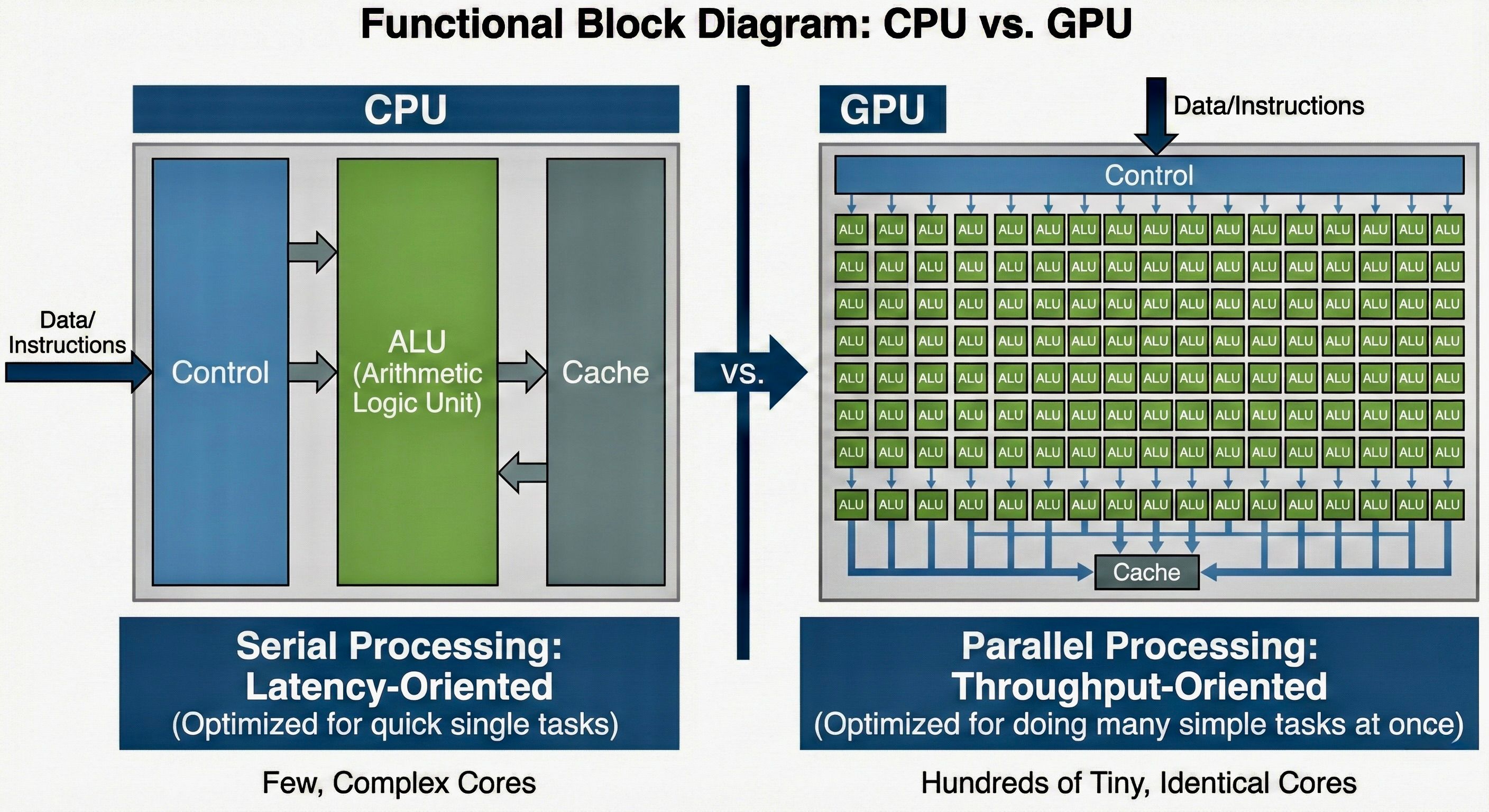
CPU vs GPU

SuperKalam is your personal mentor for UPSC preparation, guiding you at every step of the exam journey.
Download the App


STUDY RESOURCES
CONTACT US
ⓒ Snapstack Technologies Private Limited