GS 2: International RelationsPrelims
Trump and Pezeshkian sign deal to end war; U.S. lifts blockade, Pg1
US lifts Iranian port blockade after Trump-Pezeshkian deal ends West Asia war, Iran agrees to dilute uranium for economic relief.
Practice MCQs
898 Students attempted
Key Highlights:
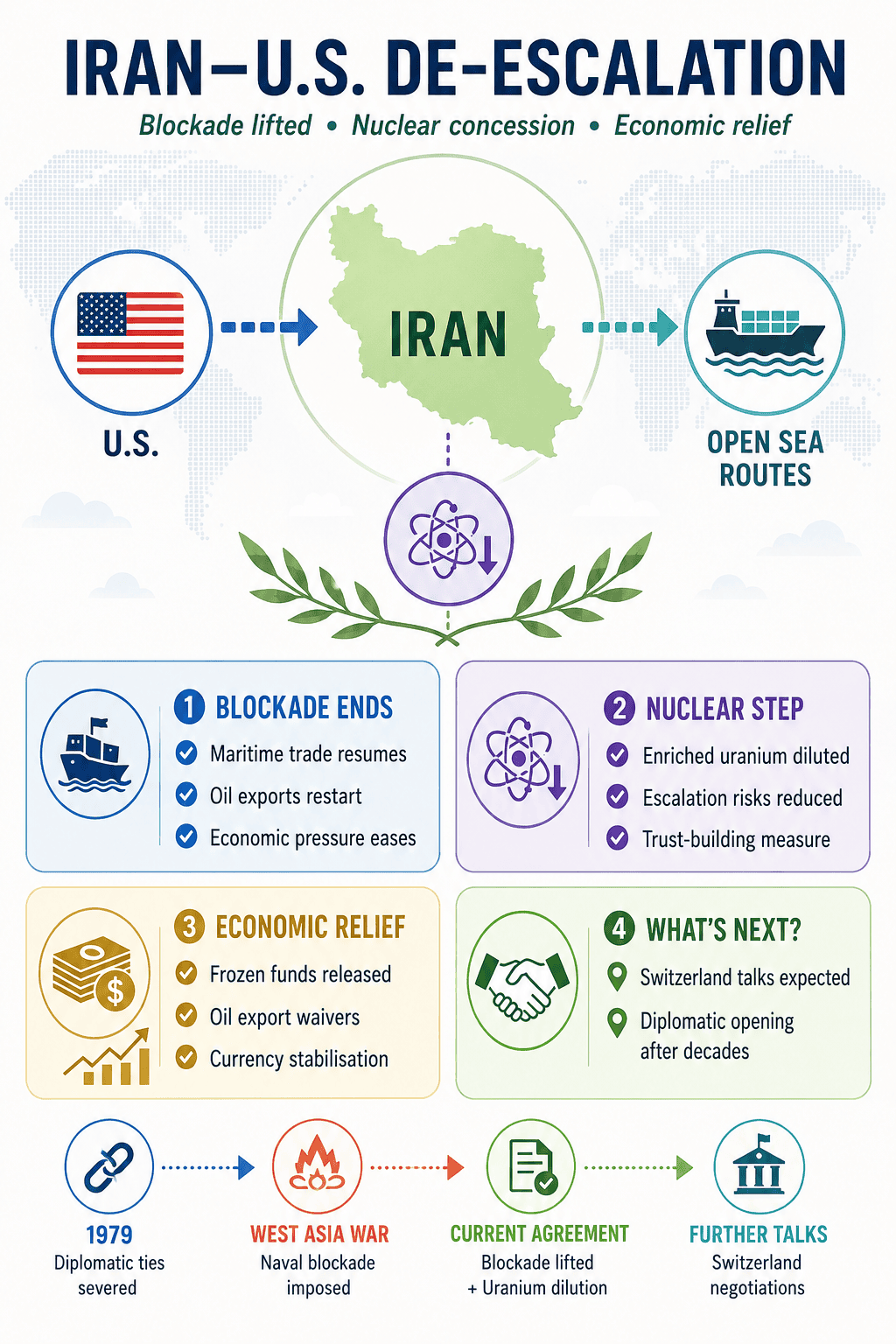
- The U.S. lifted its naval blockade on Iranian ports following a deal signed by President Donald Trump and Iranian President Masoud Pezeshkian to end the West Asia war.
- The agreement, signed on Wednesday, stipulates that Iran will dilute its enriched uranium in exchange for significant economic relief.
- Iran's Supreme Leader Ayatollah Mojtab Khamenei endorsed the talks with the U.S.
- A 60-day period has been set for further negotiations on broader issues between the two nations.
US-Iran.png
Detailed Insights:
- The lifting of the naval blockade, which had been in place during the recently concluded West Asia war, is expected to alleviate economic pressure on Iran.
- The agreement to dilute enriched uranium is a key step towards de-escalation, addressing international concerns regarding Iran's nuclear program.
- The U.S. and Iran have lacked diplomatic relations since the 1979 Islamic Revolution, making this deal a significant development in their strained history.
- The blockade had severely impacted Iran's economy by preventing maritime trade and oil exports, leading to reduced revenue and currency depreciation.
- Further talks are anticipated in Switzerland, though their exact timing and format remain uncertain.
- Economic relief for Iran is expected to include the release of frozen funds and waivers for oil exports, as outlined in a leaked Memorandum of Understanding.
Key Concepts Involved:
- Naval Blockade: A military operation to prevent vessels from entering or leaving enemy ports, often used as an economic sanction.
- Enriched Uranium: Uranium processed to increase the concentration of the fissile isotope Uranium-235, essential for nuclear power and weapons.
- Dilution of Enriched Uranium: A process to reduce the concentration of Uranium-235 in enriched uranium, making it less suitable for weapons production.
- Economic Relief: Measures, such as lifting sanctions or unfreezing assets, aimed at improving a country's economic condition.

SuperKalam is your personal mentor for UPSC preparation, guiding you at every step of the exam journey.
Download the App


STUDY RESOURCES
CONTACT US
ⓒ Snapstack Technologies Private Limited