GS 3: EconomyGS 2: International RelationsPrelims
The real barriers to trade are no longer tariffs, Pg10
Non-tariff barriers, not tariffs, now dominate global trade, impacting 90% of commerce and hindering India's FTA utilization, demanding new strategic approaches.
Practice MCQs
898 Students attempted
Key Highlights:
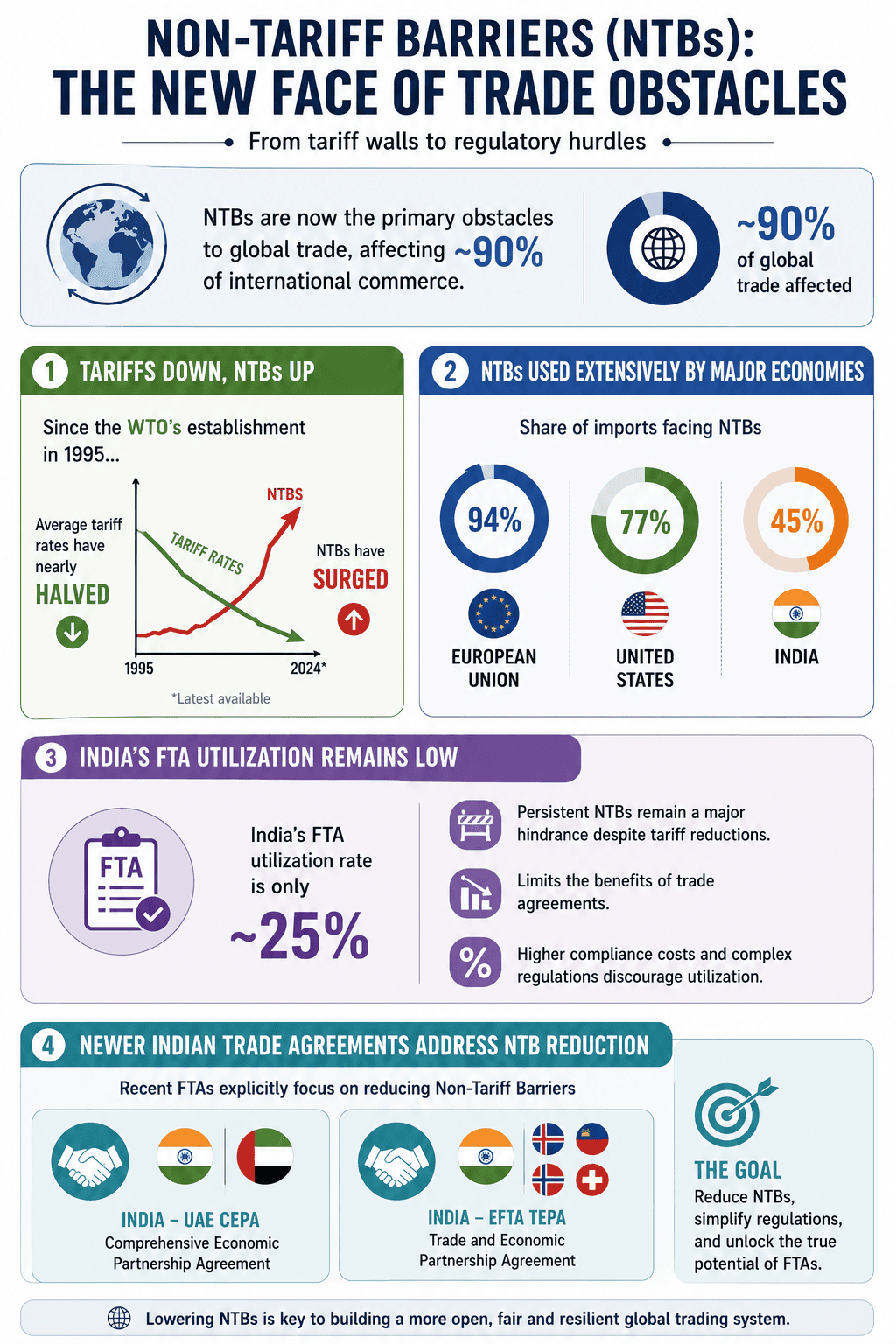
- Non-Tariff Barriers (NTBs), not tariffs, are now the primary obstacles to global trade, affecting approximately 90% of international commerce.
- Since the World Trade Organization (WTO)'s establishment in 1995, average tariff rates have nearly halved, while NTBs have surged.
- The European Union (EU) utilizes NTBs for about 94% of its imports, significantly higher than the U.S. (77%) and India (45%).
- India's Free Trade Agreement (FTA) utilization rate is low, around 25%, largely due to persistent NTBs despite tariff reductions.
- Newer Indian trade agreements, such as the UAE Comprehensive Economic Partnership Agreement (CEPA) and India-European Free Trade Association (EFTA) Trade and Economic Partnership Agreement (TEPA), explicitly address NTB reduction.
NTBs.png
Detailed Insights:
- NTBs encompass regulations, certifications, licensing rules, product requirements, technical standards, and health and safety measures.
- These regulatory hurdles are less transparent than tariffs and significantly increase compliance costs, particularly for small and medium-sized exporters.
- Over half of the 20,000 global product and safety regulations introduced in the last 70 years have emerged since 2000.
- In 2025, WTO members submitted over 7,700 notifications of NTBs, a tenfold increase compared to 1995.
- EU NTBs are concentrated in environmental rules, chemical safety, product standards, and climate policies like the Carbon Border Adjustment Mechanism (CBAM).
- U.S. NTBs are often driven by strategic competition and security concerns, involving export controls and restrictions on critical technologies.
- India is shifting its trade strategy by expanding quality regulations on imports of electronics, machinery, and chemicals to bolster domestic manufacturing.
- The ASEAN-India FTA has low preferential tariff utilization due to NTBs such as Indonesian pharmaceutical registration requirements and Thai customs procedures for gems.
- The UAE CEPA mandates automatic recognition of medicines approved by major global regulators and mutual acceptance of laboratory testing.
- The India-EFTA TEPA, in force since October 2025, includes mutual recognition of standards and a dedicated sub-committee to address NTBs, making their reduction a legally binding obligation.
Key Concepts Involved:
- Non-Tariff Barriers (NTBs): Regulations, certifications, licensing rules, and product requirements that goods must meet before entering a market.
- World Trade Organization (WTO): An intergovernmental organization that regulates and facilitates international trade among its member nations.
- Free Trade Agreement (FTA): A pact between two or more countries to reduce or eliminate tariffs and other trade barriers on goods and services.
- Carbon Border Adjustment Mechanism (CBAM): An EU policy designed to put a fair price on the carbon emitted during the production of carbon-intensive goods imported into the EU.
- EU Deforestation Regulation: An EU law aimed at minimizing the Union's contribution to global deforestation and forest degradation through its consumption of certain commodities.

SuperKalam is your personal mentor for UPSC preparation, guiding you at every step of the exam journey.
Download the App


STUDY RESOURCES
CONTACT US
ⓒ Snapstack Technologies Private Limited