GS 2: International RelationsGS 1: World GeographyGS 3: EconomyGS 3: Environment & EcologyPrelims
Thailand revives $30bn coast-to-coast corridor, Pg16
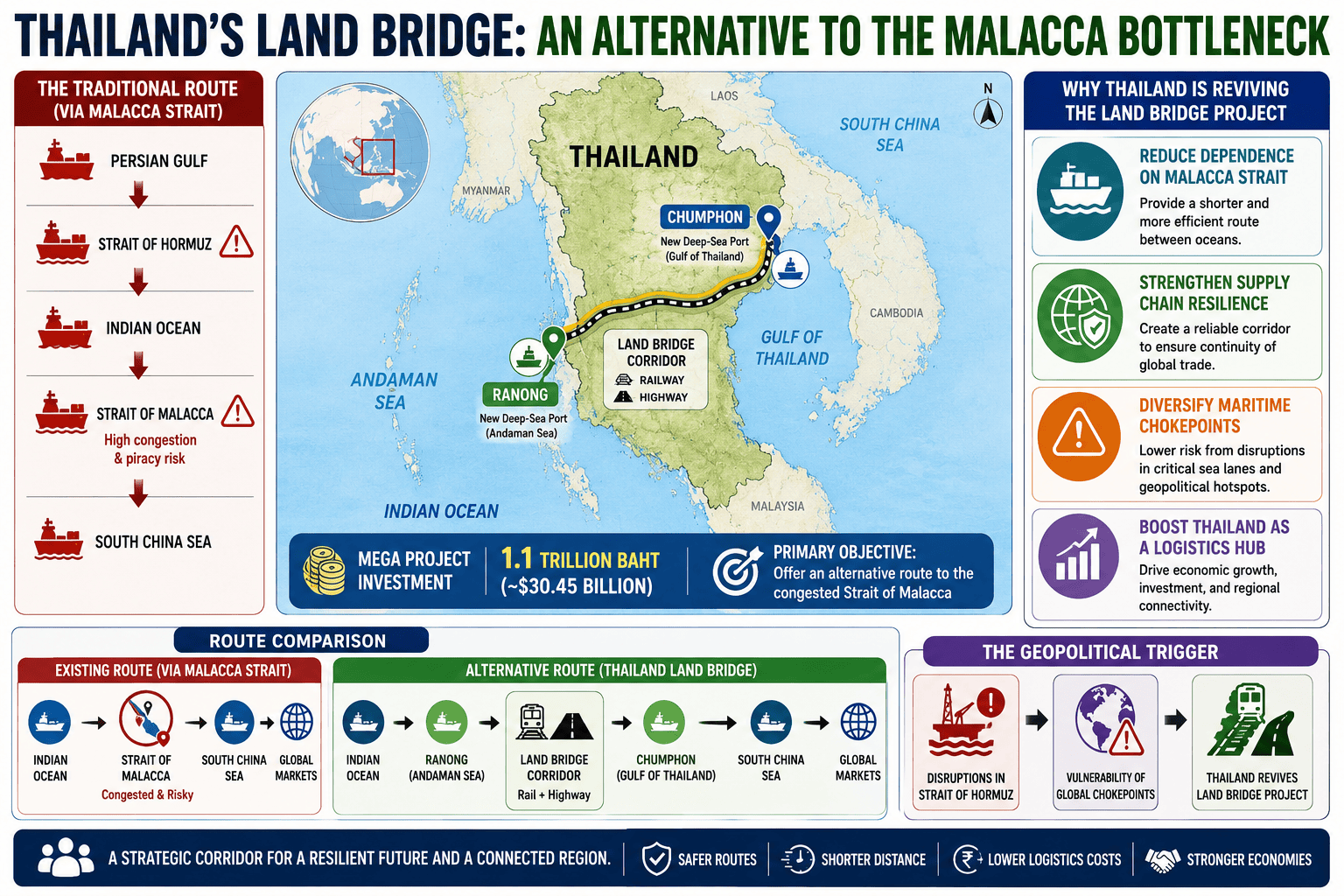
Thailand revives $30.45 billion 'Land Bridge' project, linking Andaman Sea to Gulf of Thailand, to bypass congested Malacca Strait amid global chokepoint concerns.
Practice MCQs
898 Students attempted
Key Highlights:
- Thailand is reviving a Land Bridge project, a logistics corridor estimated at 1.1 trillion baht ($30.45 billion).
- The project aims to connect new deep-sea ports in Chumphon on the Gulf of Thailand and Ranong on the Andaman Sea.
- Its primary objective is to offer an alternative route to the congested Strait of Malacca.
- The revival is driven by geopolitical concerns, including disruptions in the Strait of Hormuz, highlighting the vulnerability of global maritime chokepoints.
Land Bridge.png
Detailed Insights:
- The Land Bridge project involves constructing two deep-sea ports, a railway, and road infrastructure across approximately 90 kilometers of Thailand's southern peninsula.
- This initiative seeks to enhance Thailand's role as a regional logistics hub by facilitating cargo transshipment between the Indian and Pacific Oceans.
- Local communities, particularly fishing hamlets in areas like Had Sai Dam, have expressed opposition due to potential impacts on their livelihoods and the environment.
- While analysts consider the project economically ambitious and unlikely to fully compete with the Strait of Malacca as a global transit route, it could serve as a strategic corridor for Thailand.
- Anutin Charnvirakul, Deputy Prime Minister and Minister of Interior, is a key proponent, emphasizing the project's importance for national interest and self-reliance in transport.
- The project is currently under review by a government-appointed panel, with findings and a new environmental and health impact assessment expected soon.
Key Concepts Involved:
- Land Bridge: A multimodal transportation system connecting two seaports across a landmass, designed to bypass traditional maritime routes.
- Strait of Malacca: A narrow, vital shipping lane between the Malay Peninsula and Sumatra, connecting the Indian Ocean and the Pacific Ocean, crucial for global trade.
- Strait of Hormuz: A critical chokepoint between the Persian Gulf and the Gulf of Oman, essential for a significant portion of the world's oil and liquefied natural gas shipments.
- Deep-sea ports: Ports with sufficient water depth to accommodate large, modern container ships and oil tankers, facilitating efficient global trade.

SuperKalam is your personal mentor for UPSC preparation, guiding you at every step of the exam journey.
Download the App


STUDY RESOURCES
CONTACT US
ⓒ Snapstack Technologies Private Limited