GS 3: EconomyGS 2: Social JusticeGS 3: Science & TechnologyGS 2: GovernancePrelims
Is India producing more graduates than what the economy can absorb?, Pg11
India's higher education boom creates millions of graduates, but a widening skill gap and AI disruption fuel educated unemployment crisis.
Practice MCQs
898 Students attempted
Key Highlights:
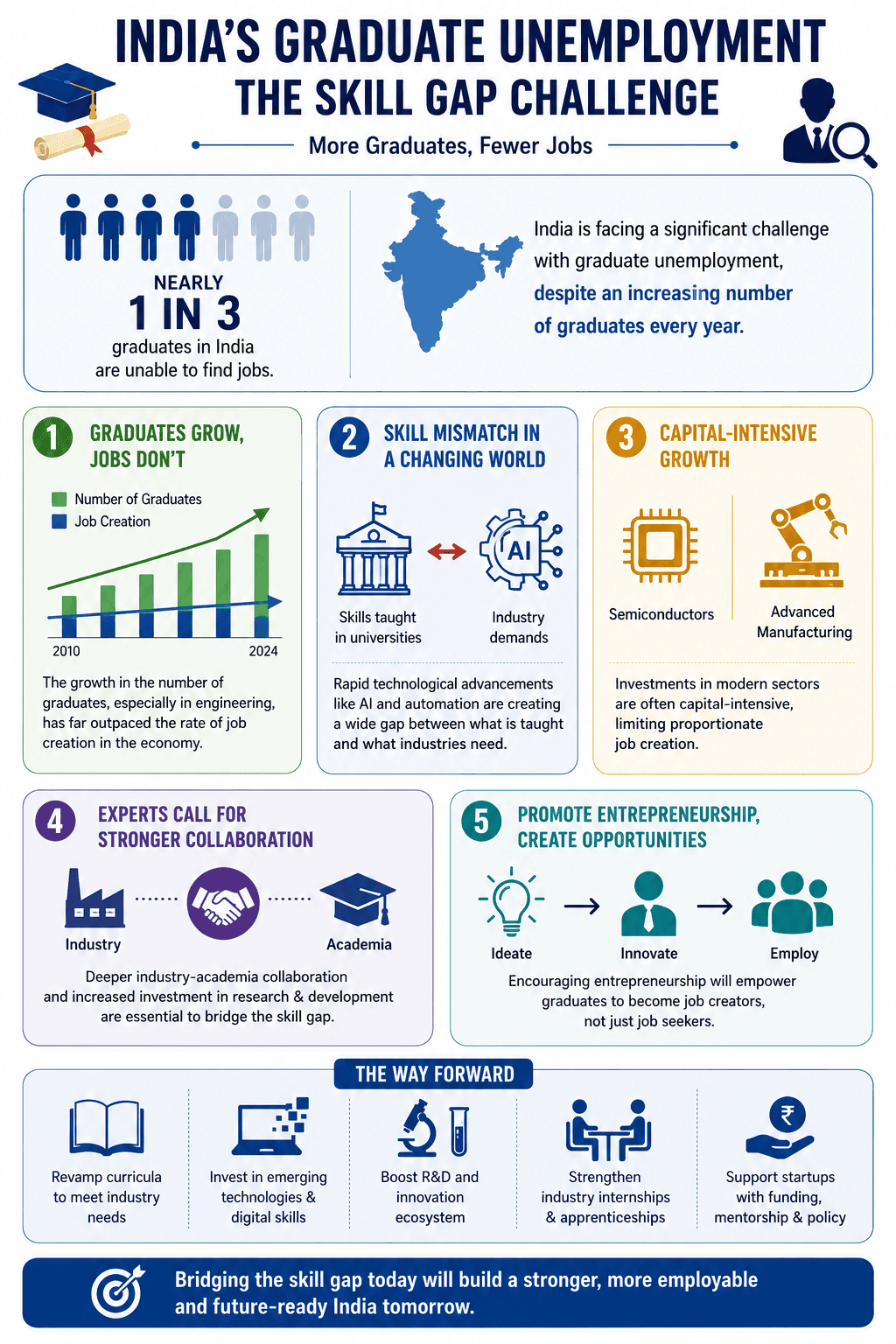
- India is experiencing a significant challenge with graduate unemployment, with nearly one in three graduates unable to find jobs.
- The growth in the number of graduates, particularly in engineering, has outpaced the rate of job creation in the economy.
- Rapid technological advancements, including artificial intelligence and automation, are creating a mismatch between skills taught in universities and industry demands.
- Investments in modern sectors like semiconductors and advanced manufacturing are often capital-intensive, limiting proportionate job creation.
- Experts advocate for deeper industry-academia collaboration and increased investment in research and development to address the skill gap.
- There is a strong emphasis on fostering entrepreneurship to encourage graduates to become job creators rather than just job seekers.
Graduate unemployment.png
Detailed Insights:
- The IT services sector, historically a major employer for engineering graduates, has significantly slowed its hiring pace.
- While new opportunities exist in banking, financial services, manufacturing, defence, and space technologies, their growth has not been sufficient to absorb the increasing number of graduates.
- Companies now seek graduates proficient in working with AI systems, validating AI-generated outputs, and understanding ethical AI use.
- Manufacturing is undergoing transformation due to automation, robotics, and Industry 4.0, reducing the need for traditional supervisory and operational roles.
- India's push for self-reliance in sectors like defence and aerospace is generating new opportunities, but automation limits overall employment growth.
- Investing aggressively in indigenous research, development, and design is crucial for creating high-value opportunities and reducing dependence on external technologies.
- The startup ecosystem requires further support, especially for deep-technology ventures, to facilitate innovation and risk-taking among entrepreneurs.
- India should focus on developing sovereign AI products for global markets, drawing inspiration from the success of platforms like UPI.
- Higher education curricula must be closely aligned with industry requirements through enhanced industry-academia collaboration, including internships and skill development.
Key Concepts Involved:
- Jobless Growth: Economic growth that does not lead to a significant increase in employment opportunities.
- Skill Mismatch: A discrepancy between the skills possessed by job seekers and the skills required by employers.
- Industry 4.0: The ongoing automation of traditional manufacturing and industrial practices, using smart technology.
- Sovereign AI: Artificial intelligence systems and capabilities developed and controlled domestically by a nation.

SuperKalam is your personal mentor for UPSC preparation, guiding you at every step of the exam journey.
Download the App


STUDY RESOURCES
CONTACT US
ⓒ Snapstack Technologies Private Limited