GS 3: EconomyGS 2: GovernanceGS 2: Social JusticePrelims
A decade of empowerment, from reform to rozgar, Pg12
Modi government launches ambitious Rs 1 lakh crore PM Viksit Bharat Rozgar Yojana, targeting 3.5 crore jobs, capping a decade of economic growth and social security expansion.
Practice MCQs
898 Students attempted
Key Highlights:
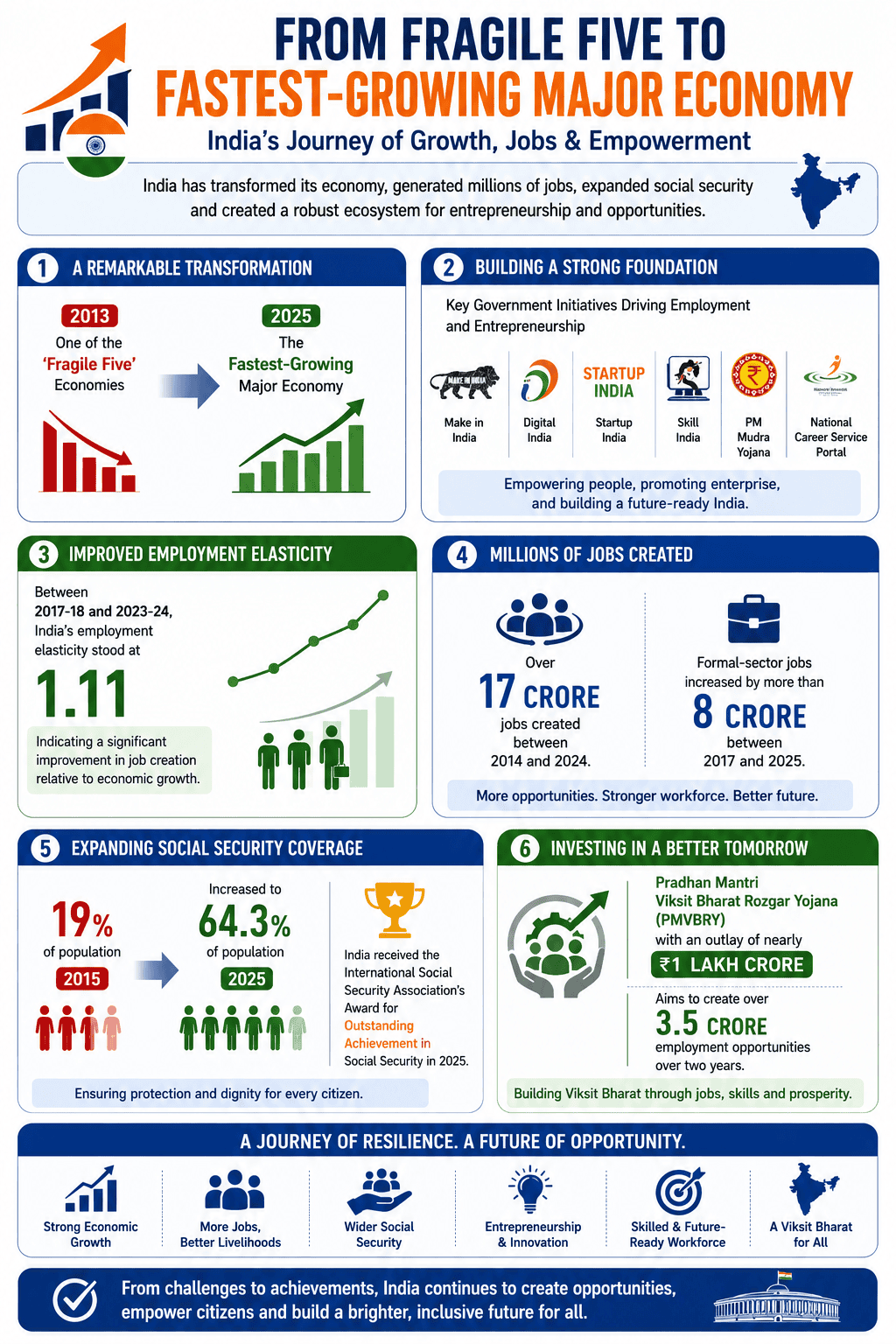
- India has transitioned from being one of the "Fragile Five" economies in 2013 to the fastest-growing major economy.
- The government launched initiatives like Make in India, Digital India, Startup India, Skill India, PM Mudra Yojana, and the National Career Service portal to boost employment and entrepreneurship.
- Between 2017-18 and 2023-24, India's employment elasticity stood at 1.11, indicating a significant improvement in job creation relative to economic growth.
- Over 17 crore jobs were created between 2014 and 2024, with formal-sector jobs increasing by more than 8 crore between 2017 and 2025.
- Social security coverage expanded from 19% of the population in 2015 to 64.3% in 2025, leading to India receiving the International Social Security Association’s Award for Outstanding Achievement in Social Security in 2025.
- The Pradhan Mantri Viksit Bharat Rozgar Yojana (PMVBRY), with an outlay of nearly ₹1 lakh crore, aims to create over 3.5 crore employment opportunities over two years.
Reform to Rozgar.png
Detailed Insights:
- India's economic transformation over the past 12 years is attributed to empowerment, good governance, and inclusive development.
- The country has emerged as a leader in Digital Public Infrastructure and strengthened its global standing.
- The initiatives like Make in India and Digital India leverage India's demographic dividend by focusing on youth power.
- The employment rate is projected to increase from 46.8% in 2017-18 to 57.4% in 2025, with unemployment declining to around 3.1%.
- The PMVBRY includes two parts: Part A provides financial assistance of up to ₹15,000 to first-time employees in two installments, and Part B offers incentives of up to ₹3,000 per employee per month to employers for additional workers.
- Incentives under PMVBRY are provided for up to four years for manufacturing employers and up to two years in other sectors.
- The scheme aims to reward work, make jobs more attractive, and generate positive cyclical impacts on industrial growth.
- Prime Minister Modi disbursed incentives worth ₹2,400 crore to 15 lakh beneficiaries through Direct Benefit Transfer under PMVBRY.
Key Concepts Involved:
- Fragile Five: A term coined in 2013 for emerging market economies (Brazil, India, Indonesia, South Africa, Turkey) heavily reliant on foreign investment, making them vulnerable to external shocks.
- Employment Elasticity: The percentage change in employment for every one percent change in economic growth (Gross Value Added or GDP).
- Digital Public Infrastructure (DPI): Shared digital platforms and systems (like Aadhaar, UPI) that operate at a societal scale, enabling efficient delivery of public and private services.
- Direct Benefit Transfer (DBT): A system where government subsidies and benefits are transferred directly to beneficiaries' bank accounts, reducing leakages and increasing efficiency.

SuperKalam is your personal mentor for UPSC preparation, guiding you at every step of the exam journey.
Download the App


STUDY RESOURCES
CONTACT US
ⓒ Snapstack Technologies Private Limited