GS 2: PolityGS 2: GovernancePrelims
‘Why delay the 2023 Act?’: women’s reservation comes full circle as govt.’s ‘U-turn’ fails in LS, Pg6
Government's attempt to fast-track women's reservation fails in Lok Sabha; Opposition renews demand for immediate implementation without census and delimitation.
Practice MCQs
883 Students attempted
Key Highlights:
- The Constitution (106th Amendment) Act, 2023, mandating 33% reservation for women in the Lok Sabha and State legislatures, has seen significant developments.
- In 2026, the government introduced the Constitution (131st Amendment) Bill to implement women's reservation immediately, using the 2011 Census data.
- The 131st Amendment Bill failed to pass in the Lok Sabha on April 17, 2026, due to a lack of special majority.
- The government operationalized the 106th Amendment Act on April 16, 2026, amidst debates on the unsuccessful 131st Amendment.
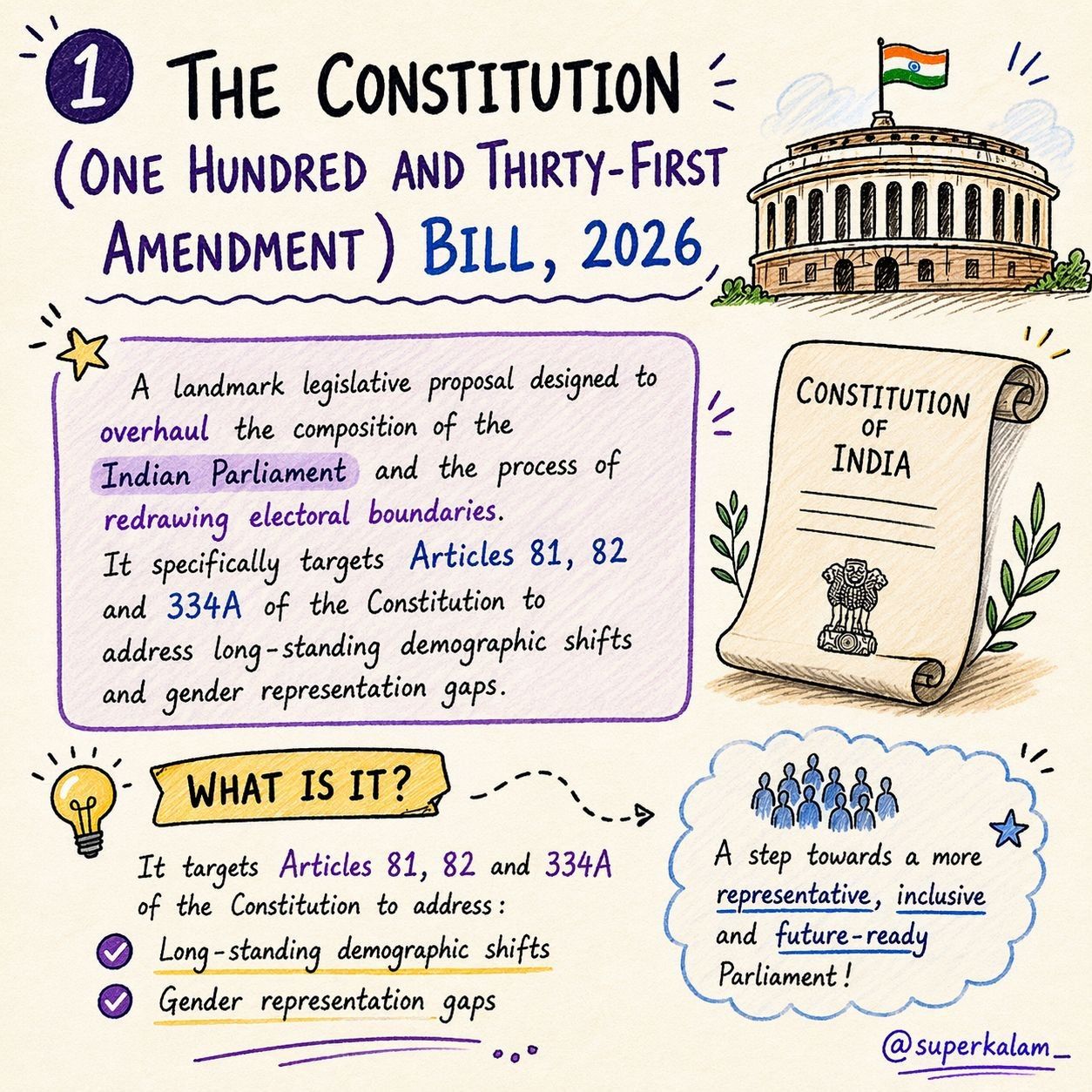
IMAGE 2026-04-19 08:06:59.jpg
Detailed Insights:
- The 106th Amendment Act required a fresh Census and delimitation exercise before the women's reservation could be implemented, a point of contention with the Opposition in 2023.
- The 131st Amendment Bill aimed to bypass the requirement for a new Census and delimitation, citing potential delays in ensuring women's participation in the democratic process.
- The Opposition has renewed its demand to remove the clause in Article 334A(1) of the 106th Amendment that mandates a fresh Census and delimitation before implementing women's reservation.
- A petition was filed in 2023 urging the Supreme Court to declare the clause requiring a fresh Census and delimitation as unconstitutional, but the court dismissed it.
Key Concepts Involved:
- Delimitation: The process of redrawing the boundaries of parliamentary or assembly constituencies to reflect changes in population.
- Census: A periodic count of a country's population, including details on demographics, used for policy planning and resource allocation.
- Article 334A: Provision in the Constitution (106th Amendment) Act, 2023, that stipulates conditions for the implementation of women's reservation.

SuperKalam is your personal mentor for UPSC preparation, guiding you at every step of the exam journey.
Download the App


STUDY RESOURCES
CONTACT US
ⓒ Snapstack Technologies Private Limited