GS 2: PolityGS 2: GovernanceGS 2: Social JusticePrelims
Rural workers, activists call for repeal of new jobs Act; to stage protest from July 1, Pg12
Rural workers launch indefinite protest against new VB-G RAM G Act replacing MGNREGA, citing insufficient funds and state burden, demanding repeal from July 1.
Practice MCQs
891 Students attempted
Key Highlights:
- The NREGA Sangharsh Morcha and the Joint Platform for Agricultural and Rural Workers’ Unions announced an indefinite protest starting July 1.
- The protest demands the repeal of the new Viksit Bharat-Guarantee for Rozgar and Ajeevika Mission (Gramin) (VB-G RAM G) scheme.
- VB-G RAM G is set to replace the Mahatma Gandhi National Rural Employment Guarantee Act (MGNREGA) on July 1, 2026.
- Activists claim the new scheme's budgetary allocation would provide only 42 days of work per household annually, despite promising 125 days.
- A key concern is the requirement for states to contribute 40% of the program's cost, which was largely borne by the Centre under MGNREGA.
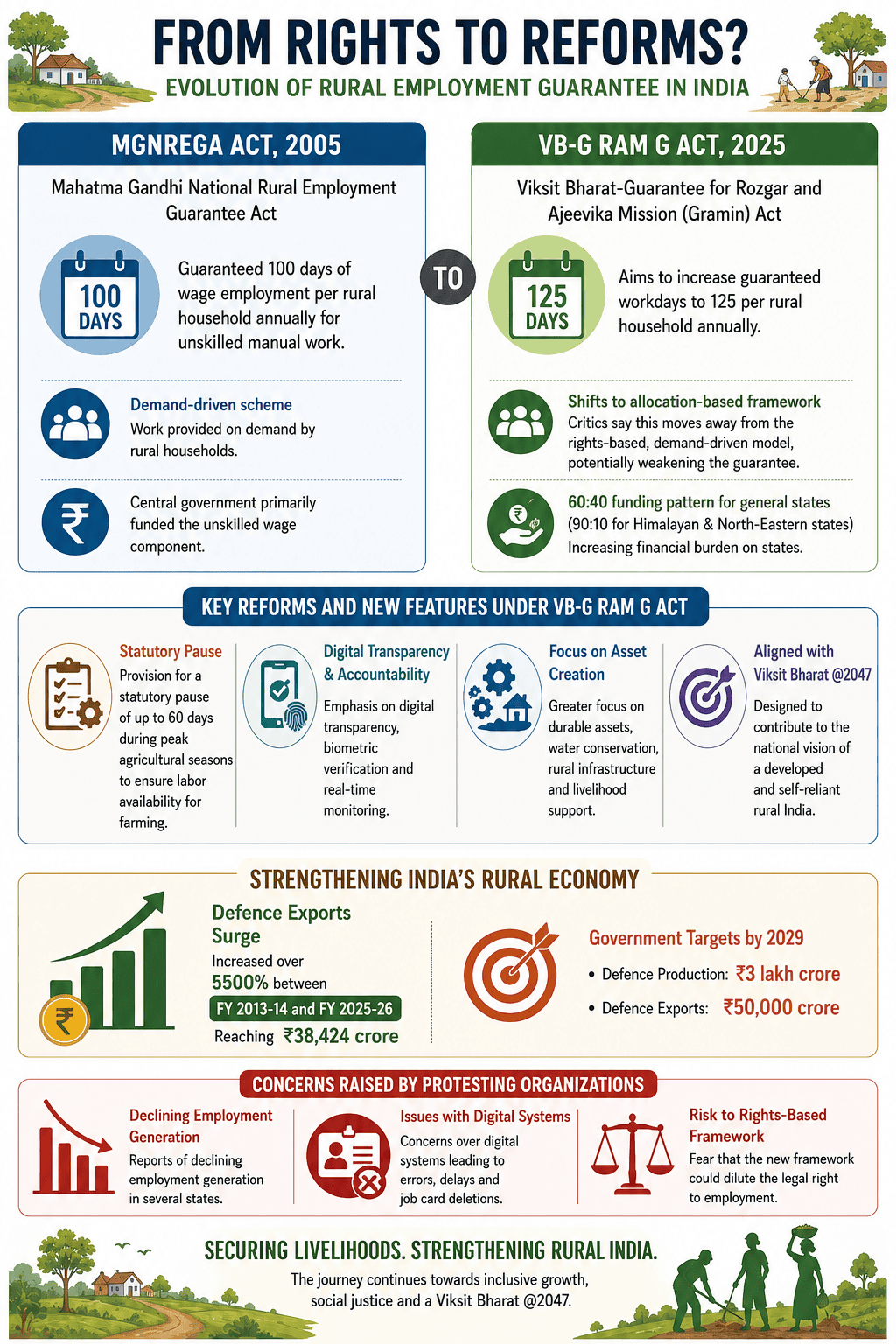
MGNREGA vs VBGRAMG.png
Detailed Insights:
- The Mahatma Gandhi National Rural Employment Guarantee Act (MGNREGA), enacted in 2005, guaranteed 100 days of wage employment per rural household annually for unskilled manual work.
- MGNREGA was a demand-driven scheme where the central government primarily funded the unskilled wage component.
- The Viksit Bharat-Guarantee for Rozgar and Ajeevika Mission (Gramin) (VB-G RAM G) Act, passed in December 2025, aims to increase the guaranteed workdays to 125 per rural household.
- Critics argue that VB-G RAM G shifts from a rights-based, demand-driven model to an allocation-based framework, potentially weakening the employment guarantee.
- The new scheme introduces a 60:40 Centre-State funding pattern for general states (90:10 for Himalayan and North-Eastern states), increasing the financial burden on states.
- VB-G RAM G also includes provisions for a statutory pause of up to 60 days during peak agricultural seasons to ensure labor availability for farming.
- The scheme emphasizes digital transparency, biometric verification, and alignment with the national vision of Viksit Bharat @2047, focusing on asset creation and rural infrastructure.
- Protesting organizations highlight concerns over declining employment generation in several states and issues with digital systems leading to job card deletions.
Key Concepts Involved:
- Mahatma Gandhi National Rural Employment Guarantee Act (MGNREGA): A social welfare measure enacted in 2005 guaranteeing 100 days of wage employment to rural households.
- Viksit Bharat-Guarantee for Rozgar and Ajeevika Mission (Gramin) (VB-G RAM G): A new rural employment legislation replacing MGNREGA, aiming for 125 days of guaranteed work with revised funding and implementation mechanisms.
- Viksit Bharat @2047: A long-term vision of the Government of India for a developed India by 2047, with which the VB-G RAM G scheme is aligned.

SuperKalam is your personal mentor for UPSC preparation, guiding you at every step of the exam journey.
Download the App


STUDY RESOURCES
CONTACT US
ⓒ Snapstack Technologies Private Limited