GS 3: Environment & EcologyGS 2: GovernancePrelims
'Partial burning' continues to be key hurdle in tackling farm fire pollution: Study, Pg4
CEEW study highlights "partial burning" by farmers, driven by pest fears and cost, as a key hurdle in tackling severe stubble burning pollution.
Practice MCQs
891 Students attempted
Key Highlights:
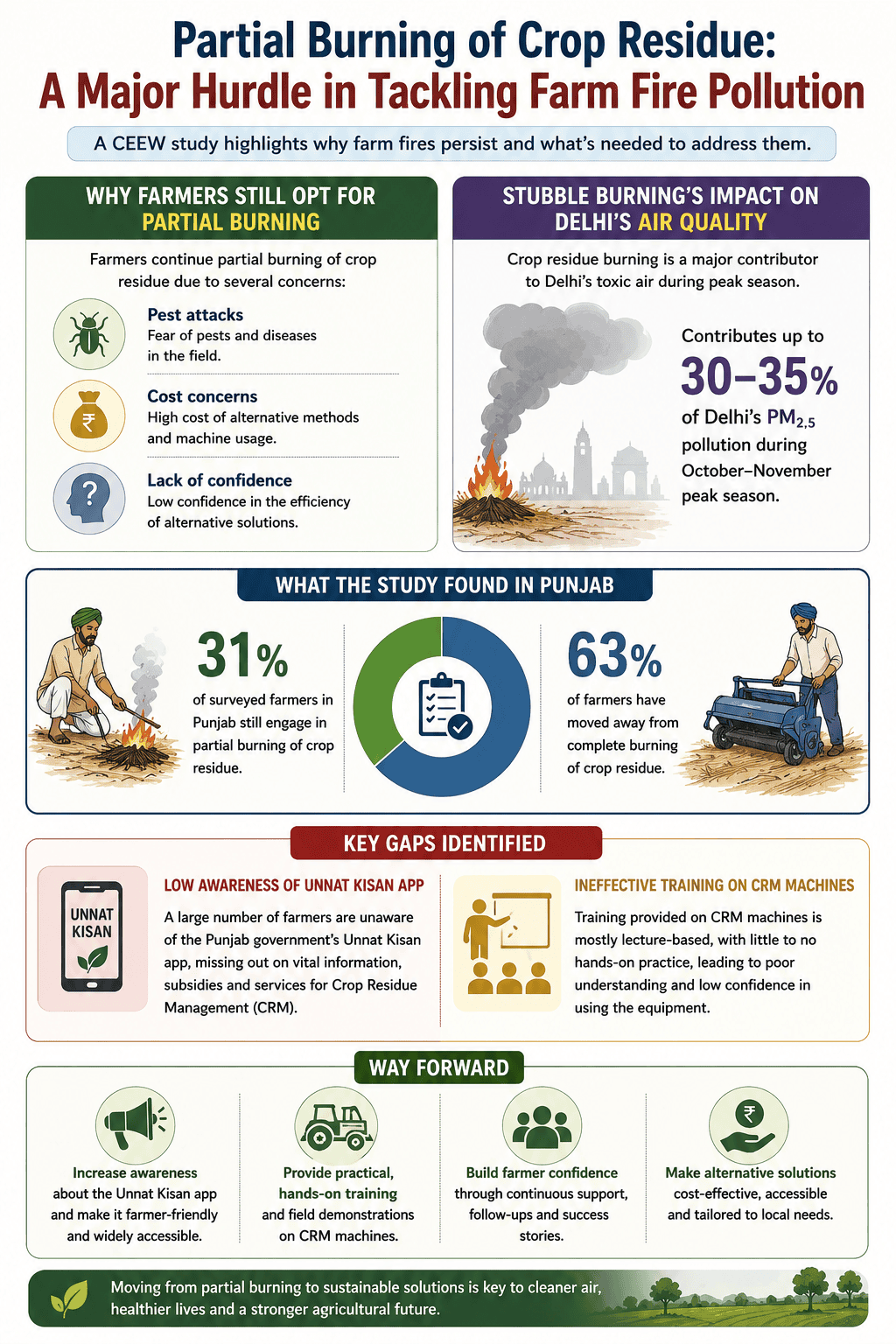
- A study by the Council on Energy, Environment and Water (CEEW) identifies "partial burning" of crop residue as a significant challenge in tackling farm fire pollution.
- Farmers continue partial burning due to concerns like pest attacks, cost, and lack of confidence in alternative methods.
- Stubble burning contributes up to 30-35% of Delhi’s PM2.5 pollution during the October-November peak season.
- The study found that 31% of surveyed farmers in Punjab still engage in partial burning, despite 63% moving away from complete burning.
- Low awareness of the Punjab government's Unnat Kisan app and ineffective, lecture-based training for Crop Residue Management (CRM) machines were noted.
Partial Burning.png
Detailed Insights:
- The CEEW is a New Delhi-based non-profit policy institution and think tank focused on energy, environment, and water issues.
- PM2.5 refers to fine particulate matter with a diameter of 2.5 micrometers or less, which can penetrate deep into the respiratory system and bloodstream, posing severe health risks.
- Research by the Indian Space Research Organisation (ISRO) indicates a shift in stubble burning times, with farmers burning later in the day to avoid satellite detection, leading to potential underestimation of fire incidents.
- The study recommends implementing a dedicated Behaviour Change Communication (BCC) strategy under the Crop Residue Management (CRM) scheme, tailoring messages to different farmer groups.
- CRM involves both in-situ methods like incorporating residue into the soil and ex-situ methods such as using residue for biomass power generation or composting.
- Government initiatives like the Sub-Mission on Agricultural Mechanization (SMAM) provide financial assistance for CRM machines and support the establishment of Custom Hiring Centres (CHCs) to make equipment accessible to farmers.
- The Commission for Air Quality Management (CAQM) is a statutory body responsible for coordinating and implementing measures to improve air quality in the National Capital Region and adjoining areas, including addressing stubble burning.
- The National Clean Air Programme (NCAP) is a government initiative aimed at reducing particulate matter concentrations in non-attainment cities across India.
Key Concepts Involved:
- Crop Residue Management (CRM): Methods and technologies used to manage leftover crop material after harvest, either by incorporating it into the soil or removing it for alternative uses.
- PM2.5: Fine inhalable particulate matter, with diameters generally 2.5 micrometers and smaller, which poses significant health and environmental hazards.
- Behaviour Change Communication (BCC): A strategic and research-based communication approach designed to encourage individuals and communities to adopt positive behaviors by addressing underlying knowledge, attitudes, and practices.

SuperKalam is your personal mentor for UPSC preparation, guiding you at every step of the exam journey.
Download the App


STUDY RESOURCES
CONTACT US
ⓒ Snapstack Technologies Private Limited