GS 3: EconomyGS 2: GovernanceGS 2: PolityPrelims
Measuring the economy, from the ground up, Pg11
NITI Aayog mandates district-level GDP estimates, revolutionizing bottom-up economic planning, fiscal devolution, and India's 'Viksit Bharat' vision by 2047.
Practice MCQs
891 Students attempted
Key Highlights:
- NITI Aayog's recent governing council meeting signaled a shift towards measuring economic performance at the district level through district-level GDP estimates.
- This initiative aims to address the historical top-down economic measurement approach, which assumed growth percolation but often bypassed local realities.
- The Aspirational Districts Programme, launched in 2018, highlighted the need for robust economic baselines at the district level.
- The 15th Finance Commission and 16th Finance Commission have advocated for greater fiscal devolution to district administrations, which district GDP can support.
- The move is crucial for achieving the vision of Viksit Bharat by 2047 by providing granular data for policy precision and addressing issues like distress migration.
District-level GDP.png
Detailed Insights:
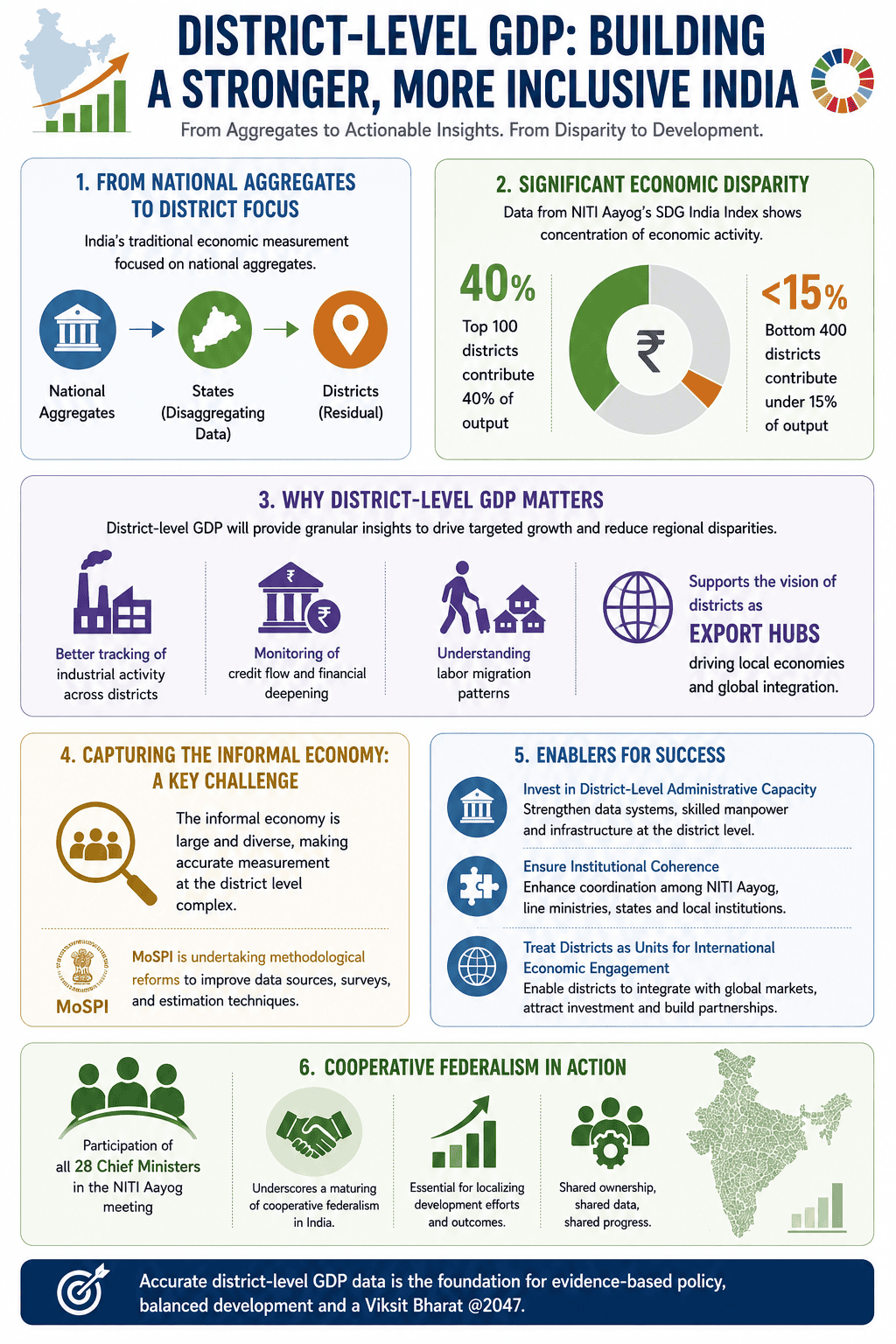
- India's traditional economic measurement focused on national aggregates, with states disaggregating data and districts being residual.
- Data from NITI Aayog's SDG India Index shows significant economic disparity, with top 100 districts contributing 40% of output, while bottom 400 contribute under 15%.
- District-level GDP will enable better tracking of industrial activity, credit flow, and labor migration, supporting the vision of districts as export hubs.
- The Ministry of Statistics and Programme Implementation (MoSPI) is working on methodological reforms to accurately capture the informal economy, which presents a significant challenge for district-level data.
- Success of this initiative requires investment in district-level administrative capacity, institutional coherence among planning bodies, and treating districts as units for international economic engagement.
- The participation of all 28 chief ministers in the NITI Aayog meeting underscores a maturing of cooperative federalism, essential for localizing development efforts.
Key Concepts Involved:
- District-level GDP: Economic metric measuring the total value of goods and services produced within a specific administrative district.
- Fiscal Devolution: Transfer of financial powers and resources from higher levels of government to lower, local levels.
- Cooperative Federalism: A principle where the central and state governments cooperate in the formulation and implementation of policies.
- Viksit Bharat by 2047: India's vision to become a developed nation by the 100th year of its independence.

SuperKalam is your personal mentor for UPSC preparation, guiding you at every step of the exam journey.
Download the App


STUDY RESOURCES
CONTACT US
ⓒ Snapstack Technologies Private Limited