GS 1: Physical GeographyGS 3: Environment & EcologyPrelims
Snowball earth: not quite still, PgII
Study reveals climate cycles persisted during 'snowball earth' period, challenging the idea of a static frozen world.
Practice MCQs
862 Students attempted
Key Highlights:
- A new study analyzed sediment layers from the Cryogenian Period (720-635 million years ago) in Scotland.
- The study found evidence of short climate cycles during a phase of the "snowball earth" period.
- Researchers identified climate cycles matching solar cycles of 9-11 years (sunspot cycle) and 60-150 years (Gleissberg cycle).
- Climate simulations of snowball earth also showed a variability of two to three years, similar to El Nino.
Detailed Insights:
- The "snowball earth" theory suggests the Earth was covered in ice, even in tropical regions, during the Cryogenian Period.
- The research team analyzed 2,640 layers of sediment in the Port Askaig Formation on the Garvellach Islands in Scotland, interpreting them as annual varves.
- Thickness variations in the sediment layers revealed climate cycles corresponding to known solar cycles, indicating climate activity during the "snowball earth" period.
- The discovery suggests that even with extensive ice cover, the Earth's climate exhibited variability on timescales of years to centuries.
Scientific/Technical Concepts Involved:
- Cryogenian Period: A geological period from 720 to 635 million years ago characterized by extreme global glaciation.
- Varves: Annual layers of sediment, often found in glacial lakes, that can provide a record of past climate conditions.
- Sunspot Cycle: An approximately 11-year cycle in the Sun's activity, characterized by variations in the number of sunspots.
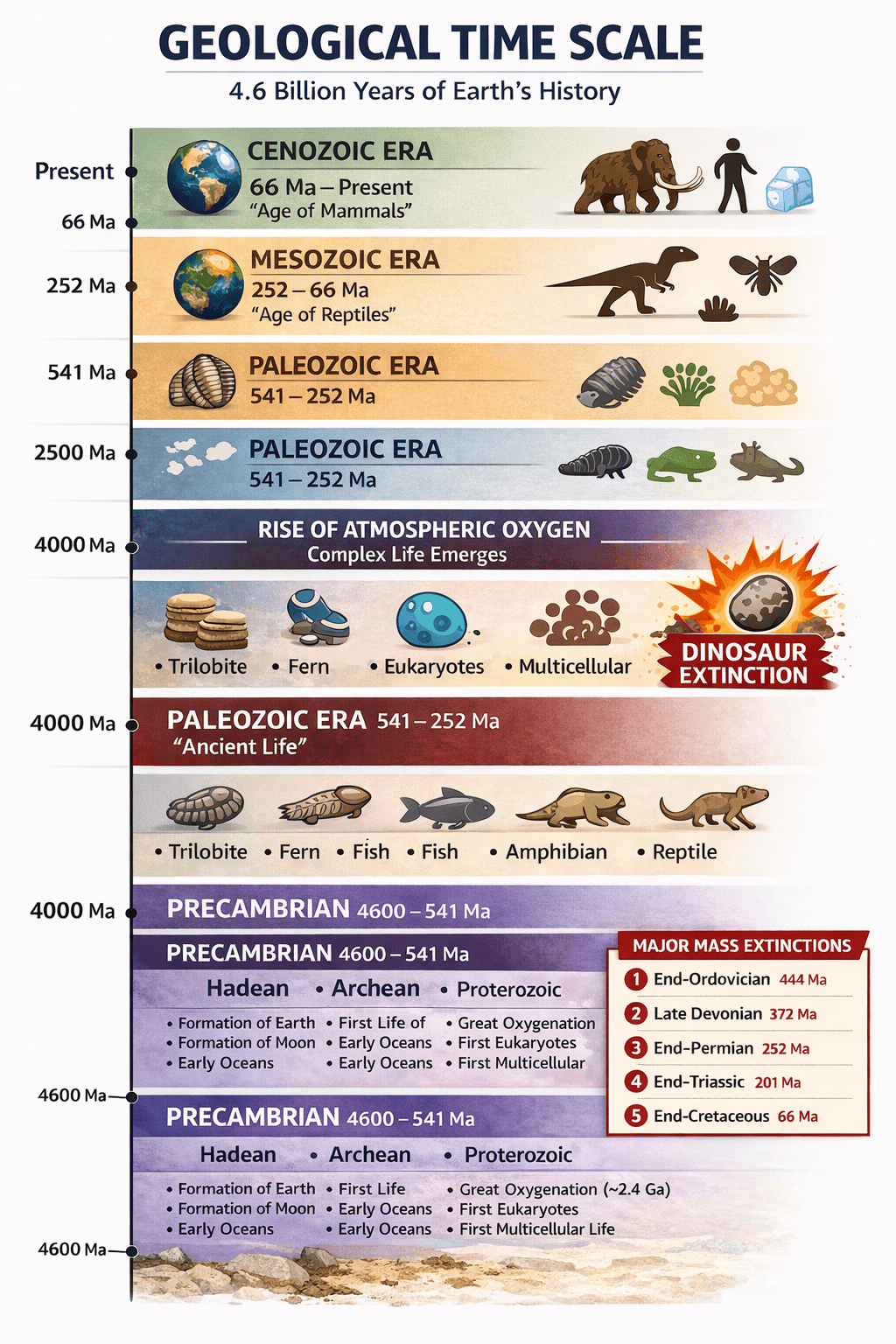
Geological Time-Scale
Previous10/10

SuperKalam is your personal mentor for UPSC preparation, guiding you at every step of the exam journey.
Download the App


STUDY RESOURCES
CONTACT US
ⓒ Snapstack Technologies Private Limited