GS 3: EconomyGS 2: PolityGS 2: GovernanceGS 2: Social JusticePrelims
States' development, welfare spending surges 131% in 10 years: CAG, Pg17
States' welfare and development spending skyrockets 131% in a decade, CAG report reveals, with revenue expenditure dominating budgets.
Practice MCQs
883 Students attempted
Key Highlights:
- States' aggregate expenditure increased by 131% between 2015-16 and 2024-25, as per a Comptroller and Auditor General of India (CAG) report.
- The report, "Publication on State Finances 2024-25," was released by CAG K Sanjay Murthy.
- This surge in spending primarily focused on welfare and development activities.
- Revenue expenditure constituted over 83% of total spending, while capital expenditure remained a smaller share.
- Social and economic services together accounted for approximately two-thirds of the total expenditure.
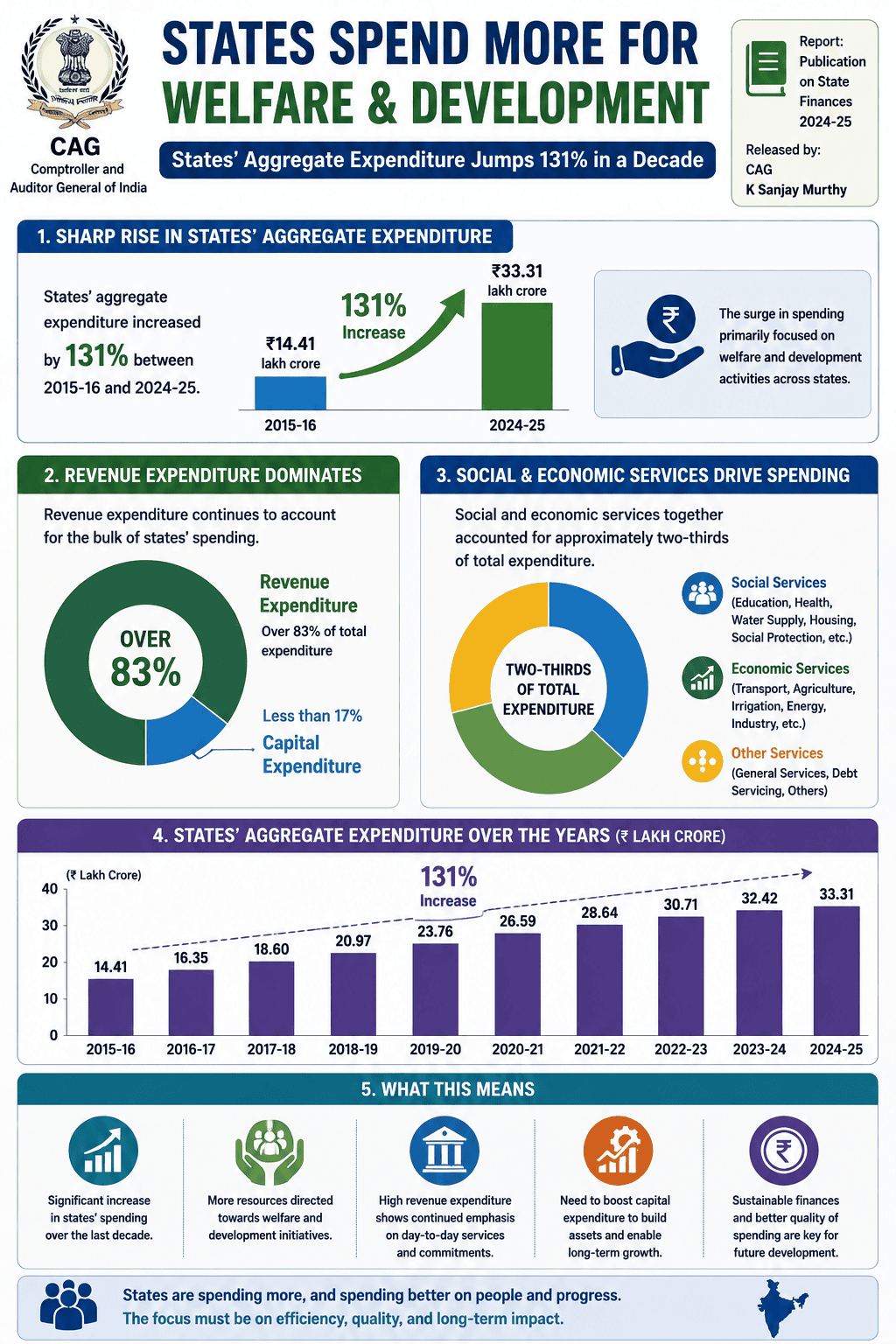
State Expenditure.png
Detailed Insights:
- The significant increase in state expenditure aligns with economic growth over the decade.
- Committed expenditure and subsidies consistently absorbed more than half of the revenue expenditure, reaching 53.31% in 2024-25.
- Subsidies showed particularly rapid growth within the states' budgets.
- State expenditure is concentrated in eight categories, including grants-in-aid, salaries, pensions, interest payments, subsidies, and major works.
- These concentrated categories represent nearly 78.46% of total spending and about 12.38% of combined Gross State Domestic Product (GSDP).
- The report highlights states' sustained focus on welfare and development initiatives.
Key Concepts Involved:
- Comptroller and Auditor General of India (CAG): The supreme audit institution of India, responsible for auditing all receipts and expenditure of the Union and State governments.
- Revenue Expenditure: Expenses incurred for the normal functioning of government departments and services, not creating assets.
- Capital Expenditure: Expenses incurred for creating long-term assets like buildings, roads, and machinery, contributing to economic growth.
- Gross State Domestic Product (GSDP): The total value of goods and services produced within a state during a financial year.
- Grants-in-aid: Financial assistance provided by the central government to state governments, or by state governments to local bodies, for specific purposes.
- Committed Expenditure: Non-discretionary expenses that a government is obligated to incur, such as salaries, pensions, and interest payments.
- Subsidies: Financial assistance provided by the government to individuals or businesses to reduce costs or prices, often for public welfare.

SuperKalam is your personal mentor for UPSC preparation, guiding you at every step of the exam journey.
Download the App


STUDY RESOURCES
CONTACT US
ⓒ Snapstack Technologies Private Limited