GS 2: International RelationsGS 3: EconomyPrelims
Modi holds talks with Carney at G7; hopeful of trade deal, Pg12
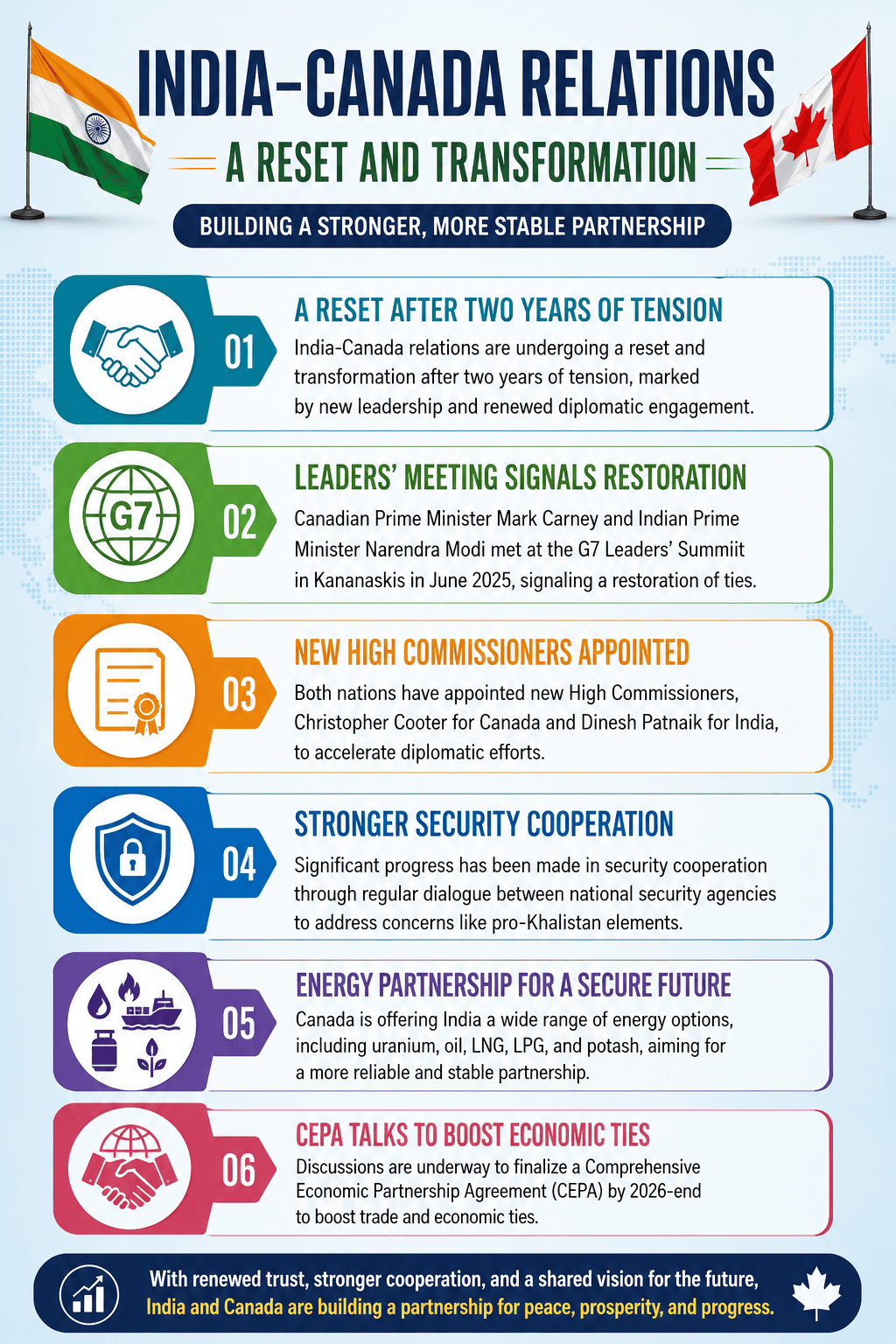
PM Modi and Canadian PM Carney discuss India-Canada FTA, energy security at G7, aiming for trade deal despite past diplomatic strains.
Practice MCQs
883 Students attempted
Key Highlights:
- Prime Minister Narendra Modi held bilateral talks with the Canadian Prime Minister on the sidelines of the G7 Summit.
- Discussions covered trade, economy, energy, technology, and people-to-people ties.
- Both leaders expressed optimism about concluding an India-Canada Free Trade Agreement (FTA) before the year ends.
- India and Canada are advancing their Security Energy Partnership, including a long-term uranium supply agreement.
- The meeting took place amidst past diplomatic tensions concerning accusations related to the killing of Hardeep Singh Nijjar.
India-Canada.png
Detailed Insights:
- This was the fourth meeting between the two leaders in less than a year, underscoring a commitment to strengthening bilateral relations.
- India views Canada, a major energy exporter, as a crucial partner for its energy security requirements.
- A CAD $2.6 billion commercial agreement for uranium supply from Canada's Cameco to India's Department of Atomic Energy for 2027-2035 was signed in March.
- Negotiations for the India-Canada Free Trade Agreement (FTA) are actively progressing, with India's Commerce and Industry Minister recently visiting Canada.
- Canada is strategically diversifying its economic partnerships, including with India, in response to global trade dynamics.
- Diplomatic strain arose from Canadian authorities' accusations in 2024 regarding alleged Indian involvement in the killing of Hardeep Singh Nijjar in British Columbia.
Key Concepts Involved:
- G7 Summit: An intergovernmental political forum comprising leading industrialized nations, addressing global economic and political issues.
- Free Trade Agreement (FTA): A treaty between two or more countries to eliminate or reduce trade barriers like tariffs and quotas.
- Energy Security: The reliable and uninterrupted availability of energy sources at an affordable price.
- Khalistan issue: A separatist movement advocating for an independent Sikh state, which has historically impacted India-Canada relations.

SuperKalam is your personal mentor for UPSC preparation, guiding you at every step of the exam journey.
Download the App


STUDY RESOURCES
CONTACT US
ⓒ Snapstack Technologies Private Limited