GS 1: Indian GeographyGS 2: GovernanceGS 3: Environment & EcologyPrelims
Indian cities need to rethink water future, Pg12
India's urban water crisis deepens amid heatwave, exposing governance failures and demanding urgent policy shifts towards efficient management and nature-based solutions.
Practice MCQs
883 Students attempted
Key Highlights:
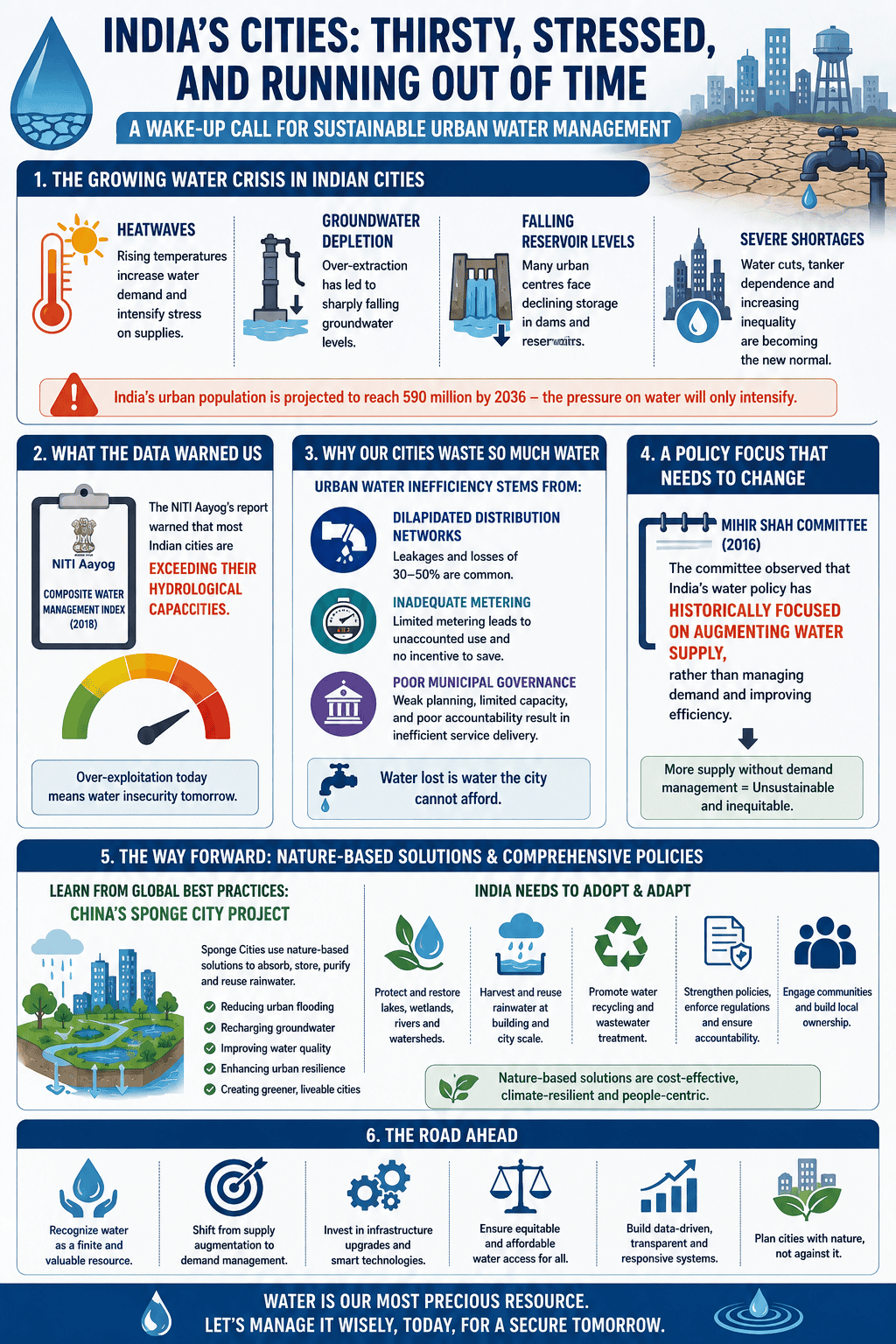
- Indian cities are experiencing severe water shortages, aggravated by heatwaves, groundwater depletion, and falling reservoir levels.
- The NITI Aayog’s Composite Water Management Index (2018) previously warned that cities were exceeding their hydrological capacities.
- Urban water inefficiency is largely due to dilapidated distribution networks, inadequate metering, and poor municipal governance.
- The Mihir Shah Committee (2016) highlighted a historical policy focus on augmenting water supply rather than managing demand.
- There is a critical need to adopt nature-based solutions and comprehensive policies, similar to China’s Sponge City project, for sustainable water management.
CWMI.png
Detailed Insights:
- The current water crisis is exacerbated by climate change, leading to increased evaporation, but structural issues are the primary drivers.
- The Jal Shakti Ministry’s Dynamic Groundwater Resources Assessment has also indicated the oversaturation of aquifers.
- Municipal and state authorities often fail to address the underlying structural causes of water scarcity, treating crises as isolated events.
- Lack of proper water metering and inefficient municipal governance significantly contribute to urban water wastage.
- The Atal Bhujal Yojana is an initiative focused on promoting efficient water use, particularly within the agricultural sector.
- Effective demand-side management requires scientific analysis of water consumption at both household and industrial levels to prevent over-exploitation.
- Nature-based solutions, such as lake restoration projects, must be implemented at a larger scale to achieve meaningful impact.
- China’s Sponge City project integrates urban landscapes and green infrastructure, including permeable pavements, for natural rainwater retention.
Key Concepts Involved:
- Composite Water Management Index (CWMI): An index developed by NITI Aayog to assess and improve water management practices across Indian states.
- Demand-side management: Strategies and policies aimed at influencing water consumption patterns to reduce overall demand and promote efficient use.
- Nature-based solutions: Sustainable management and restoration of natural ecosystems to address societal challenges like water scarcity.
- Sponge City project: An urban planning concept from China that uses green infrastructure to absorb, store, and purify rainwater.

SuperKalam is your personal mentor for UPSC preparation, guiding you at every step of the exam journey.
Download the App


STUDY RESOURCES
CONTACT US
ⓒ Snapstack Technologies Private Limited