GS 1: Physical GeographyGS 3: EconomyGS 3: Environment & EcologyGS 2: GovernancePrelims
India’s rainfall deficit at 35% as monsoon progress stalls, Pg1
India's monsoon deficit hits 35% as El Niño stalls progress, threatening kharif crops and food inflation; government prepares contingency plans.
Practice MCQs
883 Students attempted
Key Highlights:
- India is currently facing a nationwide monsoon deficit of 35%, with the monsoon's northward progress stalled for several days.
- The shortfall is primarily concentrated in Maharashtra, the Konkan coast, and adjoining regions of central India.
- Union Agriculture Minister Shivraj Singh Chouhan has directed states to formulate crop-wise contingency plans for districts experiencing low or uneven rainfall.
- The India Meteorological Department (IMD) has revised its seasonal rainfall forecast to 90% of the Long Period Average (LPA), assigning a 60% probability of a deficient year.
- This deficit is particularly significant as global forecasters predict a 'Super El Niño' year.
El Nino.png
Detailed Insights:
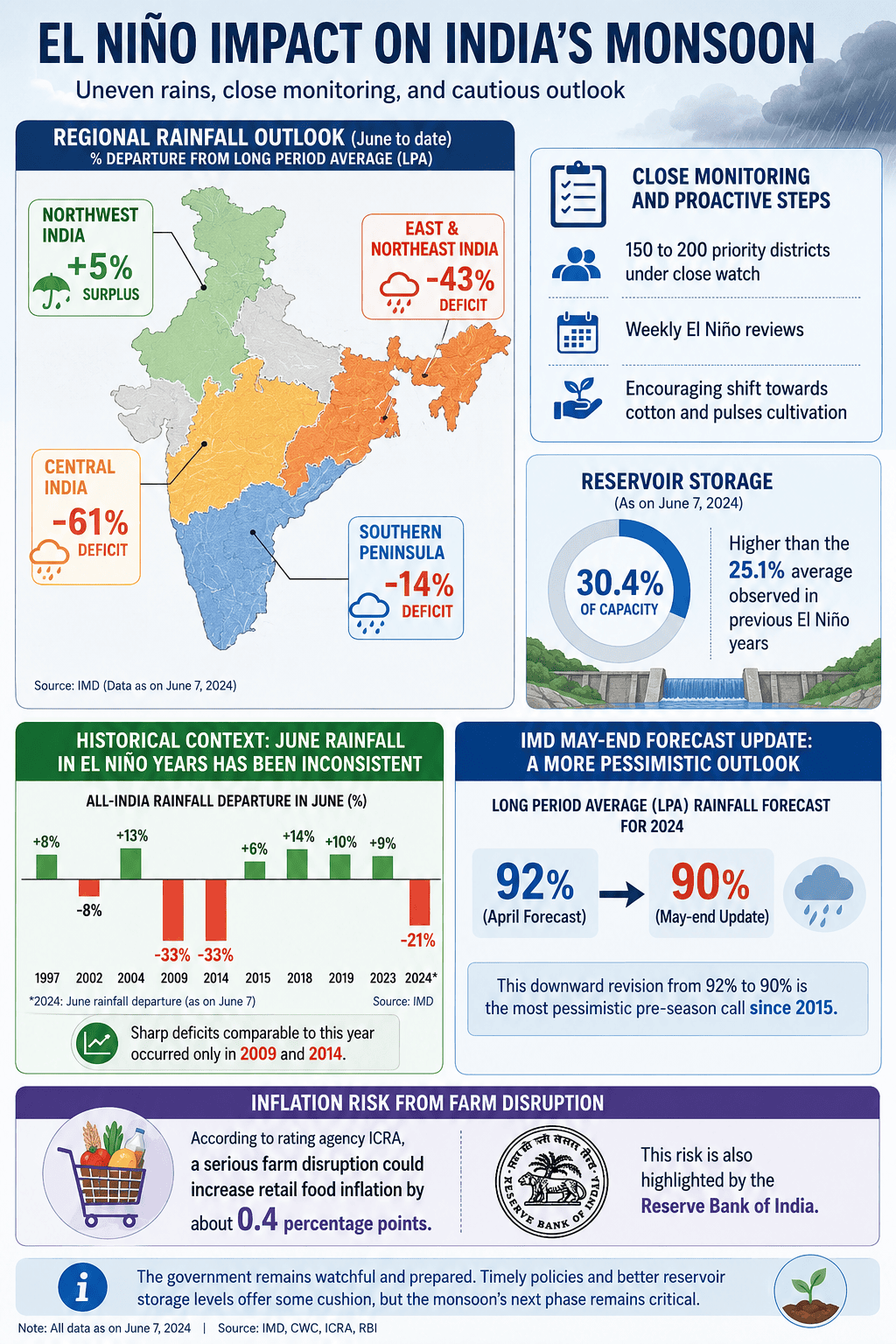
- While northwest India has received a 5% surplus, other regions show significant deficits: east and northeast India (-43%), central India (-61%), and the southern peninsula (-14%).
- The government is monitoring 150 to 200 priority districts, conducting weekly El Niño reviews, and encouraging a shift towards cotton and pulses cultivation.
- Reservoir storage is at 30.4% of capacity, which is higher than the 25.1% average observed in previous El Niño years, indicating better preparedness.
- Historical data reveals that June rainfall in El Niño years has been inconsistent, with sharp deficits comparable to this year only occurring in 2009 and 2014.
- The IMD's May-end forecast update, lowering the LPA from 92% to 90%, represents its most pessimistic pre-season call since 2015.
- Rating agency ICRA has estimated that a serious farm disruption could increase retail food inflation by about 0.4 percentage points, a risk also highlighted by the Reserve Bank of India.
Key Concepts Involved:
- Kharif crops: Crops sown during the monsoon season (June-July) and harvested in autumn (September-October), heavily reliant on monsoon rainfall.
- El Niño: A climate pattern characterized by the unusual warming of surface waters in the eastern tropical Pacific Ocean, influencing global weather patterns.
- Long Period Average (LPA): A 50-year average of monsoon rainfall, used by the IMD as a benchmark to forecast the quantity of rainfall during the monsoon season.
- India Meteorological Department (IMD): The primary agency responsible for meteorological observations, weather forecasting, and seismology in India.

SuperKalam is your personal mentor for UPSC preparation, guiding you at every step of the exam journey.
Download the App


STUDY RESOURCES
CONTACT US
ⓒ Snapstack Technologies Private Limited