GS 3: EconomyGS 3: Science & TechnologyPrelims
Energy storage capacity added by India in first quarter, Pg10
India dramatically boosts battery energy storage capacity by 941% to 4.6 GWh in Q1, reaching 5.9 GWh cumulative.
Practice MCQs
883 Students attempted
Key Highlights:
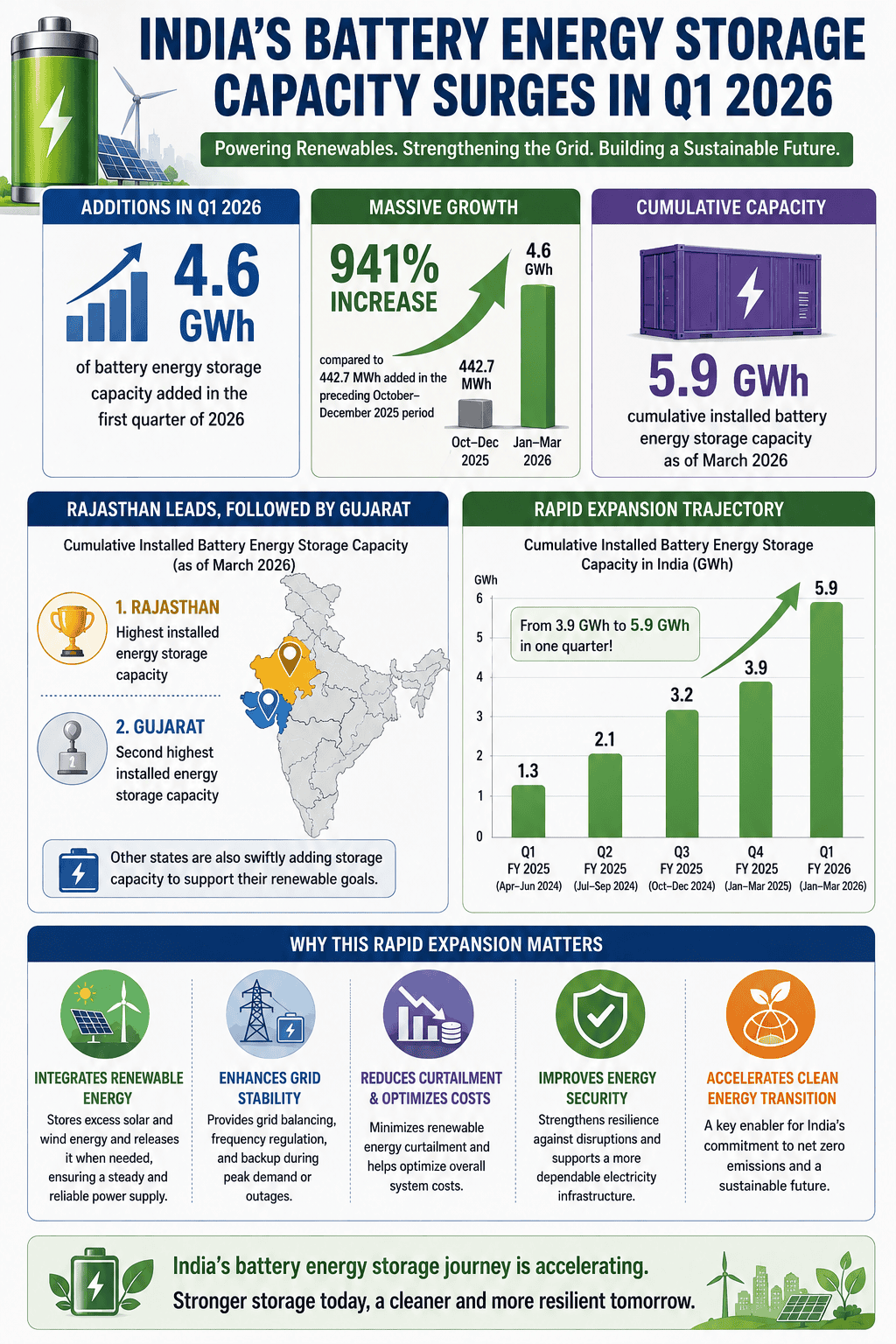
- India added 4.6 gigawatt-hours (GWh) of battery energy storage capacity in the first quarter of 2026.
- This represents a significant 941% increase compared to the 442.7 megawatt-hours (MWh) added in the preceding October-December 2025 period.
- The country's cumulative installed battery energy storage capacity reached 5.9 GWh as of March 2026.
- Rajasthan leads in cumulative installed energy storage capacity, followed by Gujarat.
- This rapid expansion is crucial for integrating renewable energy and enhancing grid stability.
Battery Capacity.png
Detailed Insights:
- The surge in battery energy storage is driven by India's ambitious target of achieving 500 GW of non-fossil fuel capacity by 2030.
- Government initiatives like the Viability Gap Funding (VGF) Scheme provide financial support, offering up to 40% of the capital cost for battery energy storage projects.
- The Energy Storage Obligation (ESO) mandates electricity distributors to source a growing percentage of energy from renewable sources coupled with storage, aiming for 4% by FY 2029-30.
- The Production Linked Incentive (PLI) Scheme for Advanced Chemistry Cell (ACC) battery manufacturing further boosts domestic production capacity.
- The National Framework for Promoting Energy Storage Systems, unveiled in August 2023, aims to ensure round-the-clock availability of renewable energy and improve grid stability.
- Standalone energy storage systems constitute a major portion, accounting for 73% of the cumulative capacity.
- India's energy storage development pipeline reached 69 GWh in Q1 2026, indicating robust future growth.
- The Central Electricity Authority (CEA) estimates a demand for 73.93 GW/411.4 GWh of energy storage by 2031-32.
- Waiver of Inter-State Transmission System (ISTS) charges for battery energy storage projects also incentivizes development.
Key Concepts Involved:
- Battery Energy Storage Systems (BESS): Technologies that store electrical energy in rechargeable batteries for later use, crucial for grid stability and renewable energy integration.
- Gigawatt-hour (GWh): A unit of energy representing one billion watt-hours, commonly used to measure the capacity of large-scale energy storage systems.
- Viability Gap Funding (VGF) Scheme: A government financial mechanism to support infrastructure projects that are economically justified but not financially viable due to high capital costs.
- Energy Storage Obligation (ESO): A regulatory mandate requiring electricity distribution companies and other obligated entities to procure a specified minimum percentage of their energy from renewable sources backed by energy storage.

SuperKalam is your personal mentor for UPSC preparation, guiding you at every step of the exam journey.
Download the App


STUDY RESOURCES
CONTACT US
ⓒ Snapstack Technologies Private Limited