GS 2: PolityGS 2: GovernancePrelims
South’s seat share won’t be cut, say PM and Shah, Pg1
Government assures South states of maintained proportional representation post delimitation and women's reservation implementation by 2029 elections.
Practice MCQs
869 Students attempted
Key Highlights:
- The Prime Minister and Home Minister assured that the proposed delimitation exercise will maintain the proportional representation of southern states in the Lok Sabha.
- The number of seats for each state will increase by approximately 50%.
- The Constitution (131st Amendment) Bill, 2026, the Delimitation Bill, 2026, and the Union Territories Laws (Amendment) Bill, 2026 were introduced in the Lok Sabha.
- After delimitation, the Lok Sabha will have 816 seats.
- The number of Lok Sabha seats in the five southern states will increase from 129 to 195.
Detailed Insights:
- The Constitution (131st Amendment) Bill, 2026 aims to implement women's reservation by the 2029 Lok Sabha polls.
- The Delimitation Bill, 2026 seeks to readjust parliamentary and Assembly constituencies through a Delimitation Commission.
- The Union Territories Laws (Amendment) Bill, 2026 aims to extend reservation to the legislatures of Delhi, Puducherry, and Jammu & Kashmir.
- The Home Minister clarified that after the delimitation exercise, Karnataka's share will become 42 seats (5.14%), Andhra Pradesh will have 38 seats (4.65%), Telangana will have 26 seats (3.18%), Kerala will have 30 seats (3.67%), and Tamil Nadu will have 59 seats (7.23%).
- The percentage share of Lok Sabha seats for the five southern states will increase from 23.76% to 23.87%.
- A Delimitation Commission is a body set up by the Government of India under provisions of the Delimitation Commission Act.
How UPSC asks Questions on this:
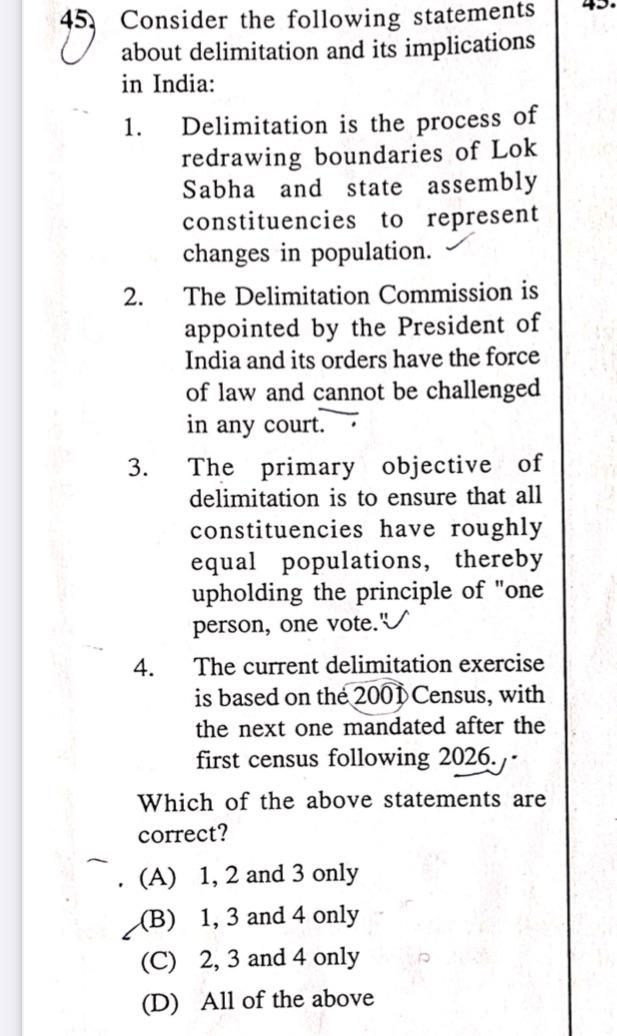
Delimitation PYQ
Key Concepts Involved:
- Delimitation: The process of redrawing boundaries of parliamentary and assembly constituencies to represent changes in population.
- Proportional Representation: An electoral system in which parties gain seats in proportion to the number of votes cast for them.
- Women's Reservation: A proposed policy to reserve a certain percentage of seats in legislatures for women.

SuperKalam is your personal mentor for UPSC preparation, guiding you at every step of the exam journey.
Download the App


STUDY RESOURCES
CONTACT US
ⓒ Snapstack Technologies Private Limited