GS 2: International RelationsGS 3: Economy
India to sign U.S. deal only after clarity on tariff rates, Pg1
India delays U.S. trade deal signing pending clarity on tariff rates after U.S. Supreme Court ruling on reciprocal tariffs.
Practice MCQs
862 Students attempted
Key Highlights:
- India will finalize a trade deal with the U.S. after clarity on the country's new tariff architecture.
- The U.S. Supreme Court invalidated reciprocal tariffs on February 20, 2026.
- The U.S. government imposed 10% tariffs on certain products from all countries under Section 122 of the Trade Act, 1974.
- A trade deal between India and the U.S. was announced on February 2, 2026, with a framework finalized on February 7, 2026.
- The U.S. removed 25% additional ad-valorem tariffs on certain Indian exports linked to India's import of Russian oil on February 7, 2026.
Detailed Insights:
- The U.S. is working to recreate a global tariff architecture, and India wants to assess its comparative advantage in the U.S. market before signing any deal.
- The initial framework involved the U.S. imposing an 18% tariff on India, but the new rate will depend on the tariffs the U.S. imposes on India's competitors.
- Section 122 of the Trade Act, 1974 tariffs are in force for 150 days starting February 24, 2026.
- India's increased buying of Russian oil is linked to the removal of tariffs by the U.S., due to current global challenges.
- Two trade-related investigations by the U.S. could potentially lead to additional tariffs on several countries, including India.
Key Concepts Involved:
- Tariff Architecture: A country's overall system of tariffs, including rates and structures, applied to imports and exports.
- Reciprocal Tariffs: Tariffs imposed by a country in response to tariffs imposed by another country.
- Ad-valorem Tariffs: A tariff based on a percentage of the value of the imported good.
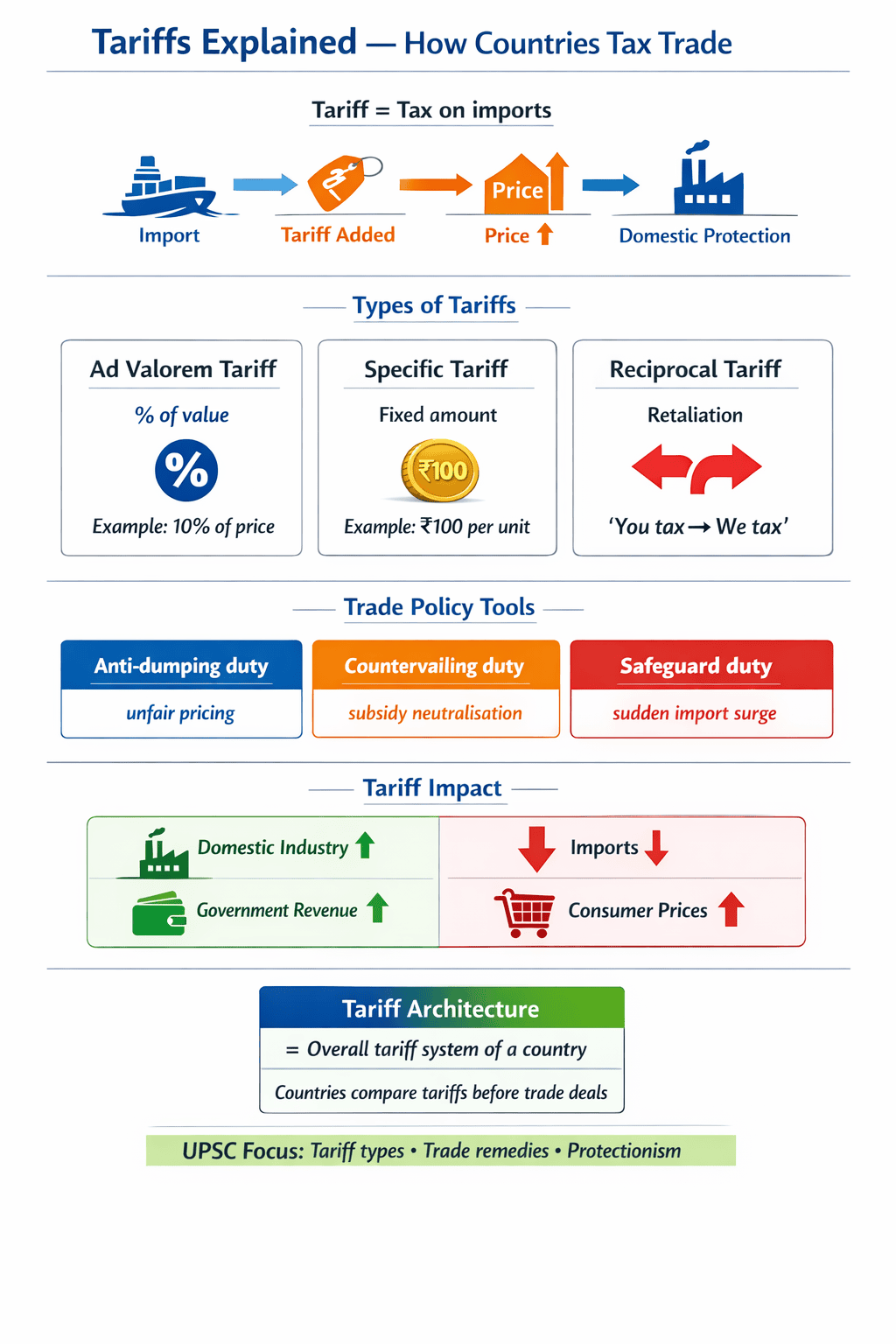
Tariffs

SuperKalam is your personal mentor for UPSC preparation, guiding you at every step of the exam journey.
Download the App


STUDY RESOURCES
CONTACT US
ⓒ Snapstack Technologies Private Limited