GS 3: Science & TechnologyGS 2: Social JusticePrelims
Single genome-editing strategy can help treat multiple disorders, PgII
Revolutionary PERT genome-editing strategy reprograms tRNA genes to override premature stop signals, potentially treating multiple genetic disorders simultaneously.
Practice MCQs
855 Students attempted
Key Highlights:
- Researchers have developed a single genome-editing strategy called PERT (Prime-Editing-mediated Readthrough of premature Termination codons) to treat multiple genetic disorders caused by nonsense mutations.
- PERT reprograms a cell's gene to override premature stop signals, allowing the cell to produce complete proteins.
- The study, published in Nature, involved researchers from the Broad Institute, Harvard University, and the University of Minnesota.
- In cultured human cells, PERT achieved 60-80% editing efficiency, significantly higher than the standard method.
- In a Hurler syndrome mouse model, PERT restored 1.7-7% of normal enzyme activity in key organs.
Detailed Insights:
- Nonsense mutations, which introduce premature stop signals in DNA, account for about a quarter of all disease-causing genetic changes, leading to a wide range of disorders.
- PERT leverages the redundancy of tRNA genes by editing a non-essential tRNA gene into a suppressor tRNA, which reads through premature stop signals.
- The researchers engineered thousands of variants of four tRNAs (leucine, arginine, tyrosine, and serine) to increase their effectiveness in suppressing premature stop codons.
- Prime editing, a precise genome-editing approach, uses a prime-editing guide RNA (pegRNA) to direct the editing machinery to the correct spot on the DNA.
- Safety tests indicated that PERT did not alter unrelated parts of the DNA, disturb the cell's overall activity, or disrupt normal protein production.
- PERT was tested in cell models of Batten disease, Tay-Sachs disease, and Niemann-Pick C1 disease, all caused by premature stop codons, and showed promising results in restoring enzyme activity.
- AAV9, a common gene-therapy vector, was used to deliver the prime-editing components into newborn mice to evaluate PERT in a living organism.
- While PERT shows promise, challenges remain in delivery, long-term safety, and performance across different tissues before it can be realistically moved toward patients.
Scientific/Technical Concepts Involved:
- Nonsense Mutation: A genetic mutation that introduces a premature stop signal in DNA, halting protein production.
- tRNA (transfer RNA): A type of RNA molecule that helps decode mRNA into a protein by transporting specific amino acids.
- Prime Editing: A precise genome-editing technique that uses a prime-editing guide RNA (pegRNA) to rewrite DNA sequences.
- AAV9 (adeno-associated virus 9): A harmless virus commonly used as a gene-therapy vector to deliver genetic cargo into cells.
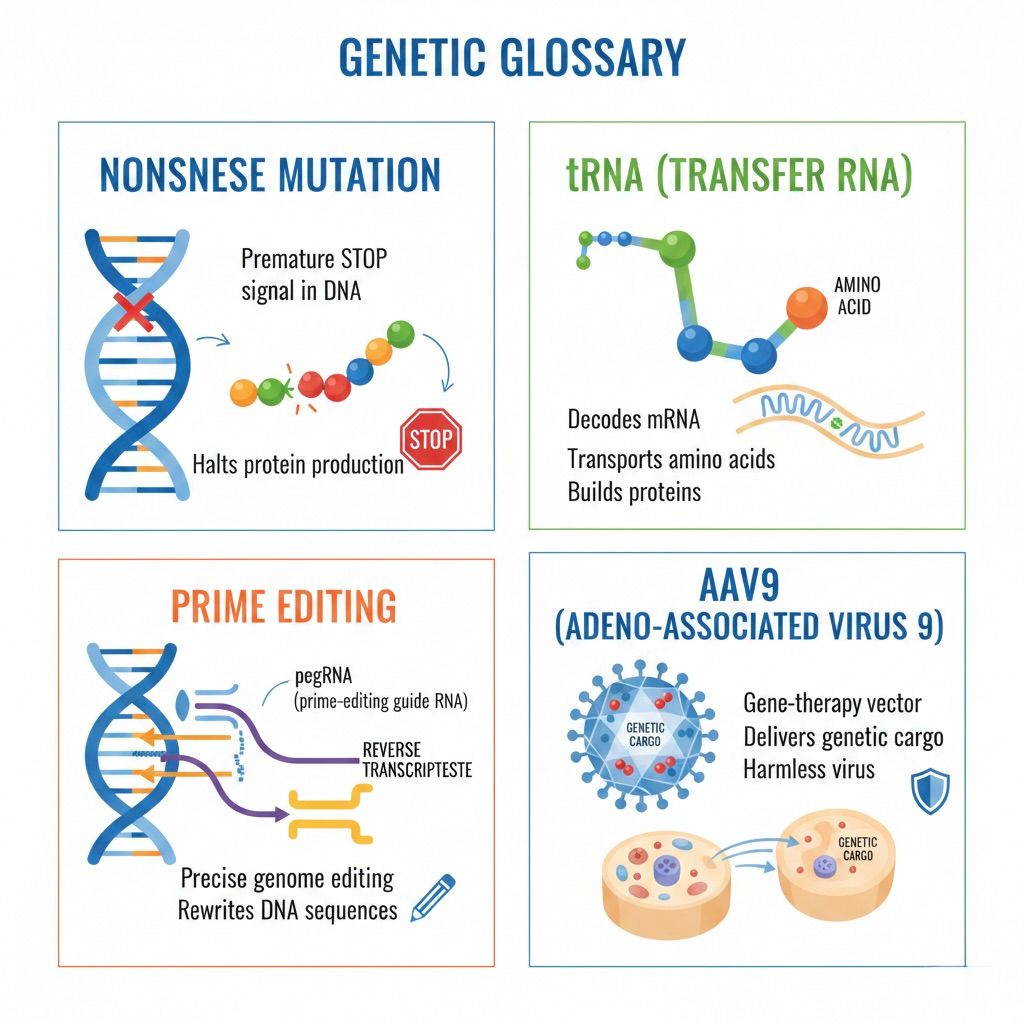
Genetic Glossary
Previous12/12

SuperKalam is your personal mentor for UPSC preparation, guiding you at every step of the exam journey.
Download the App


STUDY RESOURCES
CONTACT US
ⓒ Snapstack Technologies Private Limited