GS 1: Modern HistoryGS 2: Social JusticeGS 1: Indian SocietyPrelims
A separate classification for denotified tribes, Pg8
Denotified Tribes demand separate Census category to overcome historical stigma and ensure targeted welfare, challenging existing classification systems.
Practice MCQs
855 Students attempted
Key Highlights:
- The Union government assured Denotified, Nomadic, and Semi-Nomadic Tribes (DNTs) community leaders of enumeration in the 2027 Census.
- DNT leaders are advocating for a "separate column" in the Census form for DNTs.
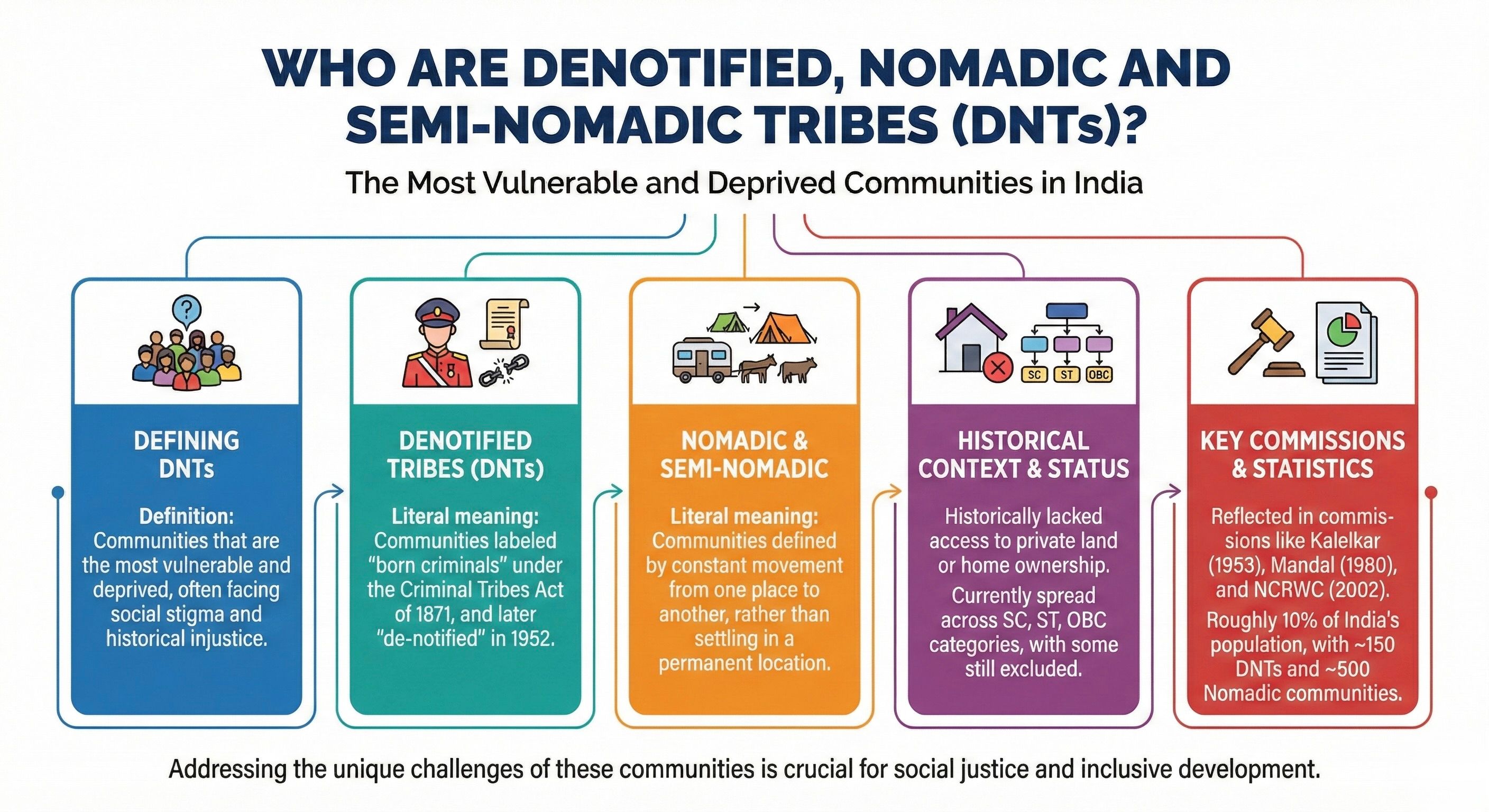
- The Criminal Tribes Act (CTA), introduced in 1871, classified certain communities as "criminal".
- In 1952, the Government of India officially repealed the CTA, leading to the denotification of these communities.
Detailed Insights:
- The Criminal Tribes Act of 1871 labeled certain communities as "criminal," leading to their systematic oppression and stigmatization by colonial authorities.
- Post-independence, many DNTs were included in SC, ST, or OBC lists, but face challenges due to continued stigma and inconsistent issuance of DNT certificates.
- The Idate Commission report identified approximately 1,200 DNT communities, recommending a permanent National Commission, which was replaced by a Welfare Board.
- DNT associations are seeking a separate Constitutional classification to address specific discrimination and ensure uniform issuance of DNT certificates.
- Community leaders argue that their historical resistance to foreign aggressors led to their "criminal" labeling, emphasizing the need for recognition of their unique identity.
- The lack of a separate classification hinders the effective implementation of welfare schemes like SEED, impacting livelihood, education, housing, and health interventions.
Key Concepts Involved:
- Denotified Tribes (DNTs): Communities formerly classified as "criminal" under the Criminal Tribes Act of 1871.
- Criminal Tribes Act (CTA): A colonial-era law that designated certain communities as inherently criminal.
- SEED Scheme: A government initiative for livelihood, education, housing, and health interventions for DNTs.
DNTs

SuperKalam is your personal mentor for UPSC preparation, guiding you at every step of the exam journey.
Download the App


STUDY RESOURCES
CONTACT US
ⓒ Snapstack Technologies Private Limited