GS 3: Internal SecurityGS 3: Science & TechnologyGS 2: International RelationsPrelims
Drone revolution and modern warfare, Pg10
Drone revolution fundamentally reshapes modern warfare, with cheap FPV systems and AI-enabled counter-drones transforming battlefields in Ukraine and West Asia, challenging conventional military superiority.
Practice MCQs
876 Students attempted
Key Highlights:
- Drones have transformed modern warfare, shifting from auxiliary assets to central instruments in conflicts like Ukraine, Lebanon, and the U.S.-Israel-Iran theatre.
- First-Person View (FPV) drones, initially commercial, are now widely weaponized for precision strikes and reconnaissance, notably in Ukraine.
- The widespread use of drones has challenged traditional military superiority, making battlefields continuously exposed and rear areas vulnerable.
- Fibre-optic FPV drones have emerged as a significant innovation, offering resistance to electronic warfare (EW) jamming.
- The economic impact is profound, with inexpensive drones capable of destroying high-value military equipment, reshaping battlefield economics.
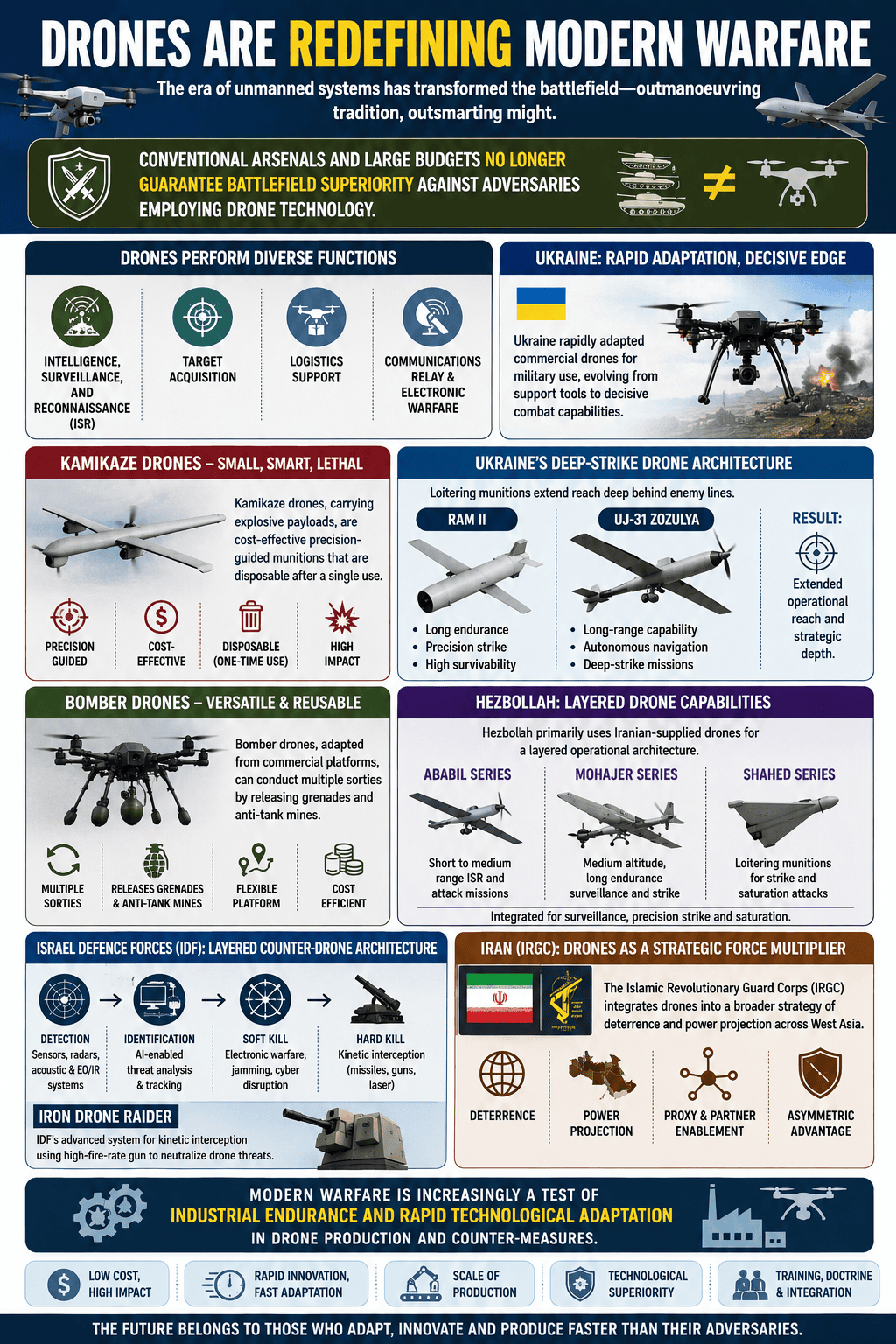
Drones.png
Detailed Insights:
- Conventional arsenals and large budgets no longer guarantee battlefield superiority against adversaries employing drone technology.
- Drones perform diverse functions including Intelligence, Surveillance, and Reconnaissance (ISR), target acquisition, and logistics support.
- Ukraine rapidly adapted commercial drones for military use, evolving from support tools to decisive combat capabilities.
- Kamikaze drones, carrying explosive payloads, are cost-effective precision-guided munitions that are disposable after a single use.
- Ukraine's deep-strike drone architecture includes loitering munitions like RAM II and UJ-31 Zozulya, extending operational reach.
- Bomber drones, adapted from commercial platforms, can conduct multiple sorties by releasing grenades and anti-tank mines.
- Hezbollah primarily uses Iranian-supplied drones such as the Ababil, Mohajer, and Shahed series for layered operational architecture.
- The Israel Defence Forces (IDF) have developed a layered counter-drone architecture, including Iron Drone Raider for kinetic interception.
- Iran's Islamic Revolutionary Guard Corps (IRGC) integrates drones into a broader strategy of deterrence and power projection across West Asia.
- Modern warfare is increasingly a test of industrial endurance and rapid technological adaptation in drone production and counter-measures.
Key Concepts Involved:
- Unmanned Aerial Systems (UAS): Aircraft without a human pilot on board, controlled remotely or autonomously.
- First-Person View (FPV) drones: Drones controlled by an operator viewing a live video feed from the drone's perspective.
- Intelligence, Surveillance, and Reconnaissance (ISR): The coordinated collection and analysis of information to support military operations.
- Electronic Warfare (EW): Military action involving the use of electromagnetic energy to control the electromagnetic spectrum.
- Loitering Munitions: Drones that can loiter over a target area and attack once a target is identified.

SuperKalam is your personal mentor for UPSC preparation, guiding you at every step of the exam journey.
Download the App


STUDY RESOURCES
CONTACT US
ⓒ Snapstack Technologies Private Limited