GS 2: PolityGS 2: GovernanceGS 3: EconomyPrelims
Poll sop, Pg6
TN CM disburses ₹5,000 to women beneficiaries ahead of elections, raising concerns over Model Code of Conduct violations.
Practice MCQs
847 Students attempted
Key Highlights:
- Tamil Nadu CM M.K. Stalin disbursed ₹5,000 to 1.31 crore women beneficiaries of the Kalaignar Magalir Urimai Thittam (KMUT).
- The disbursement included arrears for February, March, and April, plus a ₹2,000 "summer assistance."
- The KMUT, operational since September 2023, provides ₹1,000 monthly to women heads of families, with 32% being SC/ST.
- The total expenditure exceeded ₹6,550 crore, including ₹2,620 crore for the new summer assistance.
Detailed Insights:
- The move raises concerns about using welfare measures as a political tool before elections, questioning whether it's affirmative action or a poll-eve incentive.
- Stalin cited political and legal apprehensions that the scheme might be suspended before the Assembly election, prompting the early disbursement.
- The Election Commission of India (ECI) has been inconsistent in interpreting violations of the Model Code of Conduct, leading to concerns about fairness.
- A similar incident occurred during the 2025 Bihar elections, where the JD(U)-BJP coalition deposited ₹10,000 each to one crore women under the Mukhyamantri Mahila Rojgar Yojana, without ECI intervention.
- The ECI previously suspended similar schemes in Tamil Nadu, including cash support for farmers in 2004 and free color television sets in 2011.
- While such cash benefits don't guarantee voter loyalty, they provide the ruling party with a political advantage by leveraging the exchequer.
Key Concepts Involved:
- Affirmative Action: Policies designed to address past and present discrimination by ensuring equal opportunities.
- Model Code of Conduct: Guidelines issued by the ECI to regulate political parties and candidates before elections.
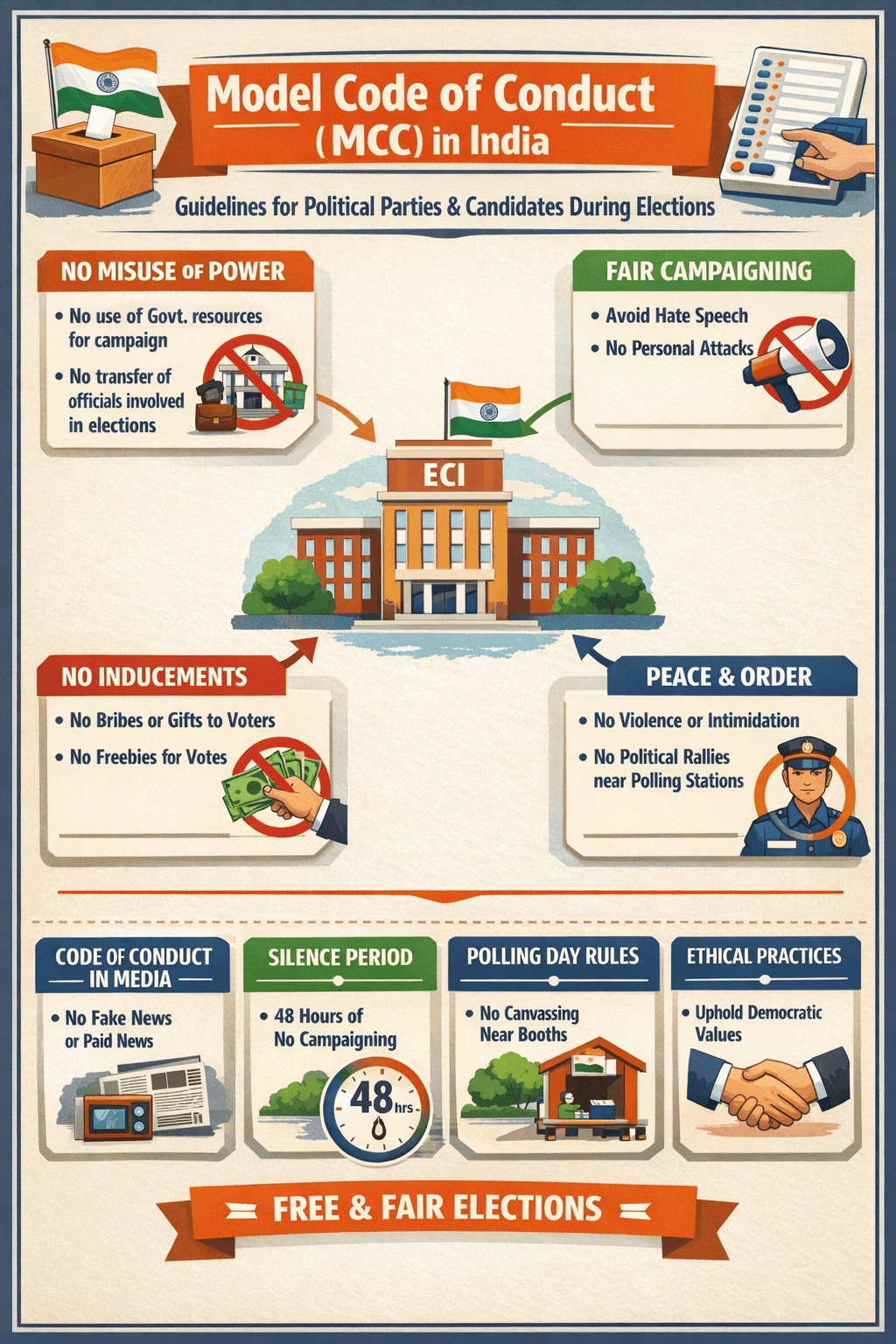
MCC
- Populist Freebie: Government programs or schemes that offer short-term benefits to gain popularity, often at the expense of long-term fiscal health.

SuperKalam is your personal mentor for UPSC preparation, guiding you at every step of the exam journey.
Download the App


STUDY RESOURCES
CONTACT US
ⓒ Snapstack Technologies Private Limited