GS 3: Science & TechnologyGS 1: Physical GeographyPrelims
LHS 1903: a strange system, PgII
Astronomers discover LHS 1903, a unique planetary system challenging planet formation theories with a rocky planet beyond gas giants.
Practice MCQs
847 Students attempted
Key Highlights:
- LHS 1903, a planetary system 117 light-years from Earth, challenges existing planet formation theories.
- The system consists of four planets: two rocky super-Earths and two gaseous mini-Neptunes, orbiting a red dwarf star.
- The outermost planet, contrary to theory, is rocky instead of gaseous, with a surface temperature of 60°C, potentially habitable.
Detailed Insights:
- The LHS 1903 system was observed using the European Space Agency’s Cheops space telescope, revealing an unusual planetary arrangement.
- The red dwarf star, LHS 1903, is about 50% as massive and 5% as luminous as our sun, influencing the planets' characteristics.
- One theory suggests the planets formed in series, with the outer planet lacking gas due to its consumption by inner planets.
- Another possibility is that the outermost planet lost its gaseous atmosphere due to a catastrophic event, leaving only its rocky core.
- The discovery provides insights into the diverse processes of planetary formation and the potential for habitable exoplanets.
Scientific/Technical Concepts Involved:
- Red Dwarf: A small, cool, and faint star, much smaller and dimmer than our Sun.
- Super-Earth: An exoplanet with a mass higher than Earth's, but substantially below that of the Solar System's gas giants.
- Mini-Neptune: A planet that is smaller than Neptune but larger than Earth, and possessing a thick hydrogen and helium atmosphere.
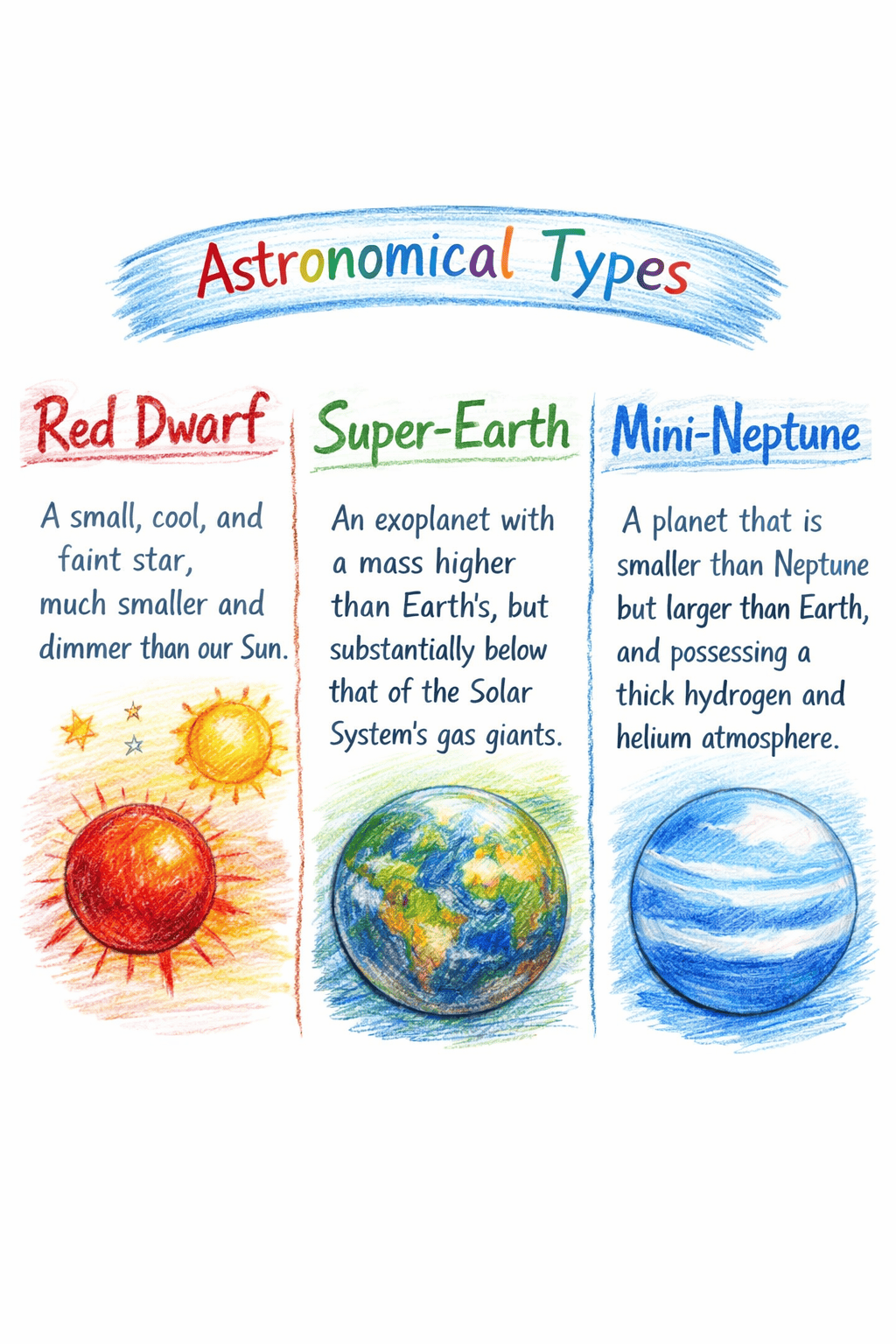
Astronomical Objects
Previous12/12

SuperKalam is your personal mentor for UPSC preparation, guiding you at every step of the exam journey.
Download the App


STUDY RESOURCES
CONTACT US
ⓒ Snapstack Technologies Private Limited