GS 3: EconomyGS 2: PolityGS 1: Indian GeographyPrelims
Why an Assam-Nagaland pact raises hopes of higher oil & gas output from Northeast, Pg13
Union, Assam, Nagaland ink pact to resume oil/gas exploration in disputed border, targeting tenfold output increase and boosting national energy security.
Practice MCQs
862 Students attempted
Key Highlights:
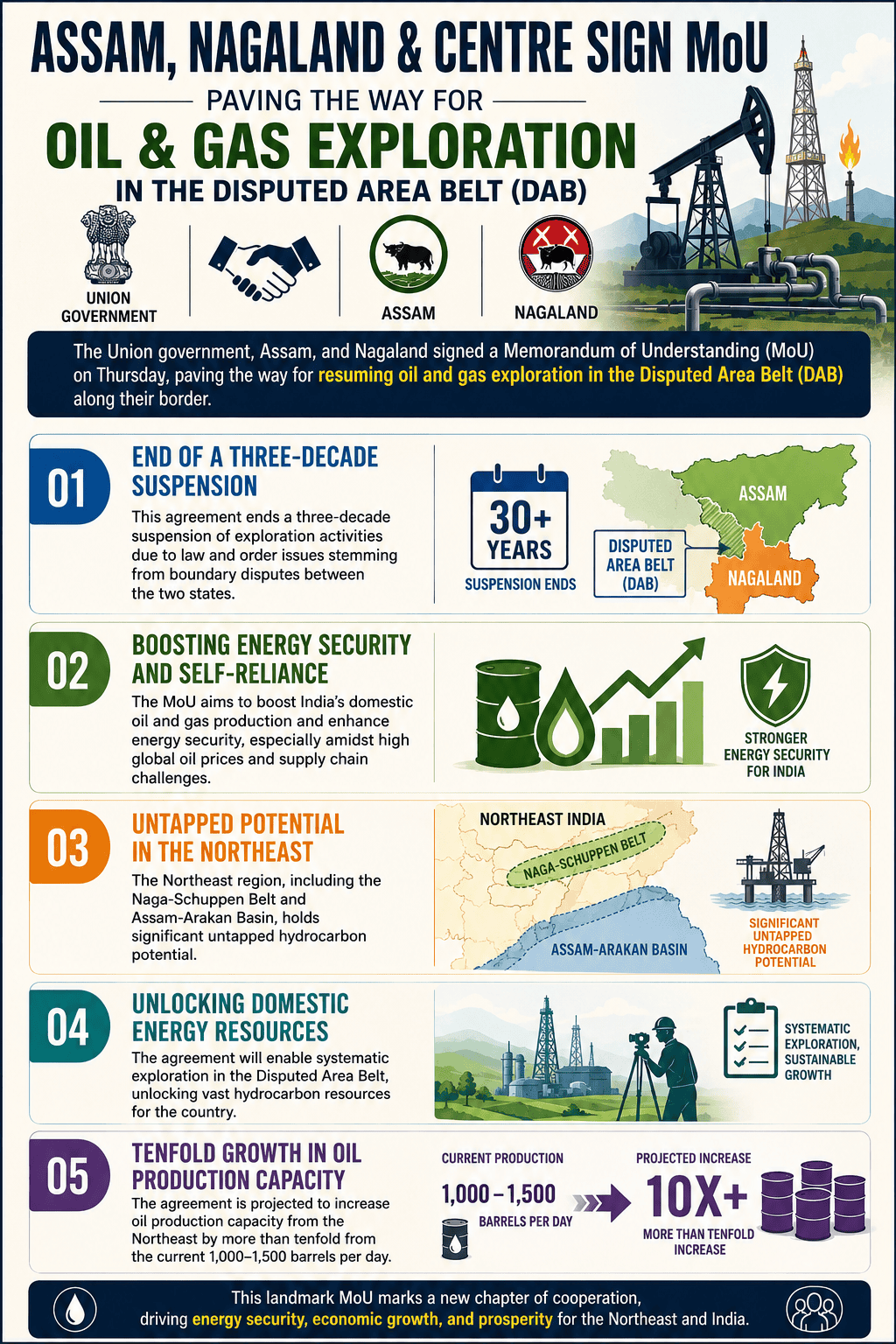
- The Union government, Assam, and Nagaland signed a Memorandum of Understanding (MoU) on Thursday, paving the way for resuming oil and gas exploration in the Disputed Area Belt (DAB) along their border.
- This agreement ends a three-decade suspension of exploration activities due to law and order issues stemming from boundary disputes between the two states.
- The MoU aims to boost India's domestic oil and gas production and enhance energy security, especially amidst high global oil prices and supply chain challenges.
- The Northeast region, including the Naga-Schuppen Belt and Assam-Arakan Basin, holds significant untapped hydrocarbon potential.
- The agreement is projected to increase oil production capacity from the Northeast by more than tenfold from the current 1,000-1,500 barrels per day.
Assam-Nagaland.png
Detailed Insights:
- The tripartite MoU establishes a coordinated framework to facilitate mineral oil operations, ensuring operational continuity, safety, and security for personnel and assets.
- This initiative is part of broader government efforts to encourage investments in India’s upstream petroleum sector through various policy reforms.
- The Disputed Area Belt (DAB), covering over 1,000 sq km, is believed to contain promising hydrocarbon prospects, crucial for national energy needs.
- Resumption of exploration activities is expected to significantly contribute to the economic development of both Assam and Nagaland, which had been affected by the long-standing challenges.
- The agreement provides certainty to investors and facilitates regulatory coordination, creating conditions necessary for long-term investment decisions in the region.
- Assam currently accounts for approximately 22% of India’s crude oil reserves and about 15% of the country’s natural gas reserves, highlighting the region's strategic importance.
- The move is critical for reducing India's dependence on foreign sources for oil and gas, aligning with the goal of greater self-reliance in energy.
Scientific/Technical Concepts Involved:
- Upstream Activities: The initial phase of the oil and gas industry, involving exploration, drilling, and extraction of crude oil and natural gas.
- Hydrocarbon Prospects: Geological formations or areas identified as potentially containing commercially viable quantities of oil and natural gas.
- Naga-Schuppen Belt: A significant geological fold-and-thrust belt in Northeast India, known for its rich hydrocarbon potential within the Assam-Arakan Basin.
- Assam-Arakan Basin: A major sedimentary basin in Northeast India and parts of Bangladesh and Myanmar, recognized for its substantial oil and natural gas reserves.

SuperKalam is your personal mentor for UPSC preparation, guiding you at every step of the exam journey.
Download the App


STUDY RESOURCES
CONTACT US
ⓒ Snapstack Technologies Private Limited