GS 3: Environment & EcologyPrelimsGS 2: GovernanceGS 3: Internal Security
A stray tigress makes a new home, giving a struggling Chhattisgarh reserve hope of revival, Pg11
Stray tigress 'Paheli' sparks revival hopes for Chhattisgarh's Udanti-Sitanadi Tiger Reserve, prompting habitat restoration, anti-poaching drives, and translocation plans.
Practice MCQs
862 Students attempted
Key Highlights:
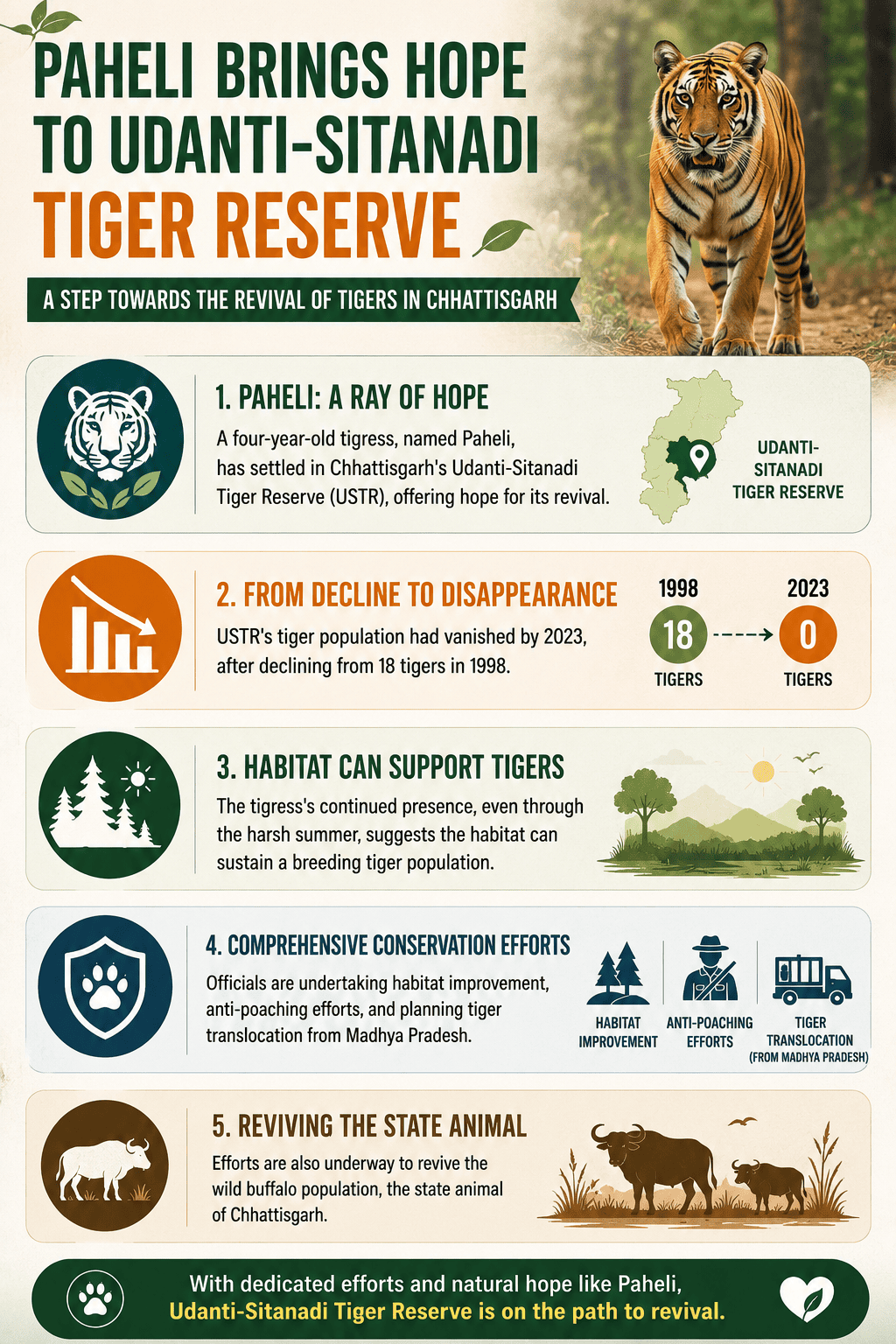
- A four-year-old tigress, named Paheli, has settled in Chhattisgarh's Udanti-Sitanadi Tiger Reserve (USTR), offering hope for its revival.
- USTR's tiger population had vanished by 2023, after declining from 18 tigers in 1998.
- The tigress's continued presence, even through the harsh summer, suggests the habitat can sustain a breeding tiger population.
- Officials are undertaking habitat improvement, anti-poaching efforts, and planning tiger translocation from Madhya Pradesh.
- Efforts are also underway to revive the wild buffalo population, the state animal of Chhattisgarh.
USTR.png
Detailed Insights:
- Udanti-Sitanadi Tiger Reserve (USTR), established in 2009 by merging Udanti and Sitanadi sanctuaries, spans 1,842.54 sq km.
- The reserve experienced a significant decline in wildlife, with tiger numbers falling from 18 in 1998 to zero by 2023, and wild buffaloes from 80 to one.
- The arrival of Paheli in January is significant as she is not officially recorded by the Wildlife Institute of India (WII).
- Achanakmar Tiger Reserve in Chhattisgarh provides a successful precedent for natural tiger population recovery, exemplified by a tigress named Jhumri.
- USTR is implementing regular foot patrolling, camera trapping, and thermal drone monitoring for Paheli, with plans for radio-collaring.
- Habitat improvement initiatives include developing 500 hectares of grassland and creating water bodies to enhance wildlife sustenance.
- Over 956 hectares of encroached land have been cleared from the core and buffer areas, despite the presence of over 100 villages within the reserve.
- Anti-poaching efforts have resulted in 15 inter-state operations and over 100 arrests related to wildlife trafficking and illegal firearm manufacturing.
- The National Tiger Conservation Authority (NTCA) has approved the translocation of one male and two female tigers from Madhya Pradesh to USTR.
- Three female wild buffaloes have been brought from Assam for release into the reserve to bolster the critically endangered population.
Key Concepts Involved:
- Tiger Reserve: Protected areas designated for the conservation of tigers and their habitats under Project Tiger.
- National Tiger Conservation Authority (NTCA): A statutory body under the Ministry of Environment, Forest and Climate Change, responsible for tiger conservation.
- Wildlife Institute of India (WII): An autonomous institution under the MoEFCC, involved in wildlife research, training, and management.
- Translocation: The capture, transport, and release of wild animals from one location to another for conservation or population management.
- Wild Buffalo: Bubalus arnee, an endangered species and the state animal of Chhattisgarh, crucial for maintaining grassland ecosystems.

SuperKalam is your personal mentor for UPSC preparation, guiding you at every step of the exam journey.
Download the App


STUDY RESOURCES
CONTACT US
ⓒ Snapstack Technologies Private Limited