GS 2: PolityGS 2: Governance
'Constitution entrusts religious reform to legislature not courts', Pg2
Centre advocates legislative religious reforms, opposing court intervention in Sabarimala case, citing constitutional mandate and democratic consensus for lasting social change.
Practice MCQs
855 Students attempted
Key Highlights:
- The Centre argued in the Supreme Court that religious reform should be entrusted to the legislature, not the courts, regarding the Sabarimala temple case.
- The Centre advocated for denomination status for devotees of Lord Ayyappa, asserting that courts shouldn't act as "reformatory overlords."
- A nine-judge bench, led by CJI Surya Kant, is reviewing petitions against the 2018 SC judgment that removed age restrictions on women entering the Sabarimala temple.
- Solicitor General Tushar Mehta argued that Article 25(2)(b) of the Constitution assigns religious reform to the legislature.
Detailed Insights:
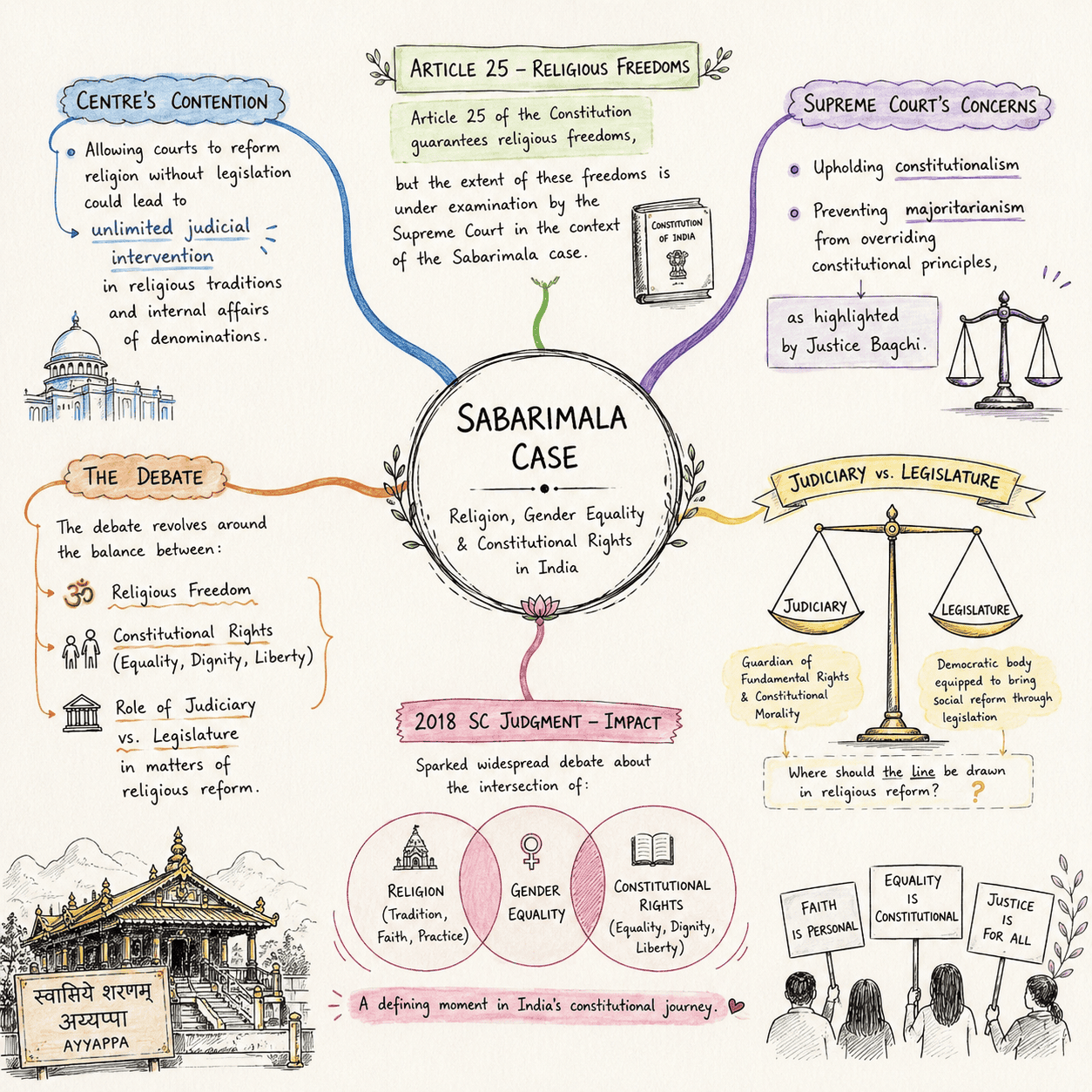
- The Centre contends that allowing courts to reform religion without legislation could lead to unlimited judicial intervention in religious traditions and internal affairs of denominations.
- Article 25 of the Constitution guarantees religious freedoms, but the extent of these freedoms is under examination by the Supreme Court in the context of the Sabarimala case.
Sabrimala Case.png
- The court is concerned about upholding constitutionalism and preventing majoritarianism from overriding constitutional principles, as highlighted by Justice Bagchi.
- The debate revolves around the balance between religious freedom, constitutional rights, and the role of the judiciary versus the legislature in matters of religious reform.
- The 2018 SC judgment sparked widespread debate about the intersection of religion, gender equality, and constitutional rights in India.
Key Concepts Involved:
- Article 25: Guarantees the freedom of conscience and free profession, practice, and propagation of religion.
- Denomination: A recognized autonomous branch of a religion.
- Majoritarianism: A political philosophy that asserts that a majority has the right to make decisions that affect the minority.

SuperKalam is your personal mentor for UPSC preparation, guiding you at every step of the exam journey.
Download the App


STUDY RESOURCES
CONTACT US
ⓒ Snapstack Technologies Private Limited