GS 2: PolityGS 1: Indian SocietyPrelims
Resisting amendments for delimitation can harm the South, Pg10
Delimitation debate intensifies as BJP pushes for Lok Sabha expansion based on 2011 Census, sparking Southern states' concerns over representation.
Practice MCQs
847 Students attempted
Key Highlights:
- The BJP is advocating for an immediate delimitation of Lok Sabha constituencies, proposing an increase from 543 to 816 seats.
- The Congress opposes the proposal, demanding delimitation based on the latest Census, immediate implementation of 33% reservation for women within the existing 543 seats, and objecting to the growing disparity in seat numbers between states.
- The BJP proposes allocating additional seats while reserving one-third for women, nationally and in each State, through a draw of lots.
- Articles 81 and 82 of the Constitution govern the size and distribution of the Lok Sabha, with amendments required to enact the BJP's proposed changes.
- If the existing constitutional scheme continues, States that have stabilized their populations are set to lose both their proportional share and their absolute numbers in the Lok Sabha after the 2027 Census.
- Kerala and Tamil Nadu are projected to lose seats, while Uttar Pradesh and Bihar are expected to gain seats based on projected population changes.
- Several Chief Ministers, including those from Tamil Nadu, Kerala, Telangana, and Punjab, have called for maintaining the current proportional share of States that have stabilized their populations.
Detailed Insights:
- The current distribution of Lok Sabha seats among States is based on the 1971 Census, and the distribution within each State is based on the 2001 Census, set to remain in force until the first Census after 2026.
- Without changes, the 2027 Census could significantly shift the center of gravity of Indian politics from the south to the heartland due to population changes.
- Kerala could lose eight seats, potentially ending up with 12, while Tamil Nadu could also lose eight seats, resulting in 31 seats if the 543 seats are redrawn as per the projected population of 2026.
- Implementing 33% women's reservation on 543 seats could leave 11 or 12 sitting Lok Sabha MPs from Kerala without a seat to contest.
- States with higher total fertility rates, such as Uttar Pradesh and Bihar, are projected to gain seats, increasing their representation in the Lok Sabha.
- The conference convened by Tamil Nadu's Chief Minister M.K. Stalin in March 2025 aimed to advocate for "fair delimitation" to maintain the current proportional share of States that have stabilized their populations.
- Extending the freeze on parliamentary constituencies based on the 1971 Census would require amending Articles 81 and 82 of the Constitution.
- The BJP's proposal aims to keep the proportion of seats the same based on the 1971 Census, making the 2011 Census relevant only within each State for internal distribution.
Key Concepts Involved:
- Delimitation: The process of redrawing boundaries of parliamentary or assembly constituencies to represent population changes.
- Census: A periodic count of a country's population, including details like age, sex, and occupation.
- Total Fertility Rate: The average number of children a woman is expected to have during her reproductive years.
- Constitutional Amendment: A modification to the constitution of a nation or state, requiring a specific procedure.
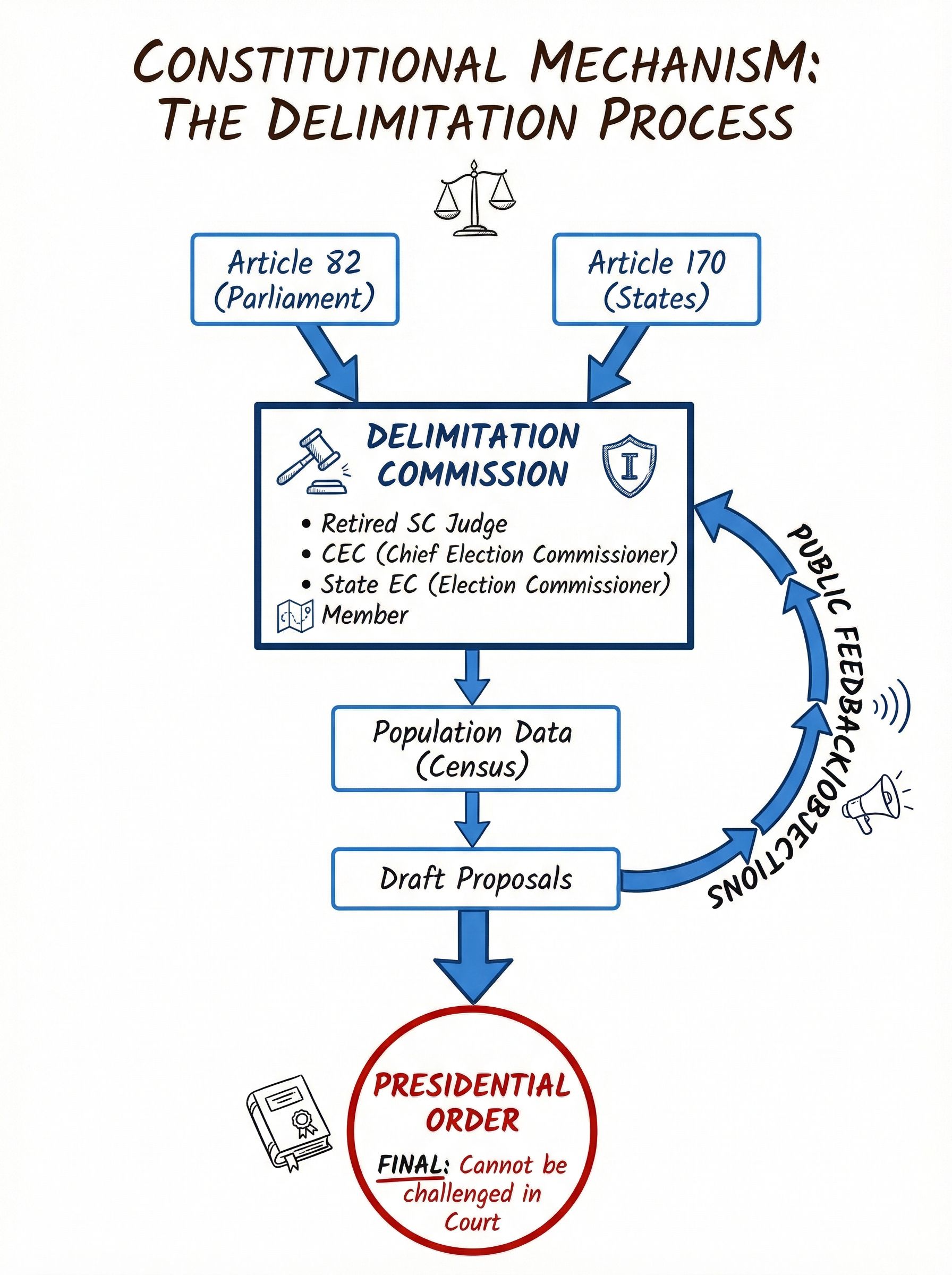
The Delimitation Process

SuperKalam is your personal mentor for UPSC preparation, guiding you at every step of the exam journey.
Download the App


STUDY RESOURCES
CONTACT US
ⓒ Snapstack Technologies Private Limited