GS 3: EconomyGS 2: International RelationsGS 1: World History
The fate of the Washington Consensus, once talisman, Pg6
Washington Consensus's failure led to global financial crises, inequality, and protectionism, necessitating context-sensitive policies amid geopolitical shifts and economic nationalism.
Practice MCQs
840 Students attempted
Key Highlights:
- The Washington Consensus (WC), a set of 10 policy prescriptions for macro stability and market-led growth, was formulated by John Williamson in 1989.
- The WC promoted policies like fiscal discipline, privatization, deregulation, and trade liberalization.
- The Asian financial crisis of 1997 and the 2008 global financial meltdown exposed systemic flaws in the Washington Consensus.
- The rise of economic nationalism and geopolitical considerations have challenged the dominance of the WC in recent years.
Detailed Insights:
- The Washington Consensus emerged from Reaganomics and Thatcherite structural adjustment programs, emphasizing fiscal austerity and deregulation.
- Bretton Woods Institutions (BWIs), like the World Bank and IMF, adopted the WC in response to debt crises in developing countries during the mid to late 1980s.
- The WC's rejection of industrial strategy and deregulation in contexts with weak market institutions had destabilizing consequences, particularly in Africa.
- Discontent with the WC's conditionalities and WTO rules led to protests in the Global South and contributed to the backlash against globalization.
- Successful industrializing nations like South Korea, Taiwan, and China did not adhere to the WC's prescriptions during their formative years, prioritizing state-led strategies.
- The emergence of a "post-Washington consensus" emphasizes public accountability, social safety nets, and redistribution, while the Beijing model offers an alternative with state-led intervention.
- The current global landscape is characterized by pragmatic eclecticism, where policymakers prioritize national interests and strategic decoupling over a single ideological narrative.
Key Concepts Involved:
- Washington Consensus: A set of 10 economic policy prescriptions considered standard reform packages for developing countries.
- Reaganomics: The economic policies promoted by U.S. President Ronald Reagan in the 1980s, emphasizing supply-side economics and deregulation.
- Thatcherism: The political and economic policies associated with British Prime Minister Margaret Thatcher, including privatization and reduced government spending.
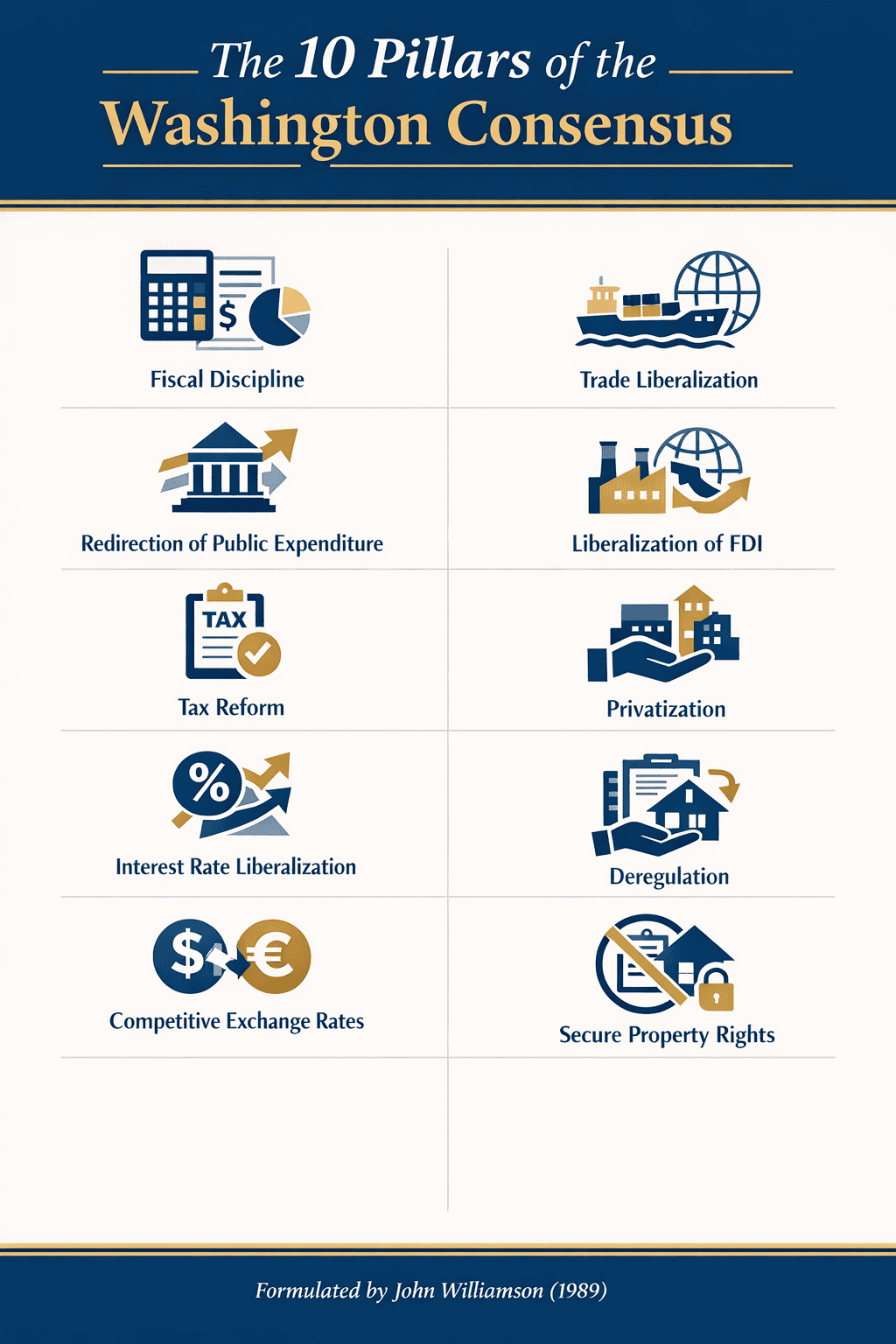
The Washington Consensus

SuperKalam is your personal mentor for UPSC preparation, guiding you at every step of the exam journey.
Download the App


STUDY RESOURCES
CONTACT US
ⓒ Snapstack Technologies Private Limited