GS 2: Social JusticeGS 2: PolityGS 2: GovernanceGS 3: EconomyPrelims
Equality of treatment for Persons with Disabilities, Pg8
Experts advocate Minimum Universal Disability Pension Floor Rate for India's 4.5 crore PwDs, urging uniform national support to ensure dignity and economic inclusion.
Practice MCQs
855 Students attempted
Key Highlights:
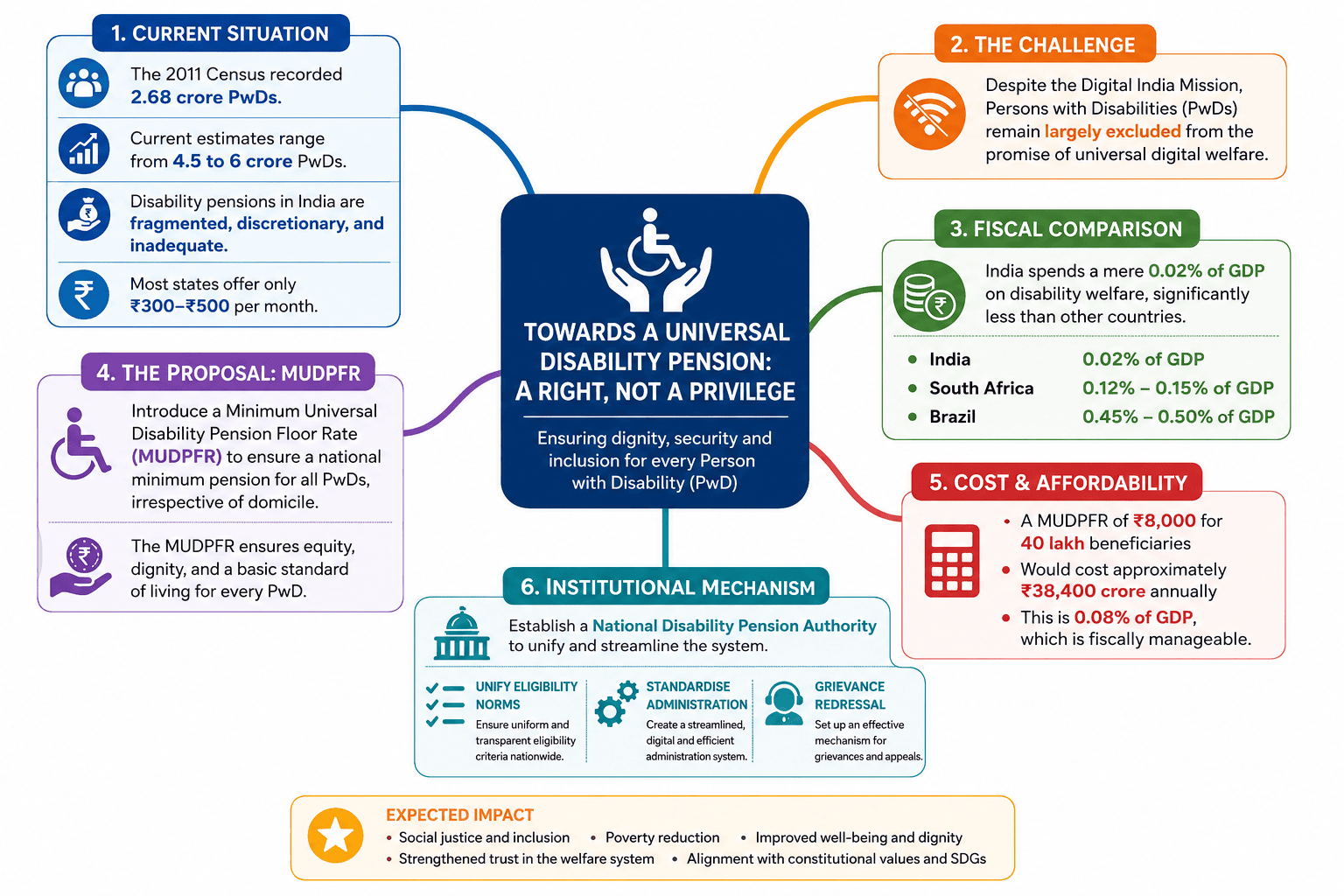
- Despite the Digital India Mission, Persons with Disabilities (PwDs) remain largely excluded from the promise of universal digital welfare.
- The 2011 Census recorded 2.68 crore PwDs, with current estimates ranging from 4.5 to 6 crore.
- Disability pensions in India are fragmented, discretionary, and inadequate, with most states offering only ₹300-₹500 per month.
- India spends a mere 0.02% of GDP on disability welfare, significantly less than countries like South Africa (0.12-0.15%) and Brazil (0.45-0.50%).
- A Minimum Universal Disability Pension Floor Rate (MUDPFR) is proposed to ensure a national minimum pension for all PwDs, irrespective of domicile.
- A MUDPFR of ₹8,000 for 40 lakh beneficiaries would cost approximately ₹38,400 crore annually (0.08% of GDP), which is fiscally manageable.
- The establishment of a National Disability Pension Authority is suggested to unify eligibility norms, administration, and grievance redressal.
PwD.png
Detailed Insights:
- The current system's reliance on domicile and state discretion for disability pensions contradicts the principles of disability rights and inclusivity.
- The Rights of Persons with Disabilities Act, 2016, and the Supreme Court's recognition of the right to live with dignity are not fully translated into adequate social security for PwDs.
- Economic studies by the World Bank and UNDP suggest that low- and middle-income countries lose 3-7% of GDP due to the exclusion of PwDs from education, employment, and social security.
- Disability pensions are viewed as an investment with fiscal multipliers of 1.4-1.6, contributing to household stability, rural consumption, and labor participation.
- Implementing a MUDPFR would operationalize Article 41 of the Constitution and Section 24 of the RPwD Act, 2016, fulfilling the state's obligation for social security.
- International examples from South Africa, Brazil, Australia, and New Zealand demonstrate the effectiveness of national-level disability pension systems in promoting uniformity and universality.
- The current fragmented administration of disability pensions between the Ministry of Rural Development and the Department of Empowerment of Persons with Disabilities leads to inefficiencies and diffused accountability.
- A unified National Disability Pension Authority would streamline processes, create a national registry, ensure portability, and integrate digital services.
- Strengthening disability pensions aligns with India's international commitments under the UN Convention on the Rights of Persons with Disabilities (Article 28), ILO Recommendation No. 202, SDG 1.3, and the G-20 New Delhi Leaders’ Declaration.
- Combining pensions with employment support through schemes like PM-DAKSH and NAPS can facilitate productive participation for PwDs, moving beyond mere survival.
- India possesses the necessary technological platforms like DBT and UPI for efficient delivery, highlighting that the primary requirement is political will to prioritize the dignity of PwDs.
Key Concepts Involved:
- Digital India Mission: A flagship government program launched in 2015 aimed at transforming India into a digitally empowered society and knowledge economy.
- Rights of Persons with Disabilities Act, 2016: Indian legislation that replaced the 1995 Act, expanding the rights and entitlements of PwDs and increasing the recognized categories of disabilities.
- Minimum Universal Disability Pension Floor Rate (MUDPFR): A proposed national minimum pension amount for PwDs, designed to ensure uniform financial support across the country.
- Article 41 of the Indian Constitution: A Directive Principle of State Policy that directs the State to make effective provision for securing the right to public assistance in cases of disablement and other undeserved wants.

SuperKalam is your personal mentor for UPSC preparation, guiding you at every step of the exam journey.
Download the App


STUDY RESOURCES
CONTACT US
ⓒ Snapstack Technologies Private Limited