GS 2: International RelationsGS 2: Social JusticeGS 2: GovernancePrelims
BRICS backs people-centric, inclusive urban development, Pg12
BRICS nations adopt a landmark declaration on inclusive, resilient, and people-centred urban development at the 13th Urbanisation Forum.
Practice MCQs
855 Students attempted
Key Highlights:
- The 13th BRICS Urbanisation Forum concluded in New Delhi on June 12, 2026, with the adoption of an Urban Ministerial Declaration.
- The declaration focuses on promoting inclusive, resilient, and people-centred urban development among the BRICS nations.
- It emphasizes creating cities that ensure equitable access to urban services, particularly for marginalized groups.
- The forum was held under India's BRICS Chairship in 2026, with Union Minister for Housing and Urban Affairs Manohar Lal inaugurating the event.
- India proposed the establishment of a BRICS Urban Research and Knowledge Network, which was welcomed by member nations.
- The BRICS group currently comprises eleven countries: Brazil, Russia, India, China, South Africa, Egypt, Ethiopia, Iran, Saudi Arabia, United Arab Emirates, and Indonesia.
BRICS Urban Forum.png
Detailed Insights:
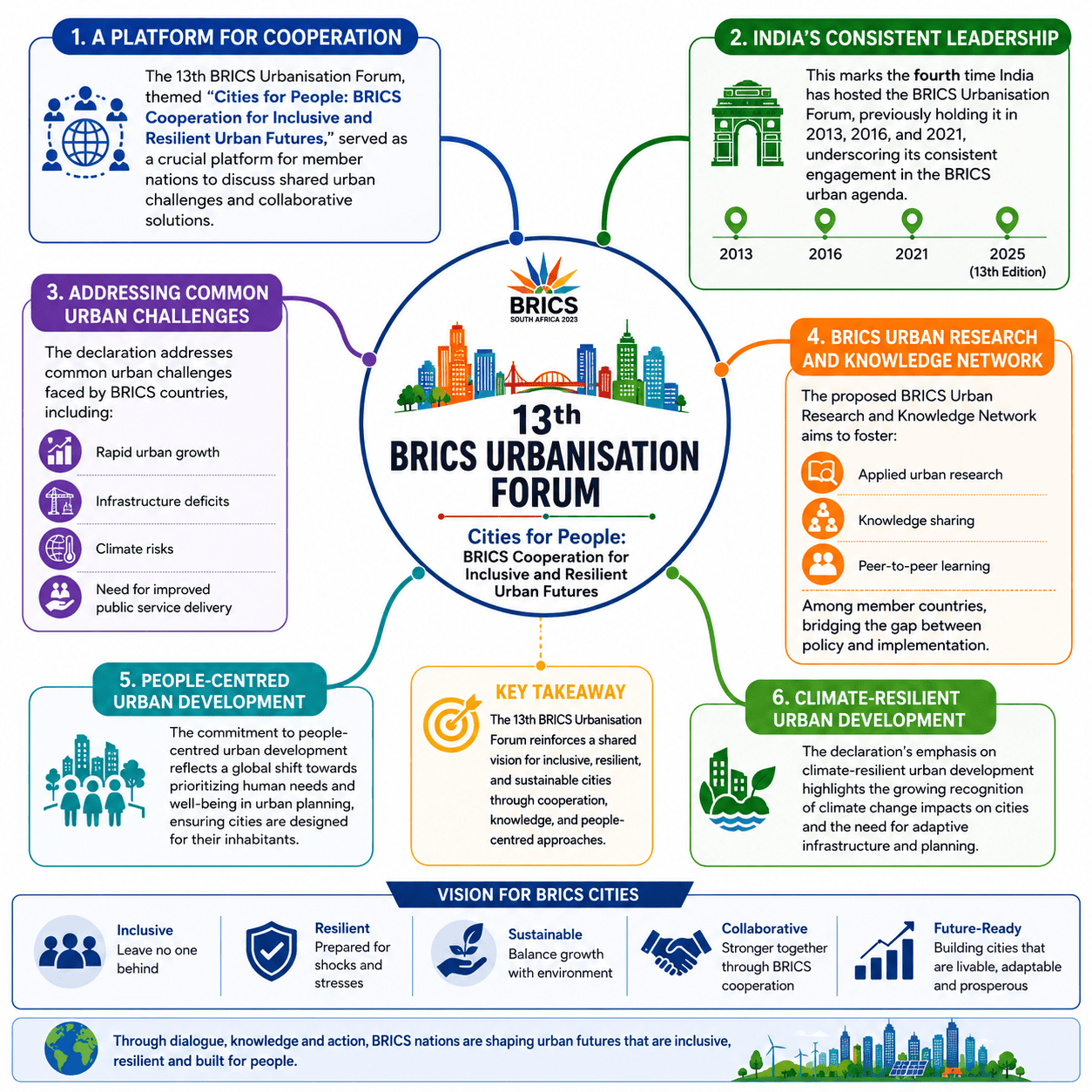
- The 13th BRICS Urbanisation Forum, themed "Cities for People: BRICS Cooperation for Inclusive and Resilient Urban Futures," served as a crucial platform for member nations to discuss shared urban challenges and collaborative solutions.
- This marks the fourth time India has hosted the BRICS Urbanisation Forum, previously holding it in 2013, 2016, and 2021, underscoring its consistent engagement in the BRICS urban agenda.
- The declaration addresses common urban challenges faced by BRICS countries, including rapid urban growth, infrastructure deficits, climate risks, and the need for improved public service delivery.
- The proposed BRICS Urban Research and Knowledge Network aims to foster applied urban research, knowledge sharing, and peer-to-peer learning among member countries, bridging the gap between policy and implementation.
- The commitment to people-centred urban development reflects a global shift towards prioritizing human needs and well-being in urban planning, ensuring cities are designed for their inhabitants.
- The declaration's emphasis on climate-resilient urban development highlights the growing recognition of climate change impacts on cities and the need for adaptive infrastructure and planning.
Key Concepts Involved:
- BRICS: An intergovernmental organization comprising eleven major emerging economies, serving as a platform for consultation and cooperation on global issues.
- Urbanisation Forum: A dedicated ministerial platform for BRICS countries to exchange urban policy experiences and identify shared priorities in urban development.
- People-centric urban development: An approach to urban planning that prioritizes the needs, perspectives, and well-being of residents, ensuring equitable access to services and participatory governance.
- Inclusive cities: Urban environments designed to provide equal opportunities and access to resources and services for all residents, especially vulnerable and marginalized communities.

SuperKalam is your personal mentor for UPSC preparation, guiding you at every step of the exam journey.
Download the App


STUDY RESOURCES
CONTACT US
ⓒ Snapstack Technologies Private Limited