GS 2: GovernanceGS 3: Environment & EcologyGS 3: EconomyPrelims
How India is governing its water resources, Pg7
India grapples with water governance paradox: Abundant rainfall, yet scarcity persists due to inefficient management and fragmented institutional structures.
Practice MCQs
847 Students attempted
Key Highlights:
- India faces a water paradox: abundant rainfall (4,000 billion cubic metres annually) but inefficient capture and usage.
- Only about 1,100 billion cubic metres of the total water availability is considered usable.
- Per capita water availability has declined from over 5,000 cubic metres post-independence to about 1,400 cubic metres.
- The Ministry of Jal Shakti is the nodal agency for water resources at the national level.
- Key initiatives include the Jal Jeevan Mission (tap connections), Atal Bhujal Yojana (groundwater management), and Namami Gange Programme (river restoration).
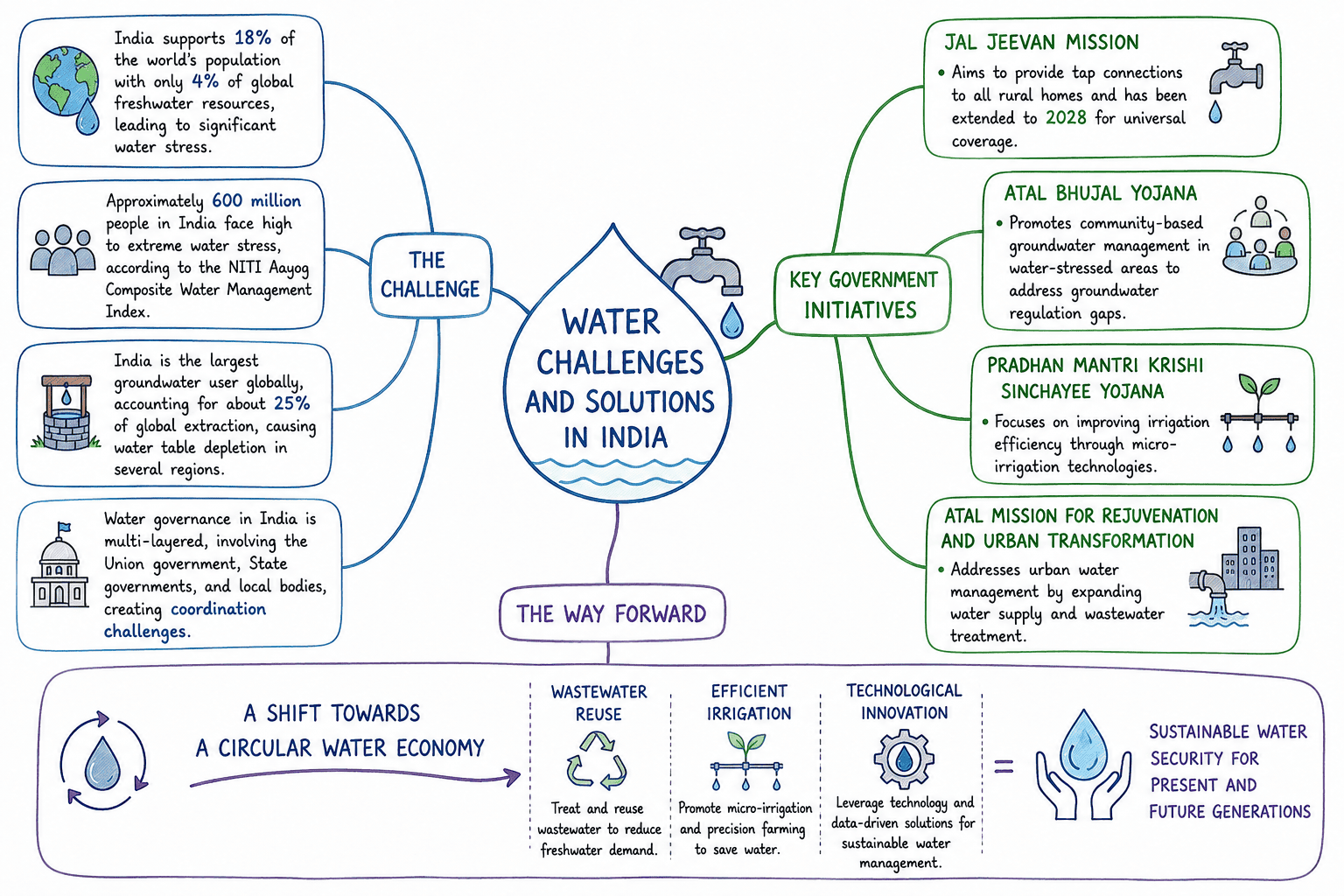
Water Challenge.png
Detailed Insights:
- India supports 18% of the world's population with only 4% of global freshwater resources, leading to significant water stress.
- Approximately 600 million people in India face high to extreme water stress, according to the NITI Aayog Composite Water Management Index.
- India is the largest groundwater user globally, accounting for about 25% of global extraction, causing water table depletion in several regions.
- Water governance in India is multi-layered, involving the Union government, State governments, and local bodies, creating coordination challenges.
- The Jal Jeevan Mission aims to provide tap connections to all rural homes and has been extended to 2028 for universal coverage.
- The Atal Bhujal Yojana promotes community-based groundwater management in water-stressed areas to address groundwater regulation gaps.
- The Pradhan Mantri Krishi Sinchayee Yojana focuses on improving irrigation efficiency through micro-irrigation technologies.
- The Atal Mission for Rejuvenation and Urban Transformation addresses urban water management by expanding water supply and wastewater treatment.
- A shift towards a circular water economy emphasises wastewater reuse, efficient irrigation, and technological innovation for sustainability.
Key Concepts Involved:
- Water Governance: The set of policies, regulations, and institutions that manage and distribute water resources.
- Sustainable Development Goal 6: A UN goal focused on ensuring availability and sustainable management of water and sanitation for all.
- Circular Economy: An economic system aimed at minimizing waste and making the most of resources.

SuperKalam is your personal mentor for UPSC preparation, guiding you at every step of the exam journey.
Download the App


STUDY RESOURCES
CONTACT US
ⓒ Snapstack Technologies Private Limited