GS 2: GovernanceGS 2: Polity
Question CEC,but move to impeach is unwise, Pg10
The provided editorial argues that while the Opposition’s grievances against the Chief Election Commissioner (CEC) may be valid, resorting to an impeachment motion is a strategic mistake.
Practice MCQs
833 Students attempted
Key Highlights
- Opposition parties are moving an impeachment motion against CEC Gyanesh Kumar, alleging partisan conduct and mass disenfranchisement through the Special Intensive Revision (SIR) of electoral rolls.
- This follows a failed no-confidence motion against Lok Sabha Speaker Om Birla, indicating a trend of the Opposition targeting constitutional "umpires" to highlight perceived biases.
- The editorial contends that the Opposition lacks the numerical strength to pass the motion, making it a symbolic gesture that may ultimately prove counterproductive.
- While the Election Commission's (EC) actions have invited accusations of bias, the Judiciary (Supreme Court) has already stepped in as a check, directing greater transparency and voter protection.
- The move is described as an "abdication of responsibility," suggesting that the Opposition should instead focus on strengthening existing democratic checks and balances.
Detailed Insights
- The "Umpire" Crisis: The Opposition’s targeting of both the Speaker and the CEC reflects a deep-seated distrust in the neutrality of constitutional authorities. The editorial acknowledges there is "merit" in these grievances but warns against using "instruments of last resort" for routine political messaging.
- The Role of the Judiciary: The Supreme Court is highlighted as a vital "countervailing force." Its intervention in the SIR process—mandating Aadhaar as proof and establishing tribunals—demonstrates that judicial oversight can effectively temper executive or administrative overreach.
- Special Intensive Revision (SIR) Controversy: The SIR in Bihar and West Bengal is a core point of contention. Critics argue it placed an undue "burden of proof" on vulnerable voters, effectively turning a routine roll update into a stressful test of citizenship.
- Weaponisation of Majority: The text notes that while the executive may use its majority to push its agenda, the Opposition's reliance on doomed-to-fail motions is a "cop-out" that avoids the harder work of building strategic and imaginative political counters.
- Long-term Institutional Risk: Rushing to impeach high-ranking officials without a legal or numerical path to success risks desensitizing the public to these grave constitutional tools, potentially weakening them for when they might truly be needed.ing accurate voter lists without disenfranchising legitimate citizens.
Key Concepts Involved
- Impeachment: A formal process by which a high-ranking official is accused of misconduct, potentially leading to their removal from office.
- No-Confidence Motion: A parliamentary motion demonstrating that the house no longer supports a particular leader or government body.
- Special Intensive Revision (SIR): A thorough process used by the Election Commission to clean and update electoral rolls, often involving house-to-house verification.
- Countervailing Forces: Entities (like the Judiciary or a free Press) that act to limit or balance the power of the central executive.
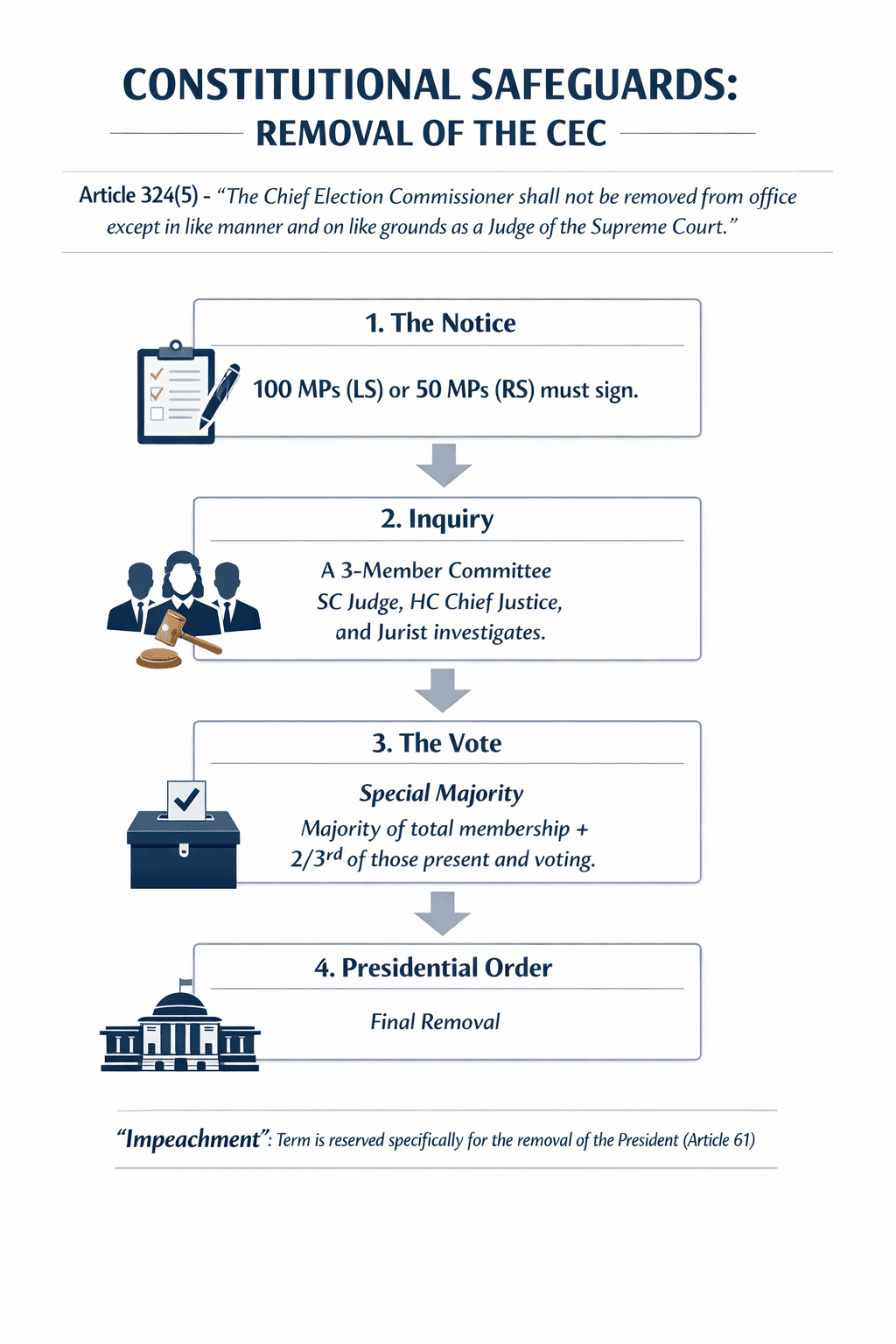
Removal of CEC

SuperKalam is your personal mentor for UPSC preparation, guiding you at every step of the exam journey.
Download the App


STUDY RESOURCES
CONTACT US
ⓒ Snapstack Technologies Private Limited