GS 3: EconomyGS 3: Science & TechnologyGS 2: Governance
Preparing India for a true innovation-led economy, Pg8
India's innovation paradox: Despite increased R&D spending and improved rankings, private sector investment lags, hindering true innovation-led economic transformation.
Practice MCQs
833 Students attempted
Key Highlights:
- The Indian government has shown unprecedented ambition in research, development, and innovation (RDI) through funding, regulatory reforms, and improved global innovation rankings.
- In 2026, the government reaffirmed its commitment to R&D with a ₹20,000 crore corpus for deep-tech startups and increased funding for Atal Tinkering Labs from ₹500 crore to ₹3,200 crore.
- India's Global Innovation Index (GII) ranking improved to 38th among 139 economies in 2025, with patent filings nearly doubling from under 59,000 in 2020-21 to over 1,10,000 in 2024-25.
- India's R&D expenditure is only 0.65% of GDP, which is lower than other advanced economies.
Detailed Insights:
- Despite government initiatives, India faces challenges in R&D intensity, global technological influence, research-to-market translation, and private-sector participation.
- The SHANTI Act, 2025 allows patents for peaceful uses of nuclear energy, potentially increasing private-sector involvement, but industry investment is crucial for translating this into deployable technologies.
- While domestic patent filings have increased, driven by policy, the underlying innovation base, particularly industry-led R&D, remains shallow.
- India's performance on human capital indicators is weak, ranking low in employment in knowledge-intensive sectors and the number of full-time equivalent researchers.
- There is a significant gender diversity gap in science and engineering, which affects innovation outcomes, despite government initiatives like WIDUSHI and WISE-KIRAN.
- The absence of globally significant technologies of Indian origin is due to the private sector's reluctance to invest in deep, long-gestation R&D.
- India needs to strengthen technology transfer, venture creation, and risk-capital alignment to bridge the gap between research and commercialization.
Key Concepts Involved:
- Research and Development (R&D): Activities undertaken to improve, innovate, and develop new products, processes, or services.
- Global Innovation Index (GII): A ranking of countries based on their capacity for, and success in, innovation.
- Deep-tech: Startups or companies that are based on high-tech or scientific advances and discoveries.
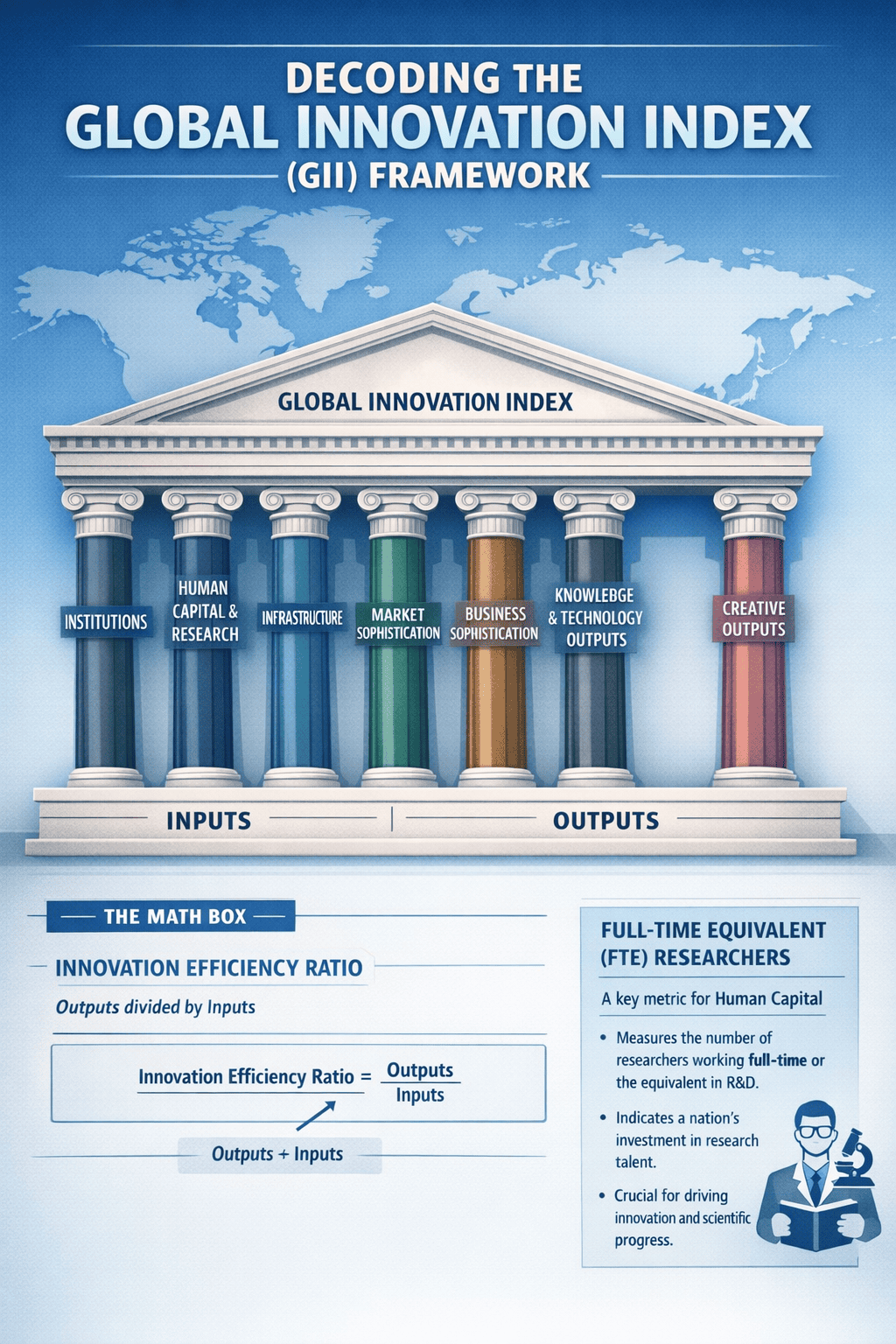
GII

SuperKalam is your personal mentor for UPSC preparation, guiding you at every step of the exam journey.
Download the App


STUDY RESOURCES
CONTACT US
ⓒ Snapstack Technologies Private Limited