GS 2: PolityGS 2: Social JusticePrelims
‘Parental income alone cannot set creamy layer status’, Pg14
Supreme Court rules parental income alone insufficient to determine OBC creamy layer status, potentially widening reservation pool for PSU employee children.
Practice MCQs
833 Students attempted
Key Highlights:
- The Supreme Court ruled that determining the creamy layer status of OBC candidates for reservation cannot be based solely on parental income.
- The ruling potentially expands the reservation pool to include children of senior public sector officials.
- The court emphasized that parental income from salaries and agricultural land should be excluded when applying the income/wealth test.
- The judgment addresses confusion regarding the application of the income test for OBC children of PSU/PSB officials.
Detailed Insights:
- The creamy layer exclusion aims to ensure reservation benefits reach those without accumulated social and economic privileges.
- A 1993 charter initially declared certain OBC families ineligible based on occupations, including those in constitutional posts and senior government employees.
- Exceptions exist for children of MPs, promoted government officials, and owners of unirrigated agricultural land, subject to an income limit.
- The Department of Personnel and Training (DoPT) previously interpreted that parental salaries could be counted separately for PSU employees, which the court deemed discriminatory.
- The court stated that excluding candidates solely based on salary income, without considering their parents' positions, leads to unequal treatment.
Key Concepts Involved:
- Creamy Layer: A section of OBC that is considered forward and hence not eligible for reservation.
- Reservation: A policy of reserving percentage of seats in educational institutions, public sector jobs etc for specific groups.
- Other Backward Classes (OBC): A collective term used by the Government of India to classify castes which are disadvantaged.
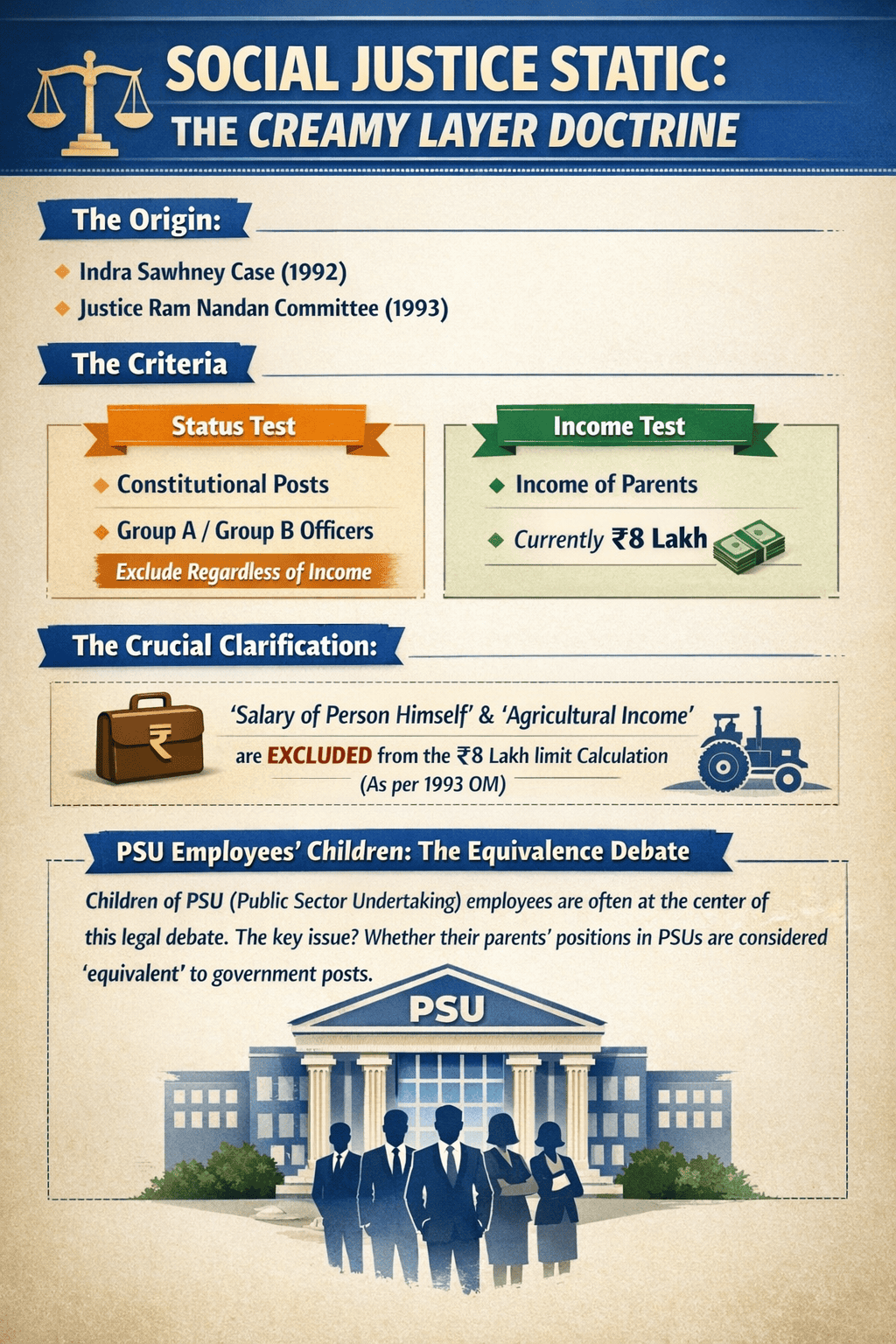
OBC- CL

SuperKalam is your personal mentor for UPSC preparation, guiding you at every step of the exam journey.
Download the App


STUDY RESOURCES
CONTACT US
ⓒ Snapstack Technologies Private Limited